Swiss Institute for Cancer Research (ISREC), School of Life Sciences, Federal Institute of Technology, Lausanne, 1015 Lausanne, Switzerland
Department of Genetics and Evolution, University of Geneva, 1211 Geneva 4, Switzerland.
Development. 2020 Feb 3;147(3):dev171736. doi: 10.1242/dev.171736.
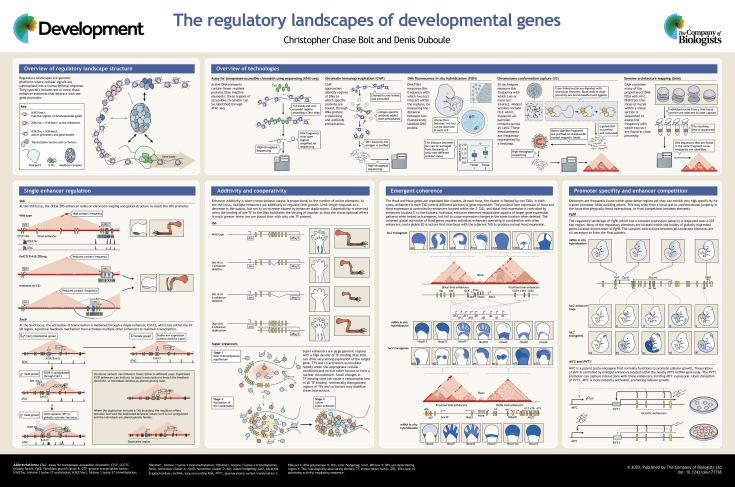
Regulatory landscapes have been defined in vertebrates as large DNA segments containing diverse enhancer sequences that produce coherent gene transcription. These genomic platforms integrate multiple cellular signals and hence can trigger pleiotropic expression of developmental genes. Identifying and evaluating how these chromatin regions operate may be difficult as the underlying regulatory mechanisms can be as unique as the genes they control. In this brief article and accompanying poster, we discuss some of the ways in which regulatory landscapes operate, illustrating these mechanisms using genes important for vertebrate development as examples. We also highlight some of the techniques available to researchers for analysing regulatory landscapes.
调控景观在脊椎动物中被定义为包含多种增强子序列的大片段 DNA,这些序列能够产生一致的基因转录。这些基因组平台整合了多种细胞信号,因此可以触发发育基因的多效性表达。由于调控机制可能与它们所控制的基因一样独特,因此识别和评估这些染色质区域的功能可能具有挑战性。在这篇简短的文章和配套的海报中,我们讨论了调控景观发挥作用的一些方式,并使用对脊椎动物发育很重要的基因作为例子来说明这些机制。我们还强调了研究人员分析调控景观的一些可用技术。