Laboratory of Molecular Biology, NIDDK, National Institutes of Health, Bethesda, MD, USA.
California NanoSystems Institute, University of California, Los Angeles, Los Angeles, CA, USA.
Nat Struct Mol Biol. 2020 Feb;27(2):127-133. doi: 10.1038/s41594-019-0366-z. Epub 2020 Feb 3.
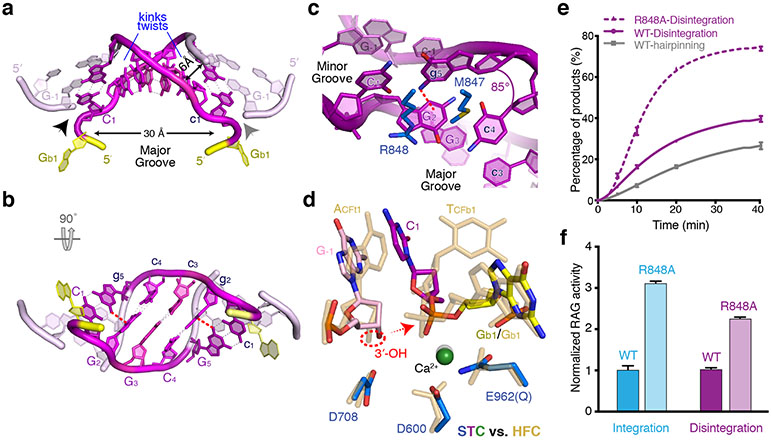
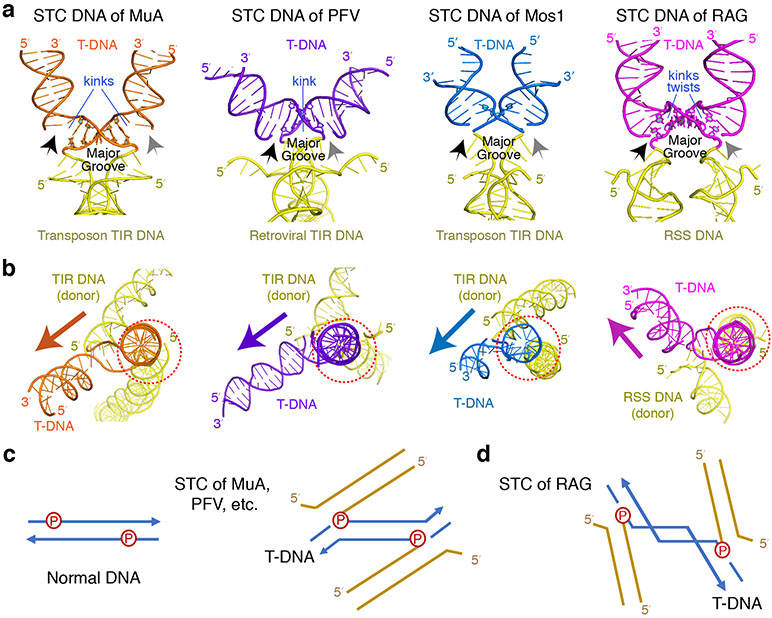
The RAG1-RAG2 recombinase (RAG) cleaves DNA to initiate V(D)J recombination, but RAG also belongs to the RNH-type transposase family. To learn how RAG-catalyzed transposition is inhibited in developing lymphocytes, we determined the structure of a DNA-strand transfer complex of mouse RAG at 3.1-Å resolution. The target DNA is a T form (T for transpositional target), which contains two >80° kinks towards the minor groove, only 3 bp apart. RAG2, a late evolutionary addition in V(D)J recombination, appears to enforce the sharp kinks and additional inter-segment twisting in target DNA and thus attenuates unwanted transposition. In contrast to strand transfer complexes of genuine transposases, where severe kinks occur at the integration sites of target DNA and thus prevent the reverse reaction, the sharp kink with RAG is 1 bp away from the integration site. As a result, RAG efficiently catalyzes the disintegration reaction that restores the RSS (donor) and target DNA.
RAG1-RAG2 重组酶 (RAG) 通过切割 DNA 启动 V(D)J 重组,但 RAG 也属于 RNH 型转座酶家族。为了了解发育中的淋巴细胞中 RAG 催化的转座如何受到抑制,我们在 3.1-Å 分辨率下确定了小鼠 RAG 的 DNA 链转移复合物的结构。靶 DNA 是 T 型(用于转座的靶标 T),其朝向小沟有两个 >80°的扭曲,仅相隔 3bp。RAG2 是 V(D)J 重组中晚期进化的产物,它似乎加强了靶 DNA 中的尖锐扭曲和额外的片段间扭曲,从而减弱了不必要的转座。与真正的转座酶的链转移复合物不同,靶 DNA 的整合位点会出现严重的扭曲,从而阻止了逆反应,而 RAG 中的尖锐扭曲距离整合位点有 1bp。因此,RAG 有效地催化了使 RSS(供体)和靶 DNA 恢复原状的解体反应。