Delosière Mylène, Pires José A A, Bernard Laurence, Cassar-Malek Isabelle, Bonnet Muriel
Université Clermont Auvergne, INRAE, VetAgro Sup, UMR Herbivores, F-63122, Saint-Genès-Champanelle, France.
Data Brief. 2020 Jan 7;29:105105. doi: 10.1016/j.dib.2019.105105. eCollection 2020 Apr.
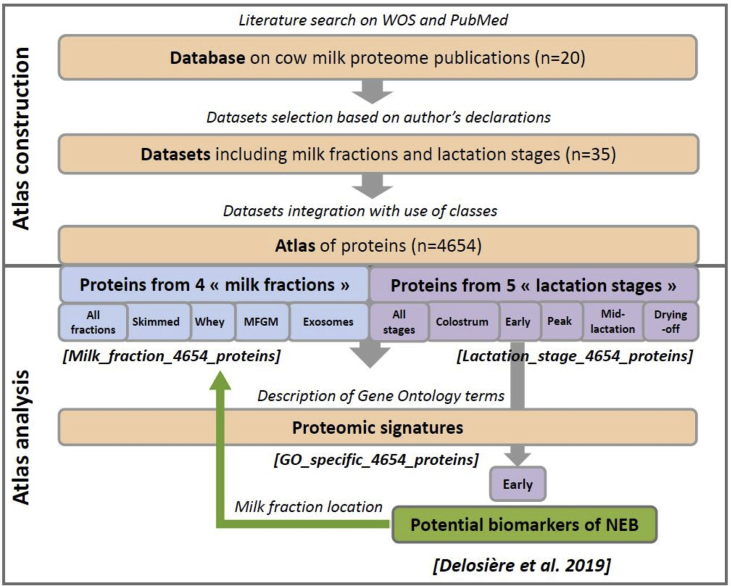
Milk contains numerous proteins including bioactive molecules that may be important in human nutrition. Thanks to improvements in proteomic methods, hundreds of proteins identified in milk are available through open data from different publications. We gathered these public data to produce an atlas reporting the cow milk proteins. We aggregated data from 20 publications reporting milk proteome and produced an atlas of 4654 unique proteins detected in milk from healthy cows. In this atlas, proteins are categorized according to four milk fractions: skimmed milk, whey, milk fat globule membranes () and exosomes; and five lactation stages: colostrum period, early lactation, peak of lactation, mid-lactation and drying-off. These 9 protein lists were compared and annotated by Gene Ontology () terms to identify the pathways they contribute to, the molecular signatures of different milk fractions and lactation stages. This data article compiles the 4654 cow milk proteins. This atlas may be used by researchers on human nutrition interested in milk protein allergy and/or digestibility in humans, and for milk processing industry. The atlas may be useful to i) find molecular signatures of physiological adaptations of dairy cows, ii) facilitate the isolation of proteins of interest, thanks to the knowledge on their presence in milk fractions and their period of secretion during lactation.
牛奶含有多种蛋白质,包括对人类营养可能很重要的生物活性分子。由于蛋白质组学方法的改进,通过不同出版物的开放数据可以获取在牛奶中鉴定出的数百种蛋白质。我们收集了这些公共数据来制作一份报告牛奶蛋白质的图谱。我们汇总了20篇报告牛奶蛋白质组的出版物中的数据,制作了一份在健康奶牛牛奶中检测到的4654种独特蛋白质的图谱。在这份图谱中,蛋白质根据四种牛奶成分进行分类:脱脂牛奶、乳清、乳脂肪球膜()和外泌体;以及五个泌乳阶段:初乳期、泌乳早期、泌乳高峰期、泌乳中期和干奶期。通过基因本体论()术语对这9个蛋白质列表进行比较和注释,以确定它们所涉及的途径、不同牛奶成分和泌乳阶段的分子特征。这篇数据文章汇编了4654种奶牛牛奶蛋白质。这份图谱可供对牛奶蛋白过敏和/或人类消化率感兴趣的人类营养研究人员以及牛奶加工业使用。该图谱可能有助于:i)发现奶牛生理适应的分子特征;ii)由于了解感兴趣的蛋白质在牛奶成分中的存在情况及其在泌乳期间的分泌时期,便于分离这些蛋白质。