Vena Antonio, Bouza Emilio, Corisco Rafael, Machado Marina, Valerio Maricela, Sánchez Carlos, Muñoz Patricia
Clinical Microbiology and Infectious Disease Division, Hospital General Universitario Gregorio Marañón, Madrid, Spain.
Instituto de Investigación Sanitaria Hospital Gregorio Marañón, Madrid, Spain.
Infect Dis Ther. 2020 Mar;9(1):119-135. doi: 10.1007/s40121-020-00281-x. Epub 2020 Feb 4.
To evaluate the clinical impact of a comprehensive care bundle for the management of candidemia.
A quasi-experimental pre-post study was implemented. During the pre-intervention period (May 2014-September 2015), a non-mandatory antifungal stewardship program (ASP) was implemented, and patients with candidemia were visited by an infectious disease specialist who provided diagnostic and therapeutic advice according to standard of care as soon as possible. During the post-intervention period (October 2015-May 2017), patients were managed according to a candidemia care bundle with clear and structured recommendations written in their medical history.
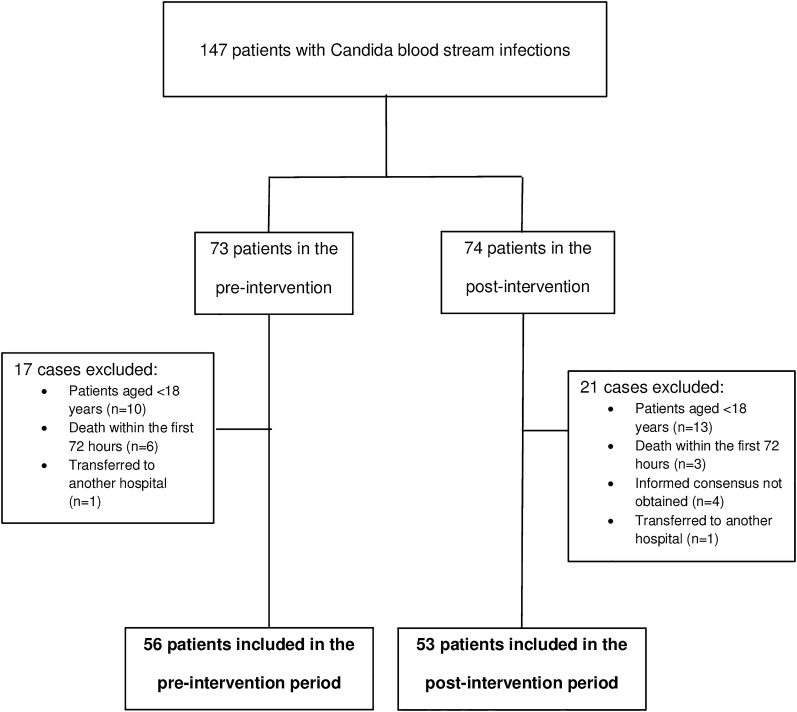
Overall, 109 patients were included, 56 in the pre-intervention and 53 in the post-intervention period. Overall, compliance with the Candida bundle significantly improved between the pre- [27/56 (48.2%)] and post-intervention [43/53 (81.1%); p = 0.01] period. Individual bundle components that significantly improved in the post-intervention period were early adequate antifungal therapy [47/56 (83.9%) vs. 51/53 (96.2%), p = 0.05], early adequate source control of the infection [37/56 (82.2%) vs. 41/53 (97.6%), p = 0.03] and appropriate duration of therapy [27/56 (48.2%) vs. 43/53 (81.1%), p = 0.01]. Adherence to follow-up blood cultures, ophthalmologic examination and echocardiography improved in the post-intervention period, but the difference was not statistically significant. Multivariate analysis revealed that being managed according to candidemia bundle had a favorable impact on 14-day mortality (HR 0.08, 95% CI 0.01-0.45, p = 0.02) and 30-day mortality (HR 0.40, 95% CI 0.18-0.89, p = 0.02).
A simple bundle focused on increasing adherence to a few evidence-based interventions contributed to a significant reduction in 14- and 30-day mortality in patients with candidemia.
评估一套用于念珠菌血症管理的综合护理方案的临床影响。
开展了一项准实验性前后对照研究。在干预前期(2014年5月至2015年9月),实施了一项非强制性的抗真菌管理计划(ASP),感染病专科医生对念珠菌血症患者进行访视,并尽快根据护理标准提供诊断和治疗建议。在干预后期(2015年10月至2017年5月),根据一套念珠菌血症护理方案对患者进行管理,该方案在患者病历中有清晰且结构化的建议。
总共纳入了109例患者,干预前期56例,干预后期53例。总体而言,念珠菌护理方案的依从性在干预前期[27/56(48.2%)]和干预后期[43/53(81.1%);p = 0.01]之间有显著改善。在干预后期有显著改善的个体护理方案组成部分包括早期充分的抗真菌治疗[47/56(83.9%)对51/53(96.2%),p = 0.05]、早期充分的感染源控制[37/56(82.2%)对41/53(97.6%),p = 0.03]以及适当的治疗持续时间[27/56(48.2%)对43/53(81.1%),p = 0.01]。干预后期对后续血培养、眼科检查和超声心动图的依从性有所提高,但差异无统计学意义。多变量分析显示,根据念珠菌血症护理方案进行管理对14天死亡率(风险比0.08,95%置信区间0.01 - 0.45,p = 0.02)和30天死亡率(风险比0.40,95%置信区间0.18 - 0.89,p = 0.02)有有利影响。
一个专注于提高对一些循证干预措施依从性的简单护理方案有助于显著降低念珠菌血症患者的14天和30天死亡率。