Zhou Heping, Urso C J, Jadeja Viren
Department of Biological Sciences, Seton Hall University, South Orange, NJ 07079, USA.
J Inflamm Res. 2020 Jan 6;13:1-14. doi: 10.2147/JIR.S229691. eCollection 2020.
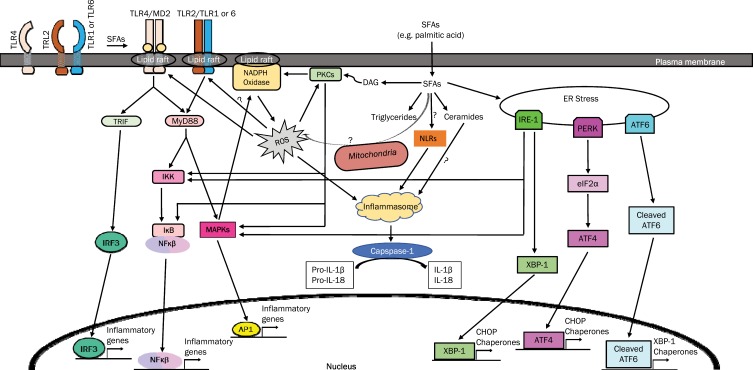
Obesity is a major risk factor for the development of various pathological conditions including insulin resistance, diabetes, cardiovascular diseases, and non-alcoholic fatty liver disease (NAFLD). Central to these conditions is obesity-associated chronic low-grade inflammation in many tissues including adipose, liver, muscle, kidney, pancreas, and brain. There is increasing evidence that saturated fatty acids (SFAs) increase the phosphorylation of MAPKs, enhance the activation of transcription factors such as nuclear factor (NF)-κB, and elevate the expression of inflammatory genes. This paper focuses on the mechanisms by which SFAs induce inflammation. SFAs may induce the expression inflammatory genes via different pathways including toll-like receptor (TLR), protein kinase C (PKC), reactive oxygen species (ROS), NOD-like receptors (NLRs), and endoplasmic reticulum (ER) stress. These findings suggest that SFAs act as an important link between obesity and inflammation.
肥胖是多种病理状况发展的主要风险因素,包括胰岛素抵抗、糖尿病、心血管疾病和非酒精性脂肪性肝病(NAFLD)。这些病症的核心是在包括脂肪、肝脏、肌肉、肾脏、胰腺和大脑在内的许多组织中与肥胖相关的慢性低度炎症。越来越多的证据表明,饱和脂肪酸(SFA)会增加丝裂原活化蛋白激酶(MAPK)的磷酸化,增强转录因子如核因子(NF)-κB的活化,并提高炎症基因的表达。本文重点关注SFA诱导炎症的机制。SFA可能通过不同途径诱导炎症基因的表达,包括Toll样受体(TLR)、蛋白激酶C(PKC)、活性氧(ROS)、NOD样受体(NLR)和内质网(ER)应激。这些发现表明,SFA是肥胖与炎症之间的重要联系。