Sari Aylin, Akdoğan Altun Zeynep, Arifoglu Karaman Cigdem, Bilir Kaya Basak, Durmus Bekir
Department of Physical Medicine and Rehabilitation, Erenkoy Physical Medicine and Rehabilitation Hospital, Istanbul, Turkey.
Department of Physical Medicine and Rehabilitation, Istinye University Medical Faculty, Istanbul, Turkey.
J Pain Res. 2020 Jan 16;13:171-179. doi: 10.2147/JPR.S203176. eCollection 2020.
This randomized, placebo-controlled study examined the effect of vitamin D replacement therapy on neuropathic symptoms and balance in patients with diabetic neuropathic pain and low vitamin D levels.
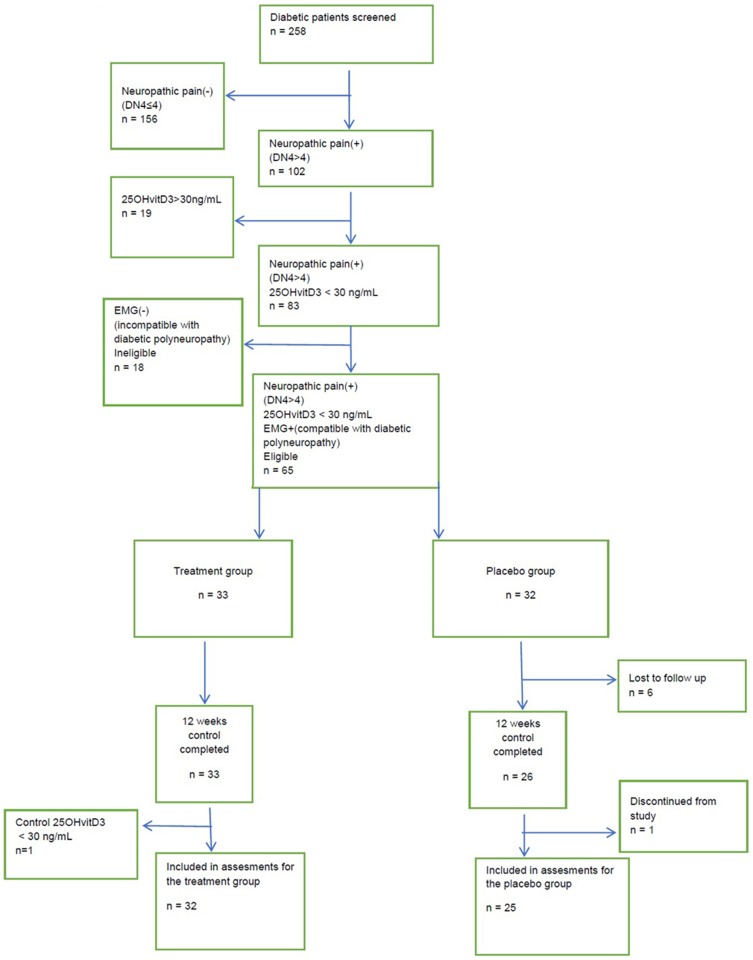
Among the 258 patients, the results in a total of 57 volunteers (32 in the treatment and 25 in the control arm) meeting the inclusion criteria are reported. Symptoms of neuropathic pain were assessed using Douleur Neuropathique 4 (DN4) questionnaire, and presence of polyneuropathy (PNP) was determined by performing electromyography (EMG). Balance was assessed using Berg balance test (BBT). After undergoing these examinations, the patients in the treatment group were intramuscularly (IM) injected with 300,000 IU vitamin D in a liquid formulation and those in the placebo group were IM injected with physiological saline. The DN4 and BBT were repeated after 12 weeks, and the results were compared.
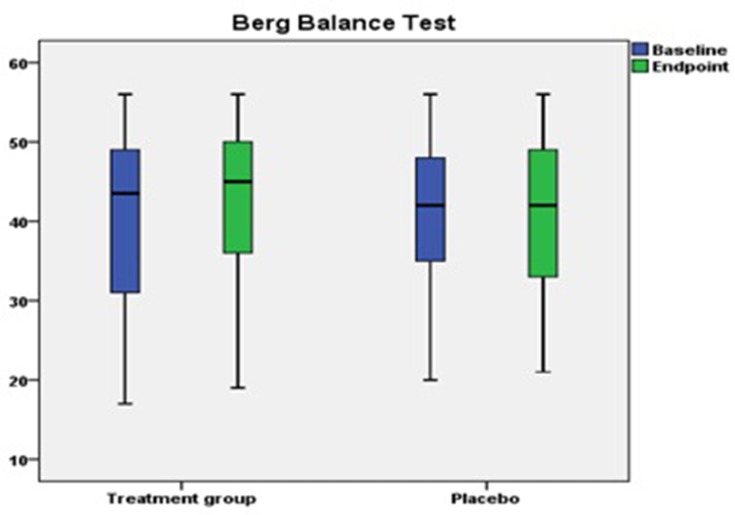
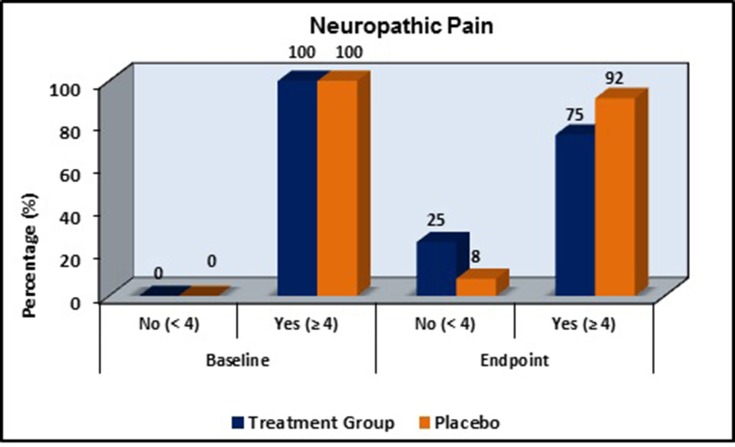
The patients in the treatment group showed a significant decrease in total DN4 scores from baseline to the study endpoint compared with the patients in the placebo group (p=0.008). The patients in the treatment group also showed a significant increase in BBT scores from baseline to the study endpoint compared with the patients in the placebo group (p=0.001). Furthermore, in subgroup analysis, these patients showed a significant decrease in electric shock and burning sensation scores from baseline to the study endpoint compared with the patients in the placebo group (p=0.006, p=0.001, respectively).
In patients with diabetic neuropathic pain, vitamin D levels should be measured and vitamin D replacement therapy should be administered as required to resolve neuropathic symptoms and to improve balance.
本随机、安慰剂对照研究探讨了维生素D替代疗法对糖尿病性神经病理性疼痛且维生素D水平低的患者的神经病理性症状及平衡能力的影响。
在258例患者中,报告了总共57名符合纳入标准的志愿者(治疗组32例,对照组25例)的结果。使用神经病理性疼痛4(DN4)问卷评估神经病理性疼痛症状,并通过肌电图(EMG)检查确定是否存在多发性神经病(PNP)。使用伯格平衡测试(BBT)评估平衡能力。在进行这些检查后,治疗组患者肌肉注射(IM)30万国际单位的液体制剂维生素D,安慰剂组患者肌肉注射生理盐水。12周后重复进行DN4和BBT检查,并比较结果。
与安慰剂组患者相比,治疗组患者从基线到研究终点的DN4总分显著降低(p = 0.008)。与安慰剂组患者相比,治疗组患者从基线到研究终点的BBT评分也显著增加(p = 0.001)。此外,在亚组分析中,与安慰剂组患者相比,这些患者从基线到研究终点的电击和烧灼感评分显著降低(分别为p = 0.006,p = 0.001)。
对于糖尿病性神经病理性疼痛患者,应检测维生素D水平,并根据需要给予维生素D替代疗法以缓解神经病理性症状并改善平衡能力。