Departamento de Imagens Médicas, Hematologia e Oncologia Clínica, Faculdade de Medicina de Ribeirão Preto, Universidade de São Paulo, Ribeirão Preto, SP, Brasil.
Laboratório de Pesquisa em Imagens Musculoesqueléticas, Faculdade de Medicina de Ribeirão Preto, Universidade de São Paulo, Ribeirão Preto, SP, Brasil.
Braz J Med Biol Res. 2020 Jan 31;53(2):e8962. doi: 10.1590/1414-431X20198962. eCollection 2020.
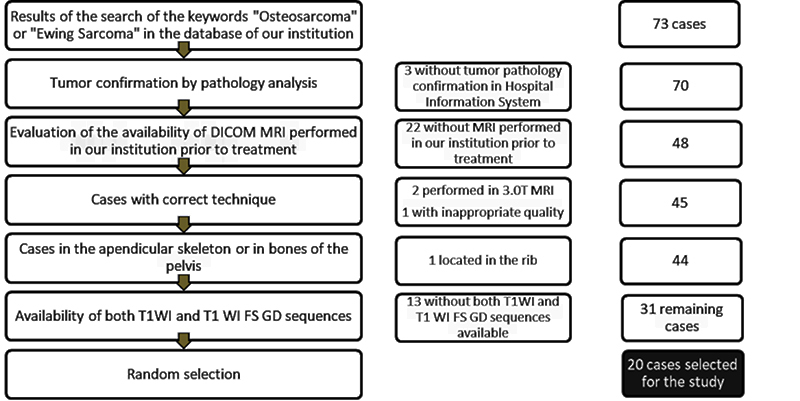
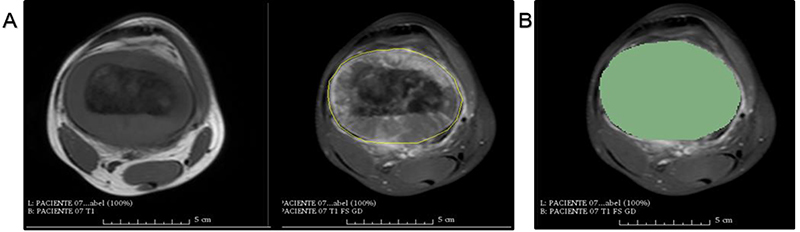
The aims of this study were to evaluate the intra- and interobserver reproducibility of manual segmentation of bone sarcomas in magnetic resonance imaging (MRI) studies and to compare manual and semiautomatic segmentation methods. This retrospective study included twelve osteosarcoma and eight Ewing sarcoma MRI studies performed prior to any therapeutic intervention. All cases were histopathologically confirmed. Three radiologists used 3D-Slicer software to perform manual segmentation of bone sarcomas in a blinded and independent manner. One radiologist segmented manually and also performed semiautomatic segmentation with the GrowCut tool. Segmentation exercises were timed for comparison. The dice similarity coefficient (DSC) and Hausdorff distance (HD) were used to evaluate similarity between the segmentation results and further statistical analyses were performed to compare DSC, HD, and volumetric results. Manual segmentation was reproducible with intraobserver DSC varying from 0.83 to 0.97 and HD from 3.37 to 28.73 mm. Interobserver DSC of manual segmentation showed variation from 0.73 to 0.97 and HD from 3.93 to 33.40 mm. Semiautomatic segmentation compared to manual segmentation resulted in DSCs of 0.71-0.96 and HDs of 5.38-31.54 mm. Semiautomatic segmentation required significantly less time compared to manual segmentation (P value ≤0.05). Among all situations compared, tumor volumetry did not show significant statistical differences (P value >0.05). We found excellent intra- and interobserver agreement for manual segmentation of osteosarcoma and Ewing sarcoma. There was high similarity between manual and semiautomatic segmentation, with a significant reduction of segmentation time using the semiautomatic method.
本研究旨在评估磁共振成像(MRI)研究中骨肉瘤手动分割的观察者内和观察者间可重复性,并比较手动和半自动分割方法。这项回顾性研究包括 12 例骨肉瘤和 8 例尤文肉瘤的 MRI 研究,这些研究均在任何治疗干预之前进行。所有病例均经组织病理学证实。三位放射科医生使用 3D-Slicer 软件以盲法和独立的方式进行骨肉瘤的手动分割。一位放射科医生手动分割,并使用 GrowCut 工具进行半自动分割。分割练习的用时用于比较。使用骰子相似系数(DSC)和 Hausdorff 距离(HD)评估分割结果之间的相似性,并进一步进行统计学分析以比较 DSC、HD 和体积结果。手动分割具有可重复性,观察者内 DSC 从 0.83 到 0.97,HD 从 3.37 到 28.73mm。手动分割的观察者间 DSC 变化范围为 0.73 到 0.97,HD 为 3.93 到 33.40mm。半自动分割与手动分割相比,DSC 为 0.71-0.96,HD 为 5.38-31.54mm。半自动分割比手动分割明显需要更少的时间(P 值≤0.05)。在所有比较的情况下,肿瘤体积均无显著统计学差异(P 值>0.05)。我们发现骨肉瘤和尤文肉瘤的手动分割具有极好的观察者内和观察者间一致性。手动和半自动分割之间具有高度相似性,半自动方法显著减少了分割时间。