Perales María, Valenzuela Pedro L, Barakat Ruben, Cordero Yaiza, Peláez Mireia, López Carmen, Ruilope Luis M, Santos-Lozano Alejandro, Lucia Alejandro
Research Institue of Hospital 12 de Octubre ('i+12'), 28041 Madrid, Spain.
Departamento de Ciencias de la Actividad Fisica y del Deporte. Universidad Camilo José Cela, 28692 Villanueva de la Cañada, Madrid, Spain.
J Clin Med. 2020 Jan 31;9(2):379. doi: 10.3390/jcm9020379.
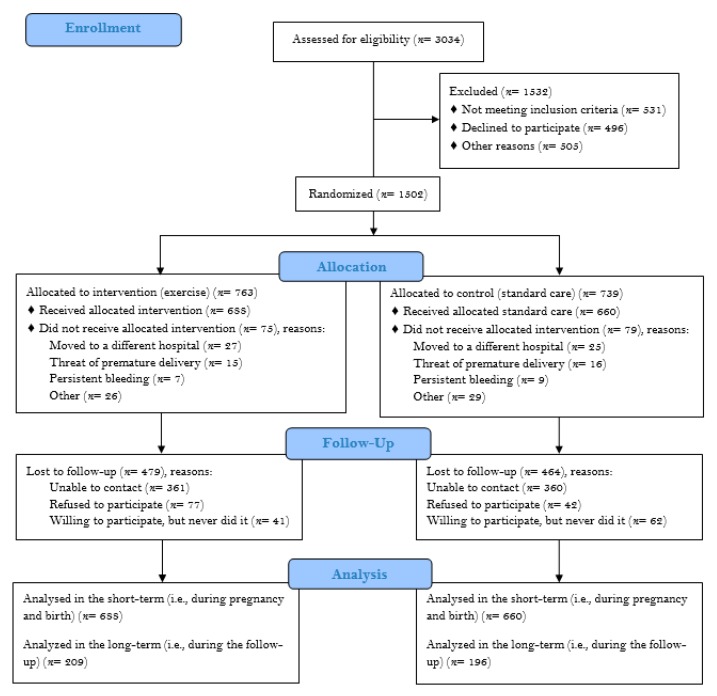
We studied the influence of pregnancy exercise on maternal/offspring cardiometabolic health until delivery and at follow-up. We pooled data from two randomized controlled trials from our group that were performed following the same methodology (one unpublished). We also collected follow-up data de novo from the participants of both trials and their offspring. In total, 1348 women with uncomplicated, singleton gestations were assigned to an intervention ( = 688, performing a supervised, moderate-intensity exercise program (three sessions/week)) or control group ( = 660). Maternal outcomes were excessive gestational weight gain (EGWG), gestational hypertension/diabetes and, at follow-up, return to pre-pregnancy weight within six months, hypertension, overweight/obesity, and other cardiometabolic conditions. Offspring outcomes were macrosomia and low-birthweight and, at follow-up, overweight/obesity, low-weight, and cardiometabolic conditions. Adherence to the intervention, which proved safe, was > 95%. Pregnancy exercise reduced the risk of EGWG, gestational hypertension, and diabetes (adjusted odds ratio (OR) and 95% confidence interval: 0.60 (0.46-0.79), 0.39 (0.23-0.67), and 0.48 (0.28-0.84)), and it was associated with a greater likelihood of returning to pre-pregnancy weight (2.37 (1.26-4.54)) and a lower risk of maternal cardiometabolic conditions (0.27 (0.08-0.95)) at the end of follow-up (median 6.1 years (interquartile range 1.8)). Pregnancy exercise also reduced the risk of macrosomia (0.36 (0.20-0.63)) and of childhood overweight/obesity during the first year (0.20 (0.06-0.63)). Our findings suggest that pregnancy exercise might protect maternal/offspring health.
我们研究了孕期运动对母婴心脏代谢健康的影响,直至分娩时及随访期。我们汇总了本团队两项采用相同方法开展的随机对照试验的数据(其中一项未发表)。我们还重新收集了两项试验参与者及其后代的随访数据。共有1348名单胎妊娠且无并发症的女性被分配至干预组(n = 688,进行有监督的中等强度运动计划(每周三次))或对照组(n = 660)。母亲的结局指标包括孕期体重过度增加(EGWG)、妊娠期高血压/糖尿病,以及随访时在六个月内恢复到孕前体重、高血压、超重/肥胖和其他心脏代谢状况。后代的结局指标包括巨大儿和低出生体重,以及随访时的超重/肥胖、低体重和心脏代谢状况。干预措施经证明是安全的,依从性> 95%。孕期运动降低了EGWG、妊娠期高血压和糖尿病的风险(校正比值比(OR)及95%置信区间:0.60(0.46 - 0.79)、0.39(0.23 - 0.67)和0.48(0.28 - 0.84)),并且与随访结束时(中位时间6.1年(四分位间距1.8))更有可能恢复到孕前体重(2.37(1.26 - 4.54))以及母亲心脏代谢状况风险较低(0.27(0.08 - 0.95))相关。孕期运动还降低了巨大儿的风险(0.36(0.20 - 0.63))以及儿童在第一年超重/肥胖的风险(0.20(0.06 - 0.63))。我们的研究结果表明,孕期运动可能会保护母婴健康。