• 文献检索
  • 文档翻译
  • 深度研究
  • 学术资讯
  • Suppr Zotero 插件Zotero 插件
  • 邀请有礼
  • 套餐&价格
  • 历史记录
应用&插件
Suppr Zotero 插件Zotero 插件浏览器插件Mac 客户端Windows 客户端微信小程序
定价
高级版会员购买积分包购买API积分包
服务
文献检索文档翻译深度研究API 文档MCP 服务
关于我们
关于 Suppr公司介绍联系我们用户协议隐私条款
关注我们

Suppr 超能文献

核心技术专利:CN118964589B侵权必究
粤ICP备2023148730 号-1Suppr @ 2026

文献检索

告别复杂PubMed语法,用中文像聊天一样搜索,搜遍4000万医学文献。AI智能推荐,让科研检索更轻松。

立即免费搜索

文件翻译

保留排版,准确专业,支持PDF/Word/PPT等文件格式,支持 12+语言互译。

免费翻译文档

深度研究

AI帮你快速写综述,25分钟生成高质量综述,智能提取关键信息,辅助科研写作。

立即免费体验

网络嵌入蛋白质-蛋白质相互作用网络用于人类必需基因识别。

Network Embedding the Protein-Protein Interaction Network for Human Essential Genes Identification.

机构信息

Faculty of Information Engineering and Automation, Kunming University of Science and Technology, Kunming 650050, China.

Computer Technology Application Key Lab of Yunnan Province, Kunming University of Science and Technology, Kunming 650050, China.

出版信息

Genes (Basel). 2020 Jan 31;11(2):153. doi: 10.3390/genes11020153.

DOI:10.3390/genes11020153
PMID:32023848
原文链接:https://pmc.ncbi.nlm.nih.gov/articles/PMC7074227/
Abstract

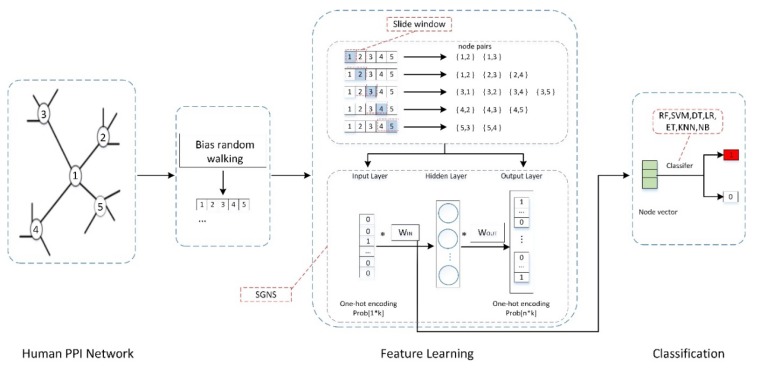
Essential genes are a group of genes that are indispensable for cell survival and cell fertility. Studying human essential genes helps scientists reveal the underlying biological mechanisms of a human cell but also guides disease treatment. Recently, the publication of human essential gene data makes it possible for researchers to train a machine-learning classifier by using some features of the known human essential genes and to use the classifier to predict new human essential genes. Previous studies have found that the essentiality of genes closely relates to their properties in the protein-protein interaction (PPI) network. In this work, we propose a novel supervised method to predict human essential genes by network embedding the PPI network. Our approach implements a bias random walk on the network to get the node network context. Then, the node pairs are input into an artificial neural network to learn their representation vectors that maximally preserves network structure and the properties of the nodes in the network. Finally, the features are put into an SVM classifier to predict human essential genes. The prediction results on two human PPI networks show that our method achieves better performance than those that refer to either genes' sequence information or genes' centrality properties in the network as input features. Moreover, it also outperforms the methods that represent the PPI network by other previous approaches.

摘要

必需基因是一组对于细胞存活和细胞生育力不可或缺的基因。研究人类必需基因有助于科学家揭示人类细胞的基本生物学机制,也为疾病治疗提供指导。最近,人类必需基因数据的公布使得研究人员可以通过使用一些已知人类必需基因的特征来训练机器学习分类器,并使用该分类器来预测新的人类必需基因。先前的研究发现,基因的必需性与其在蛋白质-蛋白质相互作用(PPI)网络中的特性密切相关。在这项工作中,我们提出了一种通过网络嵌入 PPI 网络来预测人类必需基因的新的有监督方法。我们的方法在网络上实现了有偏差的随机游走,以获取节点网络上下文。然后,将节点对输入到人工神经网络中,以学习其表示向量,最大程度地保留网络结构和网络中节点的特性。最后,将特征放入 SVM 分类器中以预测人类必需基因。在两个人类 PPI 网络上的预测结果表明,我们的方法比那些将基因序列信息或网络中基因中心性特性作为输入特征的方法具有更好的性能。此外,它也优于通过其他先前方法表示 PPI 网络的方法。
https://cdn.ncbi.nlm.nih.gov/pmc/blobs/189f/7074227/e4921067c387/genes-11-00153-g005.jpg
https://cdn.ncbi.nlm.nih.gov/pmc/blobs/189f/7074227/4042d1637666/genes-11-00153-g001.jpg
https://cdn.ncbi.nlm.nih.gov/pmc/blobs/189f/7074227/1eac9e32d783/genes-11-00153-g002.jpg
https://cdn.ncbi.nlm.nih.gov/pmc/blobs/189f/7074227/d66d3412d840/genes-11-00153-g003.jpg
https://cdn.ncbi.nlm.nih.gov/pmc/blobs/189f/7074227/a87754284a1c/genes-11-00153-g004.jpg
https://cdn.ncbi.nlm.nih.gov/pmc/blobs/189f/7074227/e4921067c387/genes-11-00153-g005.jpg
https://cdn.ncbi.nlm.nih.gov/pmc/blobs/189f/7074227/4042d1637666/genes-11-00153-g001.jpg
https://cdn.ncbi.nlm.nih.gov/pmc/blobs/189f/7074227/1eac9e32d783/genes-11-00153-g002.jpg
https://cdn.ncbi.nlm.nih.gov/pmc/blobs/189f/7074227/d66d3412d840/genes-11-00153-g003.jpg
https://cdn.ncbi.nlm.nih.gov/pmc/blobs/189f/7074227/a87754284a1c/genes-11-00153-g004.jpg
https://cdn.ncbi.nlm.nih.gov/pmc/blobs/189f/7074227/e4921067c387/genes-11-00153-g005.jpg

相似文献

1
Network Embedding the Protein-Protein Interaction Network for Human Essential Genes Identification.网络嵌入蛋白质-蛋白质相互作用网络用于人类必需基因识别。
Genes (Basel). 2020 Jan 31;11(2):153. doi: 10.3390/genes11020153.
2
DeepHE: Accurately predicting human essential genes based on deep learning.DeepHE:基于深度学习的人类必需基因精准预测。
PLoS Comput Biol. 2020 Sep 16;16(9):e1008229. doi: 10.1371/journal.pcbi.1008229. eCollection 2020 Sep.
3
Machine learning approach to gene essentiality prediction: a review.机器学习在基因必需性预测中的应用:综述。
Brief Bioinform. 2021 Sep 2;22(5). doi: 10.1093/bib/bbab128.
4
Protein Complexes Detection Based on Semi-Supervised Network Embedding Model.基于半监督网络嵌入模型的蛋白质复合物检测。
IEEE/ACM Trans Comput Biol Bioinform. 2021 Mar-Apr;18(2):797-803. doi: 10.1109/TCBB.2019.2944809. Epub 2021 Apr 8.
5
Analysis and identification of essential genes in humans using topological properties and biological information.利用拓扑性质和生物信息分析与鉴定人类必需基因。
Gene. 2014 Nov 10;551(2):138-51. doi: 10.1016/j.gene.2014.08.046. Epub 2014 Aug 27.
6
Essential Protein Detection by Random Walk on Weighted Protein-Protein Interaction Networks.基于加权蛋白质相互作用网络的随机漫步的必需蛋白质检测
IEEE/ACM Trans Comput Biol Bioinform. 2019 Mar-Apr;16(2):377-387. doi: 10.1109/TCBB.2017.2701824. Epub 2017 May 12.
7
Prioritization of candidate disease genes by enlarging the seed set and fusing information of the network topology and gene expression.通过扩大种子集并融合网络拓扑结构和基因表达信息来对候选疾病基因进行优先级排序。
Mol Biosyst. 2014 Jun;10(6):1400-8. doi: 10.1039/c3mb70588a. Epub 2014 Apr 3.
8
Disease gene classification with metagraph representations.基于超图表示的疾病基因分类。
Methods. 2017 Dec 1;131:83-92. doi: 10.1016/j.ymeth.2017.06.036. Epub 2017 Jul 8.
9
Examination of the relationship between essential genes in PPI network and hub proteins in reverse nearest neighbor topology.考察 PPI 网络中的必需基因与反向最近邻拓扑中的枢纽蛋白之间的关系。
BMC Bioinformatics. 2010 Oct 12;11:505. doi: 10.1186/1471-2105-11-505.
10
Graph embedding-based novel protein interaction prediction via higher-order graph convolutional network.基于图嵌入的高阶图卷积网络新型蛋白质相互作用预测。
PLoS One. 2020 Sep 24;15(9):e0238915. doi: 10.1371/journal.pone.0238915. eCollection 2020.

引用本文的文献

1
Protein Sequence Analysis landscape: A Systematic Review of Task Types, Databases, Datasets, Word Embeddings Methods, and Language Models.蛋白质序列分析全景:任务类型、数据库、数据集、词嵌入方法和语言模型的系统综述
Database (Oxford). 2025 May 30;2025. doi: 10.1093/database/baaf027.
2
HELP: A computational framework for labelling and predicting human common and context-specific essential genes.帮助:一种用于标记和预测人类普遍和特定情境必需基因的计算框架。
PLoS Comput Biol. 2024 Sep 27;20(9):e1012076. doi: 10.1371/journal.pcbi.1012076. eCollection 2024 Sep.
3
Enzymatic Metabolic Switches of Astrocyte Response to Lipotoxicity as Potential Therapeutic Targets for Nervous System Diseases.

本文引用的文献

1
A random walk-based method to identify driver genes by integrating the subcellular localization and variation frequency into bipartite graph.基于随机游走的方法,通过将亚细胞定位和变异频率整合到二分图中,来识别驱动基因。
BMC Bioinformatics. 2019 May 14;20(1):238. doi: 10.1186/s12859-019-2847-9.
2
An Entropy-Based Method for Identifying Mutual Exclusive Driver Genes in Cancer.基于熵的方法鉴定癌症中相互排斥的驱动基因
IEEE/ACM Trans Comput Biol Bioinform. 2020 May-Jun;17(3):758-768. doi: 10.1109/TCBB.2019.2897931. Epub 2019 Feb 7.
3
A Novel Method for Identifying Essential Genes by Fusing Dynamic Protein⁻Protein Interactive Networks.
星形胶质细胞对脂毒性反应的酶促代谢开关作为神经系统疾病的潜在治疗靶点
Pharmaceuticals (Basel). 2024 May 16;17(5):648. doi: 10.3390/ph17050648.
4
Untangling the Context-Specificity of Essential Genes by Means of Machine Learning: A Constructive Experience.通过机器学习理清必需基因的语境特异性:一种建设性的经验。
Biomolecules. 2023 Dec 22;14(1):18. doi: 10.3390/biom14010018.
5
Tumor type classification and candidate cancer-specific biomarkers discovery via semi-supervised learning.通过半监督学习进行肿瘤类型分类和候选癌症特异性生物标志物发现。
Biophys Rep. 2023 Apr 30;9(2):57-66. doi: 10.52601/bpr.2023.230005.
6
Biological network topology features predict gene dependencies in cancer cell-lines.生物网络拓扑特征可预测癌细胞系中的基因依赖性。
Bioinform Adv. 2022 Nov 10;2(1):vbac084. doi: 10.1093/bioadv/vbac084. eCollection 2022.
7
A disease-related essential protein prediction model based on the transfer neural network.一种基于迁移神经网络的疾病相关必需蛋白质预测模型。
Front Genet. 2023 Jan 4;13:1087294. doi: 10.3389/fgene.2022.1087294. eCollection 2022.
8
Protein Science Meets Artificial Intelligence: A Systematic Review and a Biochemical Meta-Analysis of an Inter-Field.蛋白质科学与人工智能相遇:跨领域的系统评价与生化荟萃分析
Front Bioeng Biotechnol. 2022 Jul 7;10:788300. doi: 10.3389/fbioe.2022.788300. eCollection 2022.
9
An Iterative Method for Predicting Essential Proteins Based on Multifeature Fusion and Linear Neighborhood Similarity.一种基于多特征融合和线性邻域相似性的必需蛋白质预测迭代方法。
Front Aging Neurosci. 2022 Jan 24;13:799500. doi: 10.3389/fnagi.2021.799500. eCollection 2021.
10
Identifying Cancer Subtypes Using a Residual Graph Convolution Model on a Sample Similarity Network.基于样本相似性网络的残差图卷积模型鉴定癌症亚型。
Genes (Basel). 2021 Dec 27;13(1):65. doi: 10.3390/genes13010065.
一种融合动态蛋白质-蛋白质相互作用网络的识别必需基因的新方法。
Genes (Basel). 2019 Jan 8;10(1):31. doi: 10.3390/genes10010031.
4
XGBFEMF: An XGBoost-Based Framework for Essential Protein Prediction.XGBFEMF:基于 XGBoost 的必需蛋白预测框架。
IEEE Trans Nanobioscience. 2018 Jul;17(3):243-250. doi: 10.1109/TNB.2018.2842219. Epub 2018 May 31.
5
WDL-RF: predicting bioactivities of ligand molecules acting with G protein-coupled receptors by combining weighted deep learning and random forest.WDL-RF:通过结合加权深度学习和随机森林预测与 G 蛋白偶联受体相互作用的配体分子的生物活性。
Bioinformatics. 2018 Jul 1;34(13):2271-2282. doi: 10.1093/bioinformatics/bty070.
6
Predicting Protein Functions by Using Unbalanced Random Walk Algorithm on Three Biological Networks.基于三个生物网络利用不平衡随机游走算法预测蛋白质功能
IEEE/ACM Trans Comput Biol Bioinform. 2017 Mar-Apr;14(2):360-369. doi: 10.1109/TCBB.2015.2394314.
7
Accurate prediction of human essential genes using only nucleotide composition and association information.仅利用核苷酸组成和关联信息对人类必需基因进行准确预测。
Bioinformatics. 2017 Jun 15;33(12):1758-1764. doi: 10.1093/bioinformatics/btx055.
8
A scored human protein-protein interaction network to catalyze genomic interpretation.一个用于催化基因组解读的评分人类蛋白质-蛋白质相互作用网络。
Nat Methods. 2017 Jan;14(1):61-64. doi: 10.1038/nmeth.4083. Epub 2016 Nov 28.
9
node2vec: Scalable Feature Learning for Networks.节点2向量:网络的可扩展特征学习
KDD. 2016 Aug;2016:855-864. doi: 10.1145/2939672.2939754.
10
Essential Human Genes.人类必需基因
Cell Syst. 2015 Dec 23;1(6):381-2. doi: 10.1016/j.cels.2015.12.007.