Masalova Olga V, Lesnova Ekaterina I, Klimova Regina R, Momotyuk Ekaterina D, Kozlov Vyacheslav V, Ivanova Alla M, Payushina Olga V, Butorina Nina N, Zakirova Natalia F, Narovlyansky Alexander N, Pronin Alexander V, Ivanov Alexander V, Kushch Alla A
Gamaleya National Research Center of Epidemiology and Microbiology, Ministry of Health of the Russian Federation, Moscow 123098, Russia.
Federal State Autonomous Educational Institution of Higher Education I.M. Sechenov First Moscow State Medical University of the Ministry of Health of the Russian Federation (Sechenov University), Moscow 119991, Russia.
Vaccines (Basel). 2020 Feb 2;8(1):62. doi: 10.3390/vaccines8010062.
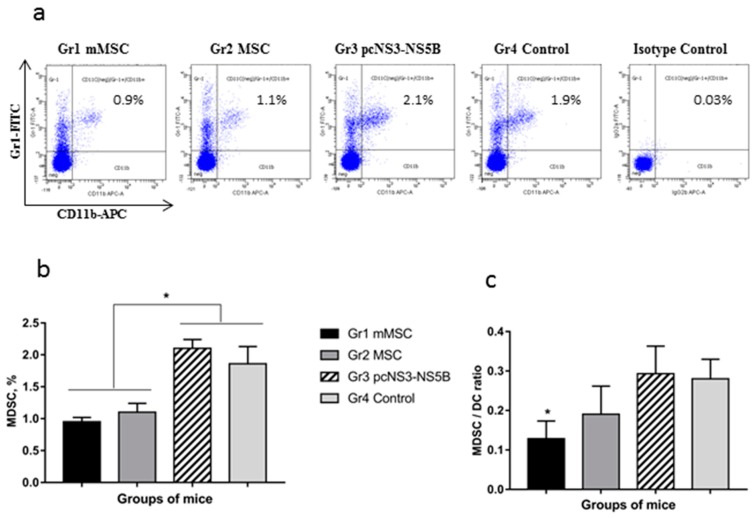
Hepatitis C virus (HCV) is one of the major causes of chronic liver disease and leads to cirrhosis and hepatocarcinoma. Despite extensive research, there is still no vaccine against HCV. In order to induce an immune response in DBA/2J mice against HCV, we obtained modified mouse mesenchymal stem cells (mMSCs) simultaneously expressing five nonstructural HCV proteins (NS3-NS5B). The innate immune response to mMSCs was higher than to DNA immunization, with plasmid encoding the same proteins, and to naïve unmodified MSCs. mMSCs triggered strong phagocytic activity, enhanced lymphocyte proliferation, and production of type I and II interferons. The adaptive immune response to mMSCs was also more pronounced than in the case of DNA immunization, as exemplified by a fourfold stronger stimulation of lymphocyte proliferation in response to HCV, a 2.6-fold higher rate of biosynthesis, and a 30-fold higher rate of secretion of IFN-γ, as well as by a 40-fold stronger production of IgG2a antibodies to viral proteins. The immunostimulatory effect of mMSCs was associated with pronounced IL-6 secretion and reduction in the population of myeloid derived suppressor cells (MDSCs). Thus, this is the first example that suggests the feasibility of using mMSCs for the development of an effective anti-HCV vaccine.
丙型肝炎病毒(HCV)是导致慢性肝病的主要原因之一,可引发肝硬化和肝癌。尽管进行了广泛研究,但目前仍没有针对HCV的疫苗。为了在DBA/2J小鼠中诱导针对HCV的免疫反应,我们获得了同时表达五种HCV非结构蛋白(NS3-NS5B)的修饰小鼠间充质干细胞(mMSCs)。与用编码相同蛋白的质粒进行DNA免疫以及未修饰的原始MSCs相比,mMSCs引发的固有免疫反应更强。mMSCs触发了强烈的吞噬活性,增强了淋巴细胞增殖以及I型和II型干扰素的产生。mMSCs引发的适应性免疫反应也比DNA免疫更为明显,例如对HCV刺激的淋巴细胞增殖的刺激强度高四倍,生物合成率高2.6倍,IFN-γ分泌率高30倍,以及针对病毒蛋白的IgG2a抗体产生量高40倍。mMSCs的免疫刺激作用与显著的IL-6分泌以及髓源性抑制细胞(MDSCs)数量减少有关。因此,这是首个表明使用mMSCs开发有效抗HCV疫苗具有可行性的实例。