Zeinalipour-Yazdi Constantinos D, Catlow C Richard A
1Kathleen Lonsdale Materials Chemistry, Department of Chemistry, University College London, London, WC1H 0AJ UK.
2School of Chemistry, Cardiff University, Cardiff, CF10 1AD UK.
Catal Letters. 2017;147(7):1820-1826. doi: 10.1007/s10562-017-2080-y. Epub 2017 May 24.
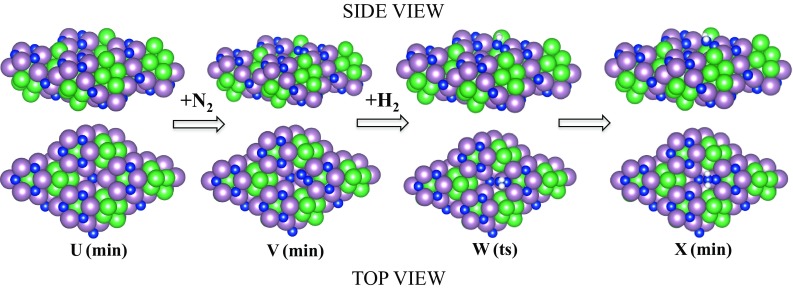
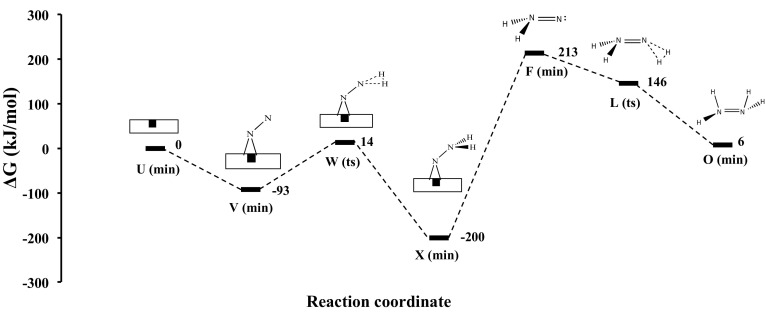
Periodic and molecular density functional theory calculations have been applied to elucidate the associative mechanism for hydrazine and ammonia synthesis in the gas phase and hydrazine formation on CoMoN. We find that there are two activation barriers for the associative gas phase mechanism with barriers of 730 and 658 kJ/mol, corresponding to a hydrogenation step from N to NNH and HNNH to HNNH, respectively. The second step of the mechanism is barrierless and an important intermediate, NNH, can also readily form on CoMoN surfaces via the Eley-Rideal chemisorption of H on a pre-adsorbed N at nitrogen vacancies. Based on this intermediate a new heterogeneous mechanism for hydrazine synthesis is studied. The highest relative barrier for this heterogeneous catalysed process is 213 kJ/mol for CoMoN containing nitrogen vacancies, clearly pointing towards a low-energy process for the synthesis of hydrazine via a heterogeneous catalysis route.
已应用周期性和分子密度泛函理论计算来阐明气相中肼和氨合成以及在CoMoN上形成肼的缔合机制。我们发现,缔合气相机制存在两个活化能垒,分别为730和658 kJ/mol,分别对应于从N到NNH以及从HNNH到HNNH的氢化步骤。该机制的第二步无势垒,并且重要的中间体NNH也可以通过H在氮空位处预先吸附的N上的埃里-里德耳化学吸附在CoMoN表面上轻松形成。基于该中间体,研究了一种新的肼合成多相机制。对于含氮空位的CoMoN,这种多相催化过程的最高相对势垒为213 kJ/mol,这清楚地表明通过多相催化途径合成肼是一个低能量过程。