Marushchak Mariya, Maksiv Khrystyna, Krynytska Inna, Dutchak Olha, Behosh Nina
Department of Functional and Laboratory Diagnostics, I. Horbachevsky Ternopil National Medical University, Ternopil, Ukraine.
Department of Medical Rehabilitation, I. Horbachevsky Ternopil National Medical University, Ternopil, Ukraine.
J Med Life. 2019 Oct-Dec;12(4):426-434. doi: 10.25122/jml-2019-0108.
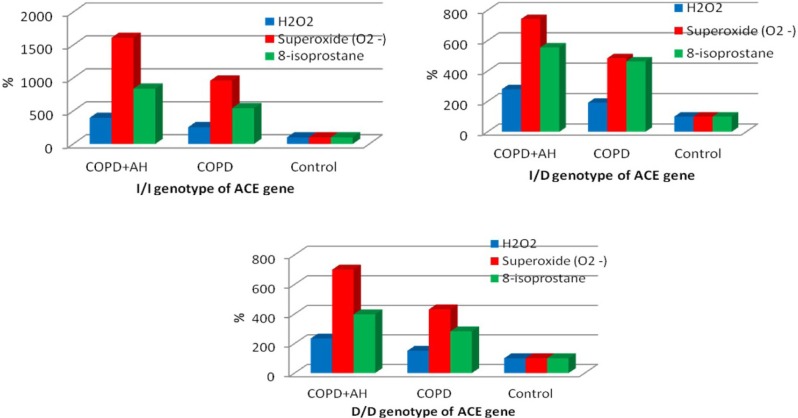
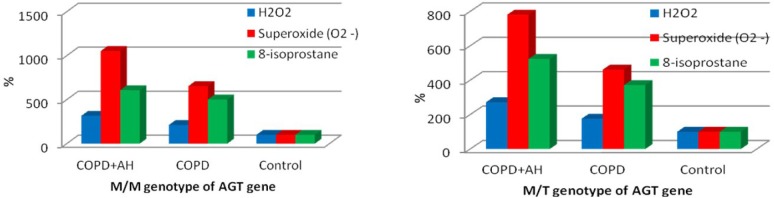
There is an increasing number of studies suggesting the role of genetic factors in the development and progression of chronic obstructive pulmonary disease and hypertension. Therefore, our study aimed to establish the role of ACE and AGT gene polymorphisms in the mechanisms behind the development of oxidative stress in patients with concomitant chronic obstructive pulmonary disease and hypertension. The study group consisted of 96 patients: Group 1 (individuals with a chronic obstructive pulmonary disease), Group 2 (individuals with arterial hypertension), Group 3 (individuals with a chronic obstructive pulmonary disease and arterial hypertension). The control group consisted of 20 healthy subjects. ACE and AGT gene polymorphisms were determined by polymerase chain reaction amplification. Detection of intracellular reactive oxygen species levels was performed by EPICS XL cytometer (Beckman Coulter, USA) with dichlorodihydrofluorescein diacetate and dihydroethidium. Serum levels of 8-isoprostane were assayed with ELISA, Cayman Chemicals (USA). No significant correlations between ACE and AGT gene polymorphisms and parameters of oxidative stress in a setting of comorbid chronic obstructive pulmonary disease and hypertension were observed. However, the increase in oxidative stress parameters was observed to be the most significant in patients with chronic obstructive pulmonary disease + hypertension and with I/I genotype of the ACE gene, which was due to their lowest values in virtually healthy individuals. This suggests that I/I genotype may be associated with lower levels of reactive oxygen species production compared with other genotypes.
越来越多的研究表明遗传因素在慢性阻塞性肺疾病和高血压的发生发展中起作用。因此,我们的研究旨在确定ACE和AGT基因多态性在慢性阻塞性肺疾病合并高血压患者氧化应激发生机制中的作用。研究组由96例患者组成:第1组(慢性阻塞性肺疾病患者),第2组(动脉高血压患者),第3组(慢性阻塞性肺疾病合并动脉高血压患者)。对照组由20名健康受试者组成。通过聚合酶链反应扩增确定ACE和AGT基因多态性。使用二氯二氢荧光素二乙酸酯和二氢乙锭,通过EPICS XL细胞仪(美国贝克曼库尔特公司)检测细胞内活性氧水平。使用美国开曼化学公司的ELISA试剂盒检测血清8-异前列腺素水平。在慢性阻塞性肺疾病合并高血压的情况下,未观察到ACE和AGT基因多态性与氧化应激参数之间存在显著相关性。然而,在慢性阻塞性肺疾病+高血压患者和ACE基因I/I基因型患者中,氧化应激参数的增加最为显著,这是因为他们在几乎健康的个体中数值最低。这表明与其他基因型相比,I/I基因型可能与较低水平的活性氧产生有关。