Roberts Megan C, Allen Caitlin G, Andersen Brittany L
The National Cancer Institute, Division of Cancer Control and Population Sciences, Rockville, Maryland, USA.
Department of Behavioral Sciences and Health Education, Emory University Rollins School of Public Health, Atlanta, Georgia, USA.
JAMIA Open. 2019 Sep 17;2(4):411-415. doi: 10.1093/jamiaopen/ooz037. eCollection 2019 Dec.
In March 2018, the Food and Drug Administration (FDA) announced its authorization of a direct-to-consumer (DTC) genetic test for three pathogenic variants. We sought to determine to whether social media discussion increased following the authorization, who was driving social media conversations, and what topics were discussed.
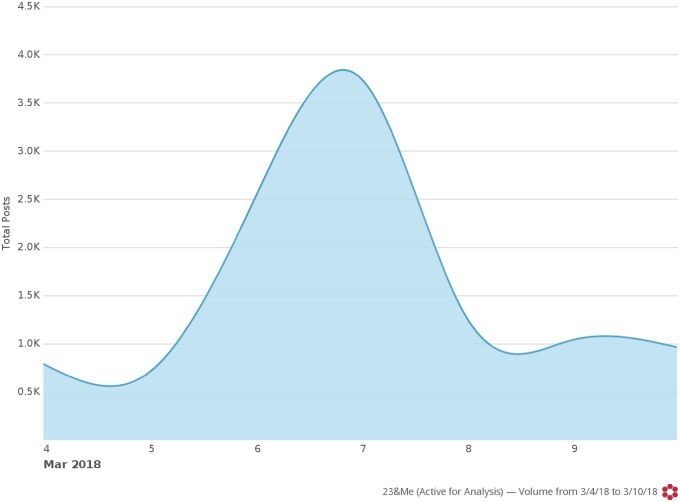
Using Crimson Hexagon, we described tweets before, during, and after the FDA announcement authorizing 23andMe to return results (3/4/18-3/10/18). We conducted qualitative coding of a subset of 605 tweets to better understand Twitter communication.
We identified 11 055 twitter posts across the week of FDA's announcement. Twitter discourse about 23andMe and the FDA authorization peaked the day following the FDA's press release. Most tweets (48.6%) were informational and 26.3% were either expressing opinions (about 23andMe and/or FDA authorization, 14.9%) or testimonials (personal experiences with genetic testing, 11.4%). The types of tweets varied over the week-long period (.001).
Twitter discussion about the FDA's authorization of DTC for three pathogenic variants increased immediately following the announcement. As more genetic technologies are brought to the DTC market, social media sites, like Twitter, will play a role in disseminating this information, providing a platform for information exchange, consumer testimonials, opinion pieces, and research.
2018年3月,美国食品药品监督管理局(FDA)宣布批准一项针对三种致病基因变异的直接面向消费者(DTC)的基因检测。我们试图确定批准后社交媒体上的讨论是否增加、谁主导了社交媒体上的对话以及讨论的话题是什么。
我们使用Crimson Hexagon描述了FDA宣布授权23andMe返回检测结果之前、期间和之后的推文(2018年3月4日至2018年3月10日)。我们对605条推文的子集进行了定性编码,以更好地理解推特上的交流情况。
在FDA宣布的那一周,我们共识别出11055条推特帖子。关于23andMe和FDA授权的推特讨论在FDA新闻稿发布后的第二天达到顶峰。大多数推文(48.6%)是提供信息的,26.3%是表达意见的(关于23andMe和/或FDA授权,14.9%)或个人经验分享(基因检测的个人经历,11.4%)。在这为期一周的时间里,推文的类型有所不同(P<0.001)。
FDA批准针对三种致病基因变异的DTC检测后,推特上的讨论立即增加。随着更多基因技术进入DTC市场,像推特这样的社交媒体将在传播此类信息方面发挥作用,为信息交流、消费者经验分享、观点文章和研究提供一个平台。