Institute for Human Infections and Immunity, University of Texas Medical Branch, Galveston, Texas, United States of America.
Department of Pathology, University of Texas Medical Branch, Galveston, Texas, United States of America.
PLoS Pathog. 2020 Feb 6;16(2):e1008102. doi: 10.1371/journal.ppat.1008102. eCollection 2020 Feb.
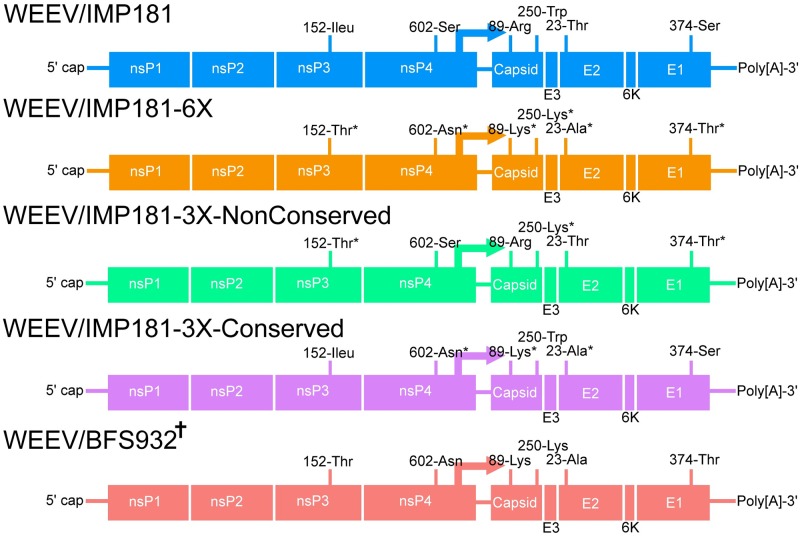
Understanding the circumstances under which arboviruses emerge is critical for the development of targeted control and prevention strategies. This is highlighted by the emergence of chikungunya and Zika viruses in the New World. However, to comprehensively understand the ways in which viruses emerge and persist, factors influencing reductions in virus activity must also be understood. Western equine encephalitis virus (WEEV), which declined during the late 20th century in apparent enzootic circulation as well as equine and human disease incidence, provides a unique case study on how reductions in virus activity can be understood by studying evolutionary trends and mechanisms. Previously, we showed using phylogenetics that during this period of decline, six amino acid residues appeared to be positively selected. To assess more directly the effect of these mutations, we utilized reverse genetics and competition fitness assays in the enzootic host and vector (house sparrows and Culex tarsalis mosquitoes). We observed that the mutations contemporary with reductions in WEEV circulation and disease that were non-conserved with respect to amino acid properties had a positive effect on enzootic fitness. We also assessed the effects of these mutations on virulence in the Syrian-Golden hamster model in relation to a general trend of increased virulence in older isolates. However, no change effect on virulence was observed based on these mutations. Thus, while WEEV apparently underwent positive selection for infection of enzootic hosts, residues associated with mammalian virulence were likely eliminated from the population by genetic drift or negative selection. These findings suggest that ecologic factors rather than fitness for natural transmission likely caused decreased levels of enzootic WEEV circulation during the late 20th century.
了解虫媒病毒出现的情况对于制定有针对性的控制和预防策略至关重要。这一点在新世界出现基孔肯雅热和寨卡病毒时得到了强调。然而,为了全面了解病毒出现和持续存在的方式,还必须了解影响病毒活性降低的因素。西部马脑炎病毒(WEEV)在 20 世纪后期明显在地方性循环以及马和人类疾病发病率下降,为研究病毒活性降低的方式提供了一个独特的案例研究,即通过研究进化趋势和机制来理解这一点。此前,我们通过系统发育学表明,在这一下降期间,有六个氨基酸残基似乎受到正选择。为了更直接地评估这些突变的影响,我们在地方性宿主和媒介(麻雀和库蚊)中利用反向遗传学和竞争适应度测定法。我们观察到,与 WEEV 循环和疾病减少同时出现的、与氨基酸特性无保守性的突变对地方性适应度有积极影响。我们还评估了这些突变对叙利亚金黄地鼠模型中病毒毒力的影响,以及与较老分离株中病毒毒力增加的一般趋势有关的影响。然而,基于这些突变,没有观察到对毒力的改变效应。因此,虽然 WEEV 显然经历了对地方性宿主感染的正选择,但与哺乳动物毒力相关的残基可能由于遗传漂变或负选择而从种群中消除。这些发现表明,生态因素而不是自然传播的适应性可能导致 20 世纪后期地方性 WEEV 循环水平降低。