Department of Dermatology and Allergy, University Hospital Bonn, Rheinische-Friedrich-Wilhelms-Universität Bonn, Bonn, Germany.
Department of Otolaryngology, Head and Neck Surgery, University Hospital Bonn, Rheinische-Friedrich-Wilhelms-Universität Bonn, Sigmund-Freud-Str. 25, 53105 Bonn, Germany.
EBioMedicine. 2020 Feb;52:102647. doi: 10.1016/j.ebiom.2020.102647. Epub 2020 Feb 3.
Immunotherapy, including checkpoint inhibition, has remarkably improved prognosis in advanced melanoma. Despite this success, acquired resistance is still a major challenge. The T cell costimulatory receptor TNFRSF9 (also known as 4-1BB and CD137) is a promising new target for immunotherapy and two agonistic antibodies are currently tested in clinical trials. However, little is known about epigenetic regulation of the encoding gene. In this study we investigate a possible correlation of TNFRSF9 DNA methylation with gene expression, clinicopathological parameters, molecular and immune correlates, and response to anti-PD-1 immunotherapy to assess the validity of TNFRSF9 methylation to serve as a biomarker.
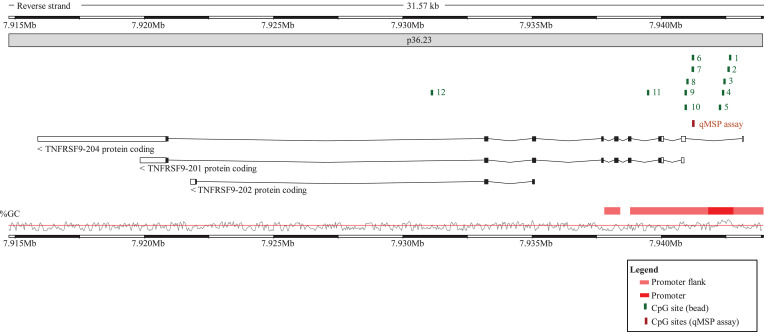
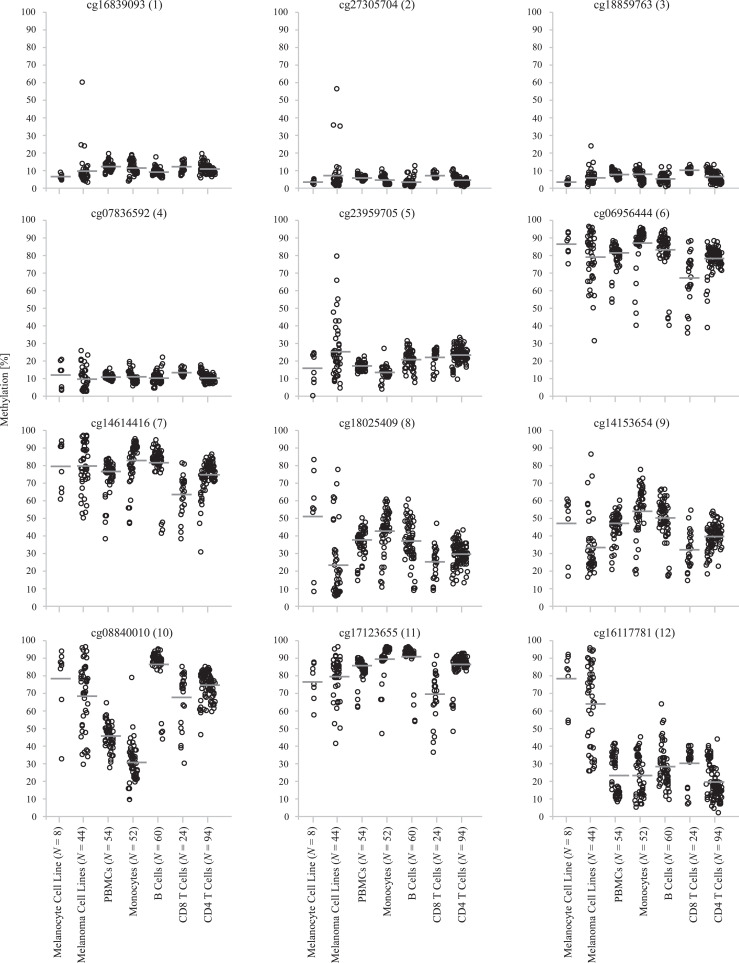
We performed a correlation analyses of methylation at twelve CpG sites within TNFRSF9 with regard to transcriptional activity, immune cell infiltration, mutation status, and survival in a cohort of N = 470 melanoma patients obtained from The Cancer Genome Atlas. Furthermore, we used quantitative methylation-specific PCR to confirm correlations in a cohort of N = 115 melanoma patients' samples (UHB validation cohort). Finally, we tested the ability of TNFRSF9 methylation and expression to predict progression-free survival (PFS) and response to anti-PD-1 immunotherapy in a cohort comprised of N = 121 patients (mRNA transcription), (mRNA ICB cohort) and a case-control study including N = 48 patients (DNA methylation, UHB ICB cohort).
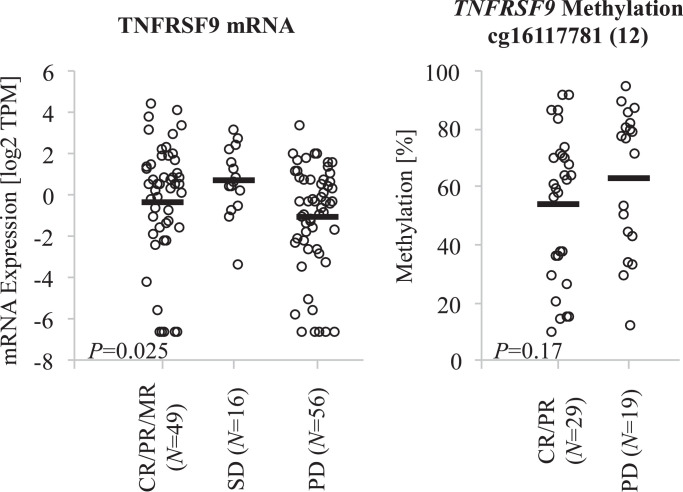
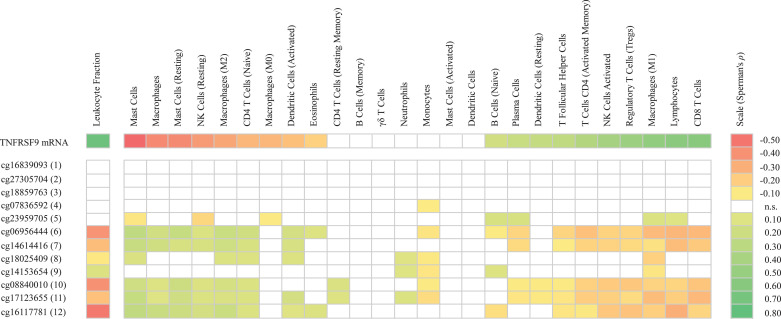
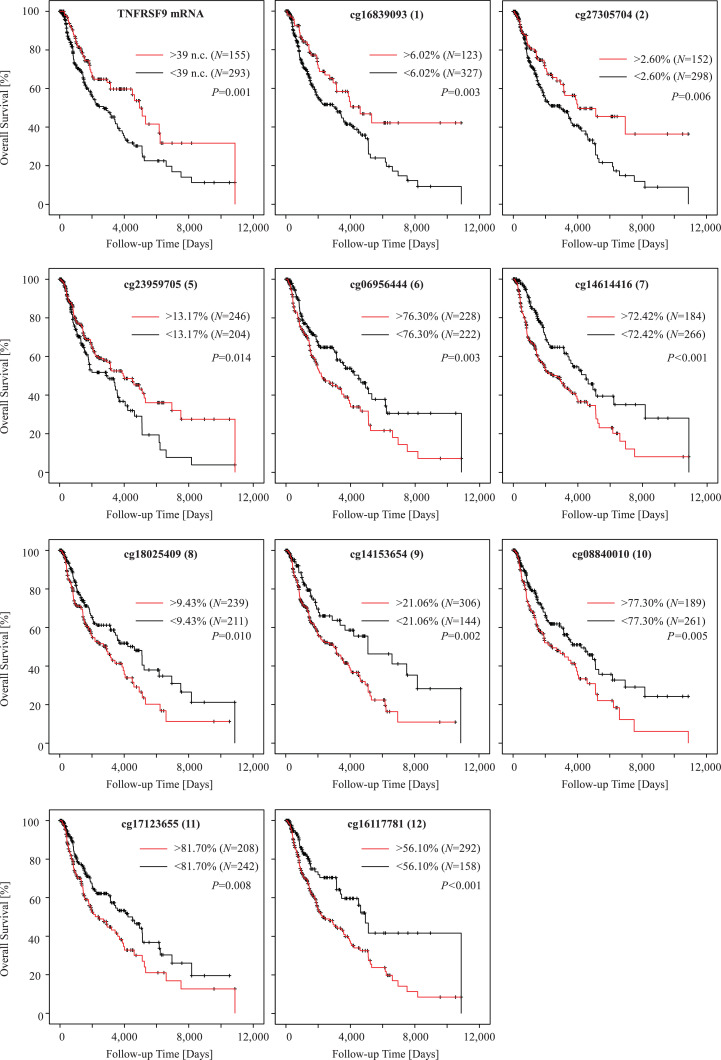
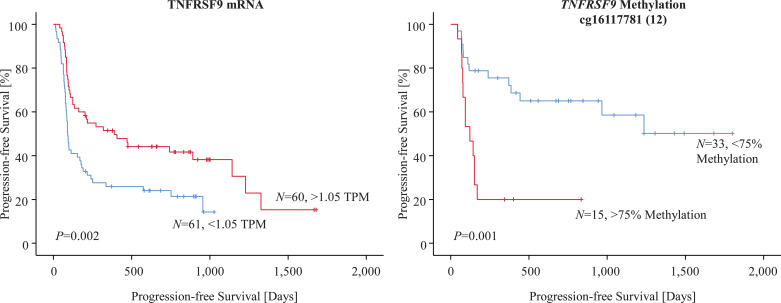
We found a significant inverse correlation between TNFRSF9 DNA methylation and mRNA expression levels at six of twelve analyzed CpG sites (P ≤ 0.005), predominately located in the promoter flank region. Consistent with its role as costimulatory receptor in immune cells, TNFRSF9 mRNA expression and hypomethylation positively correlated with immune cell infiltrates and an interferon-γ signature. Furthermore, elevated TNFRSF9 mRNA expression and TNFRSF9 hypomethylation correlated with superior overall survival. In patients receiving anti-PD-1 immunotherapy (mRNA ICB cohort), we found that TNFRSF9 hypermethylation and reduced mRNA expression correlated with poor PFS and response.
Our study suggests that TNFRSF9 mRNA expression is regulated via DNA methylation. The observed correlations between TNFRSF9 DNA methylation or mRNA expression with known features of response to immune checkpoint blockage suggest TNFRSF9 methylation could serve as a biomarker in the context of immunotherapies. Concordantly, we identified a correlation between TNFRSF9 DNA methylation and mRNA expression with disease progression in patients under immunotherapy. Our study provides rationale for further investigating TNFRSF9 DNA methylation as a predictive biomarker for response to immunotherapy.
AF was partly funded by the Mildred Scheel Foundation. SF received funding from the University Hospital Bonn BONFOR program (O-105.0069). DN was funded in part by DFG Cluster of Excellence ImmunoSensation (EXC 1023). The funders had no role in study design, data collection and analysis, interpretation, decision to publish, or preparation of the manuscript; or any aspect pertinent to the study.
免疫疗法,包括检查点抑制,显著改善了晚期黑色素瘤的预后。尽管取得了这一成功,但获得性耐药仍然是一个主要挑战。T 细胞共刺激受体 TNFRSF9(也称为 4-1BB 和 CD137)是免疫治疗的一个有前途的新靶点,目前有两种激动性抗体正在临床试验中进行测试。然而,关于其编码基因的表观遗传调控知之甚少。在这项研究中,我们研究了 TNFRSF9 DNA 甲基化与基因表达、临床病理参数、分子和免疫相关性以及对抗 PD-1 免疫治疗反应之间的可能相关性,以评估 TNFRSF9 甲基化作为生物标志物的有效性。
我们对来自癌症基因组图谱的 N=470 名黑色素瘤患者队列中 TNFRSF9 的 12 个 CpG 位点的甲基化与转录活性、免疫细胞浸润、突变状态和生存进行了相关性分析。此外,我们使用定量甲基特异性 PCR 在 N=115 名黑色素瘤患者样本的 UHB 验证队列中验证了相关性。最后,我们在由 N=121 名患者组成的队列中测试了 TNFRSF9 甲基化和表达预测无进展生存期(PFS)和抗 PD-1 免疫治疗反应的能力(mRNA 转录),并在包括 N=48 名患者的病例对照研究中进行了测试(DNA 甲基化,UHB ICB 队列)。
我们发现 12 个分析的 CpG 位点中有 6 个(P≤0.005)的 TNFRSF9 DNA 甲基化与 mRNA 表达水平呈显著负相关,主要位于启动子侧翼区。与作为免疫细胞共刺激受体的作用一致,TNFRSF9 mRNA 表达和低甲基化与免疫细胞浸润和干扰素-γ特征呈正相关。此外,升高的 TNFRSF9 mRNA 表达和 TNFRSF9 低甲基化与总生存期延长相关。在接受抗 PD-1 免疫治疗的患者(mRNA ICB 队列)中,我们发现 TNFRSF9 高甲基化和 mRNA 表达降低与较差的 PFS 和反应相关。
我们的研究表明,TNFRSF9 mRNA 表达受 DNA 甲基化调控。观察到的 TNFRSF9 DNA 甲基化或 mRNA 表达与免疫检查点阻断反应的已知特征之间的相关性表明,TNFRSF9 甲基化可以作为免疫治疗背景下的生物标志物。一致地,我们在接受免疫治疗的患者中发现了 TNFRSF9 DNA 甲基化与疾病进展之间的相关性。我们的研究为进一步研究 TNFRSF9 DNA 甲基化作为免疫治疗反应的预测生物标志物提供了依据。
AF 部分由 Mildred Scheel 基金会资助。SF 获得了波恩大学医院 BONFOR 计划(O-105.0069)的资助。DN 部分得到了德国研究基金会免疫感应卓越集群(EXC 1023)的资助。资助者在研究设计、数据收集和分析、解释、发表决定或手稿准备方面,以及与研究相关的任何方面都没有作用;或任何方面都没有作用。