Division of Orthopedics and Biotechnology, Department of Clinical Science, intervention and Technology (CLINTEC), Karolinska Institutet, Solna, Sweden.
Department of Orthopaedics and Traumatology, Faculty of Medicine, The Chinese University of Hong Kong, Hong Kong, People's Republic of China.
BMC Musculoskelet Disord. 2020 Feb 6;21(1):78. doi: 10.1186/s12891-020-3094-y.
This article systematically reviews the current evidence regarding inflammation in Tendinopathy with the aim to increase understanding of a potential common pathophysiology.
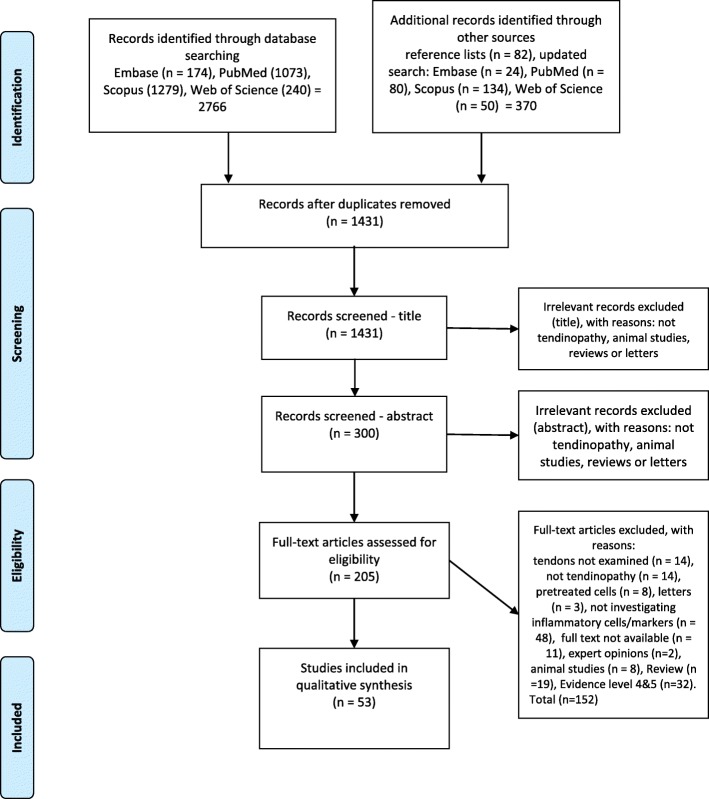
Following the PRISMA statements, the terms: (tendinopathy OR (tendons AND rupture)) AND (inflammation OR (inflammation AND cells) OR immune system OR inflammation mediators OR bacteria) were used. One thousand four hundred thirty-one articles were identified which was screened down to 53.
39/53 studies mentioned inflammatory cells but had contradicting conclusions. Macrophages were the most common cell type and inflammatory markers were detectable in all the articles which measure them.
The included studies show different conclusions, but this heterogeneity is not unexpected since the clinical criteria of 'tendinopathy' encompass a huge clinical spectrum. Different 'tendinopathy' conditions may have different pathophysiology, and even the same clinical condition may be at different disease stages during sampling, which can alter the histological and biochemical picture. Control specimen sampling was suboptimal since the healthy areas of the pathological-tendon may actually be sub-clinically diseased, as could the contralateral tendon in the same subject. Detection of inflammatory cells is most sensitive using immunohistochemistry targeting the cluster of differentiation markers, especially when compared to the conventional haematoxylin and eosin staining methods. The identified inflammatory cell types favour a chronic inflammatory process; which suggests a persistent stimulus. This means NSAID and glucocorticoids may be useful since they suppress inflammation, but it is noted that they may hinder tendon healing and cause long term problems. This systematic review demonstrates a diversity of data and conclusions in regard to inflammation as part of the pathogenesis of Tendinopathy, ranging from ongoing or chronic inflammation to non-inflammatory degeneration and chronic infection. Whilst various inflammatory markers are present in two thirds of the reviewed articles, the heterogenicity of data and lack of comparable studies means we cannot conclude a common pathophysiology from this systematic review.
本文系统地回顾了目前关于肌腱病炎症的证据,旨在提高对潜在共同病理生理学的理解。
根据 PRISMA 声明,使用以下术语:(肌腱病或(肌腱和撕裂))和(炎症或(炎症和细胞)或免疫系统或炎症介质或细菌)。共确定了 1431 篇文章,筛选后保留了 53 篇。
39/53 项研究提到了炎症细胞,但结论相互矛盾。巨噬细胞是最常见的细胞类型,所有测量炎症标志物的文章都可以检测到。
纳入的研究显示出不同的结论,但这种异质性并不出人意料,因为“肌腱病”的临床标准包含了广泛的临床谱。不同的“肌腱病”条件可能具有不同的病理生理学,甚至同一临床条件在取样时可能处于不同的疾病阶段,这会改变组织学和生化图像。对照标本采样不理想,因为病变肌腱的健康区域实际上可能处于亚临床疾病状态,同一受试者的对侧肌腱也可能如此。使用针对分化标志物的免疫组织化学检测炎症细胞最敏感,尤其是与传统的苏木精和伊红染色方法相比。鉴定的炎症细胞类型支持慢性炎症过程;这表明存在持续的刺激。这意味着 NSAID 和糖皮质激素可能有用,因为它们抑制炎症,但需要注意的是,它们可能会阻碍肌腱愈合并导致长期问题。本系统评价表明,炎症作为肌腱病发病机制的一部分,在数据和结论方面存在多样性,从持续或慢性炎症到非炎症性退变和慢性感染。虽然 reviewed 文章中有三分之二存在各种炎症标志物,但数据的异质性和缺乏可比研究意味着我们不能从本系统评价中得出共同的病理生理学结论。