University of Chinese Academy of Sciences, Beijing, 100049, China.
Industrial Enzymes National Engineering Laboratory, Tianjin Institute of Industrial Biotechnology, Chinese Academy of Sciences, No. 32 West 7th Avenue, Tianjin Airport Economic Area, Tianjin, 300308, China.
Microb Cell Fact. 2020 Feb 7;19(1):25. doi: 10.1186/s12934-020-1296-5.
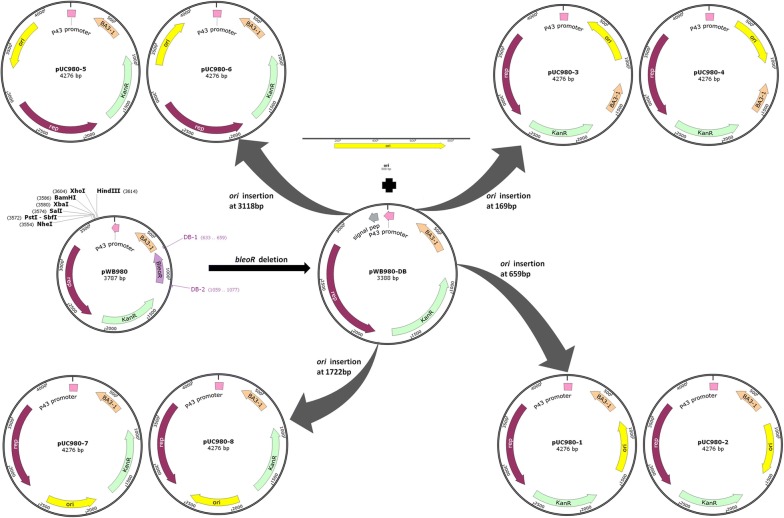
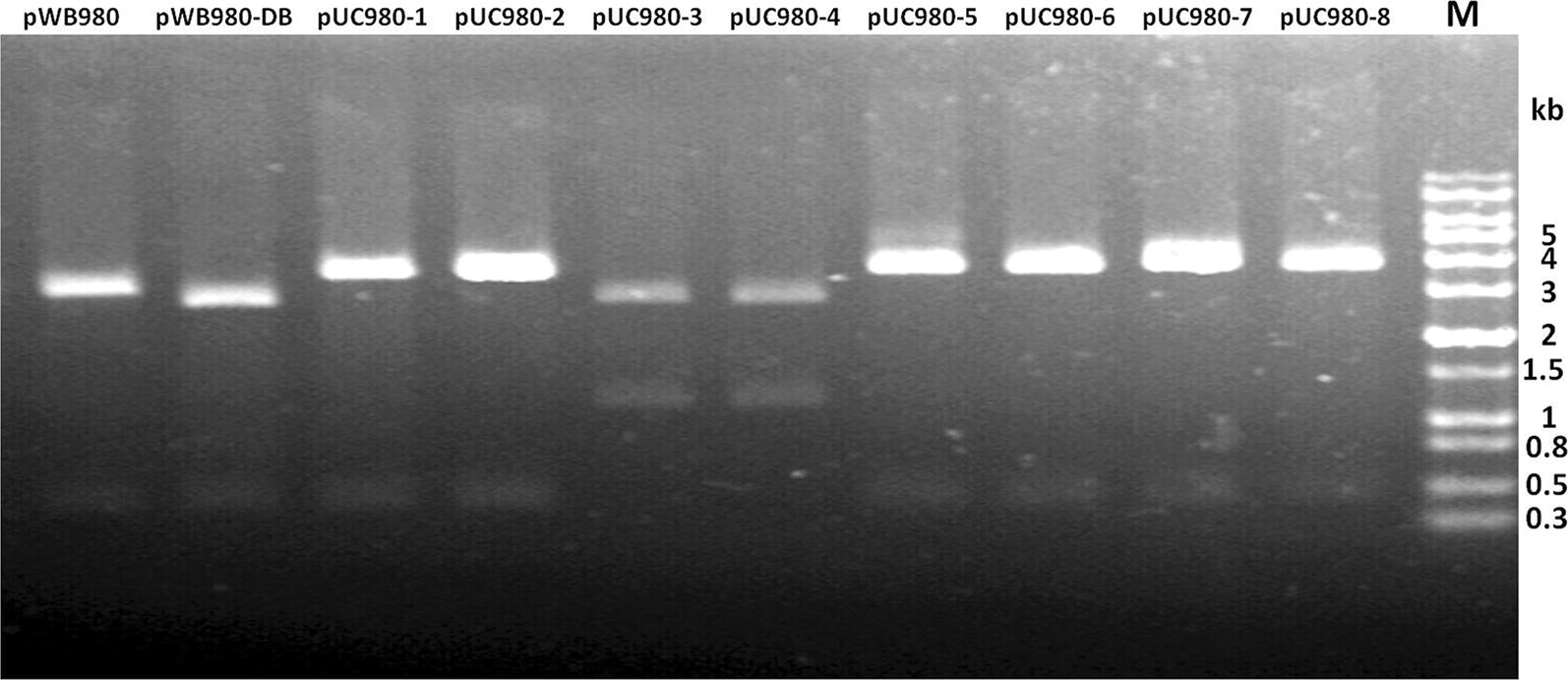
pWB980 derived from pUB110 is a promising expression vector in Bacillus for its high copy number and high stability. However, the low transformation rate of recombinant plasmids to the wild cells limited the application of it. On the basis of pWB980, constructing an E. coli-B. subtilis shuttle plasmid could facilitate the transformation rate to Bacillus cells. Because the insertion site for E. coli replication origin sequence (ori) is not unique in pWB980, in order to investigate the best insertion site, eight shuttle plasmids (pUC980-1 ~ pUC980-8) containing all possible insertion sites and directions were constructed.
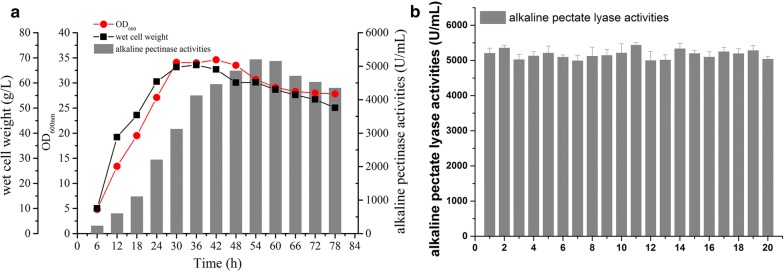
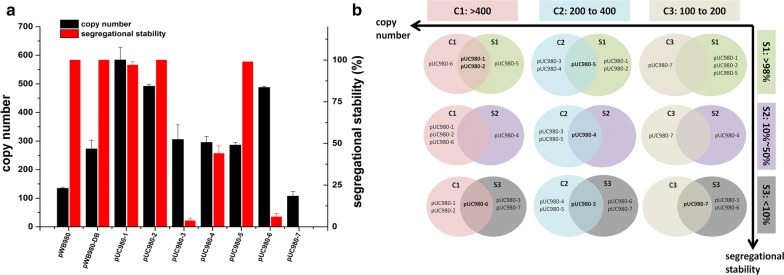
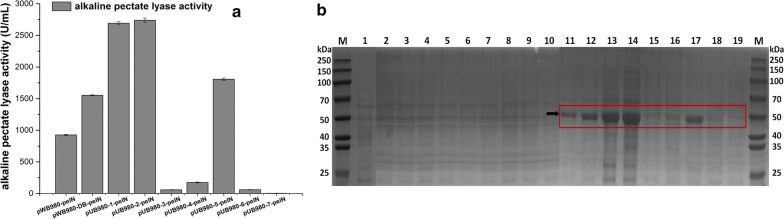
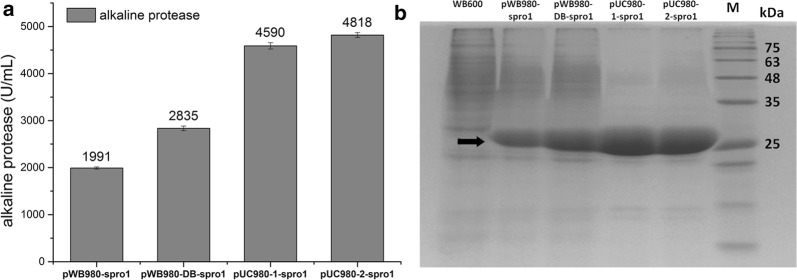
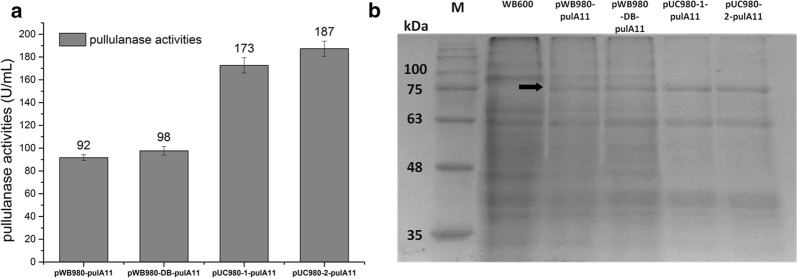
The results showed that all the selected insertion sites could be used to construct shuttle plasmid but some sites required a specific direction. And different insertion sites led to different properties of the shuttle plasmids. The best shuttle plasmids pUC980-1 and pUC980-2, which showed copies more than 450 per cell and segregational stabilities up to 98%, were selected for heterologous expressions of an alkaline pectate lyase gene pelN, an alkaline protease spro1 and a pullulanase gene pulA11, respectively. The highest extracellular activities of PelN, Spro1 and PulA11 were up to 5200 U/mL, 21,537 U/mL and 504 U/mL correspondingly after 54 h, 60 h and 48 h fermentation in a 10 L fermentor. Notably, PelN and Spro1 showed remarkably higher yields in Bacillus than previous reports.
The optimum ori insertion site was the upstream region of BA3-1 in pWB980 which resulted in shuttle plasmids with higher copy numbers and higher stabilities. The novel shuttle plasmids pUC980-1 and pUC980-2 will be promising expression vectors in B. subtilis. Moreover, the ori insertion mechanism revealed in this work could provide theoretical guidance for further studies of pWB980 and constructions of other shuttle plasmids.
pWB980 衍生自 pUB110,因其高拷贝数和高稳定性,成为芽孢杆菌中很有前途的表达载体。然而,重组质粒向野生细胞的低转化效率限制了其应用。在 pWB980 的基础上,构建大肠杆菌-枯草芽孢杆菌穿梭质粒可以提高质粒向芽孢杆菌细胞的转化效率。由于 pWB980 中大肠杆菌复制起点序列(ori)的插入位置不是唯一的,因此为了研究最佳插入位置,构建了包含所有可能插入位置和方向的 8 个穿梭质粒(pUC980-1~pUC980-8)。
结果表明,所有选择的插入位置都可以用来构建穿梭质粒,但有些位置需要特定的方向。不同的插入位置导致穿梭质粒的性质不同。选择最佳的穿梭质粒 pUC980-1 和 pUC980-2,它们的拷贝数超过每个细胞 450 个,分离稳定性高达 98%,分别用于碱性果胶酶基因 pelN、碱性蛋白酶 spro1 和普鲁兰酶基因 pulA11 的异源表达。在 10L 发酵罐中发酵 54、60 和 48h 后,PelN、Spro1 和 PulA11 的胞外酶活最高分别达到 5200U/mL、21537U/mL 和 504U/mL。值得注意的是,PelN 和 Spro1 在芽孢杆菌中的产量明显高于以前的报道。
最佳 ori 插入位置是 pWB980 中 BA3-1 上游区域,这导致了具有更高拷贝数和更高稳定性的穿梭质粒。新型穿梭质粒 pUC980-1 和 pUC980-2 将成为枯草芽孢杆菌中很有前途的表达载体。此外,本工作揭示的 ori 插入机制可为进一步研究 pWB980 和构建其他穿梭质粒提供理论指导。