Department of Laboratory Medicine, Zhujiang Hospital, Southern Medical University, Guangzhou, 510515, China.
Laboratory Medicine Center, Nanfang Hospital, Southern Medical University, Guangzhou, 510000, China.
J Transl Med. 2020 Feb 6;18(1):59. doi: 10.1186/s12967-020-02237-8.
Circulating tumor cells (CTCs) has been demonstrated as a promising liquid biopsy marker for breast cancer (BC). However, the intra-patient heterogeneity of CTCs remains a challenge to clinical application. We aim at profiling aggressive CTCs subpopulation in BC utilizing the distinctive metabolic reprogramming which is a hallmark of metastatic tumor cells.
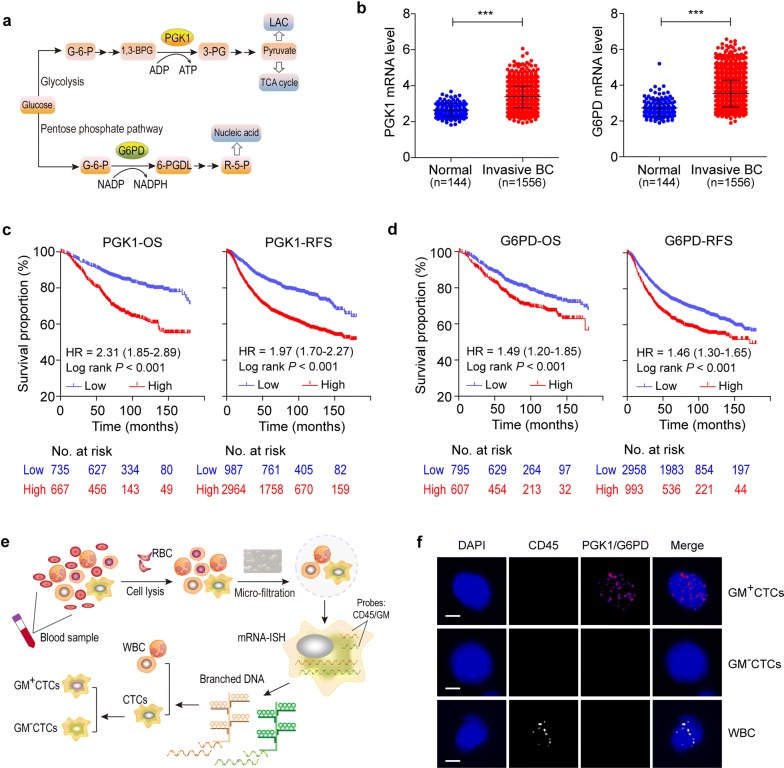
Oncomine, TCGA and Kaplan-Meier plotter databases were utilized to analyze expression and survival relevance of the previously screened metastasis-promoting metabolic markers (PGK1/G6PD) in BC patients. CTCs detection and metabolic classification were performed through micro-filtration and multiple RNA in situ hybridization using CD45 and PGK1/G6PD probes. Blood samples were collected from 64 BC patients before treatment for CTCs analysis. Patient characteristics were recorded to evaluate clinical applications of CTCs metabolic subtypes, as well as morphological EMT subtypes classified by epithelial (EpCAM/CKs) and mesenchymal (Vimentin/Twist) markers.
PGK1 and G6PD expressions were up-regulated in invasive BC tissues compared with normal mammary tissues. Increased tissue expressions of PGK1 or G6PD indicated shortened overall and relapse-free survival of BC patients (P < 0.001). Blood GMCTCs (DAPICD45PGK1/G6PD) was detectable (range 0-54 cells/5 mL) in 61.8% of tCTCs > 0 patients. Increased GMCTCs number and positive rate were correlated with tumor metastasis and progression (P < 0.05). The GMCTCs ≥ 2/5 mL level presented superior AUC of ROC at 0.854 (95% CI 0.741-0.968) in the diagnosis of BC metastasis (sensitivity/specificity: 66.7%/91.3%), compared with that of tCTCs (0.779) and CTCs-EMT subtypes (E-CTCs 0.645, H-CTCs 0.727 and M-CTCs 0.697). Moreover, GMCTCs group had inferior survival with decreased 2 years-PFS proportion (18.5%) than GMCTCs group (87.9%; P = 0.001).
This work establishes a PGK1/G6PD-based method for CTCs metabolic classification to identify the aggressive CTCs subpopulation. Metabolically active GMCTCs subtype is suggested a favorable biomarker of distant metastasis and prognosis in BC patients.
循环肿瘤细胞(CTC)已被证明是一种有前途的乳腺癌(BC)液体活检标志物。然而,CTC 的患者内异质性仍然是临床应用的一个挑战。我们旨在利用转移性肿瘤细胞的标志性代谢重编程来描绘 BC 中侵袭性 CTC 亚群。
利用 Oncomine、TCGA 和 Kaplan-Meier plotter 数据库分析先前筛选的促转移代谢标志物(PGK1/G6PD)在 BC 患者中的表达和生存相关性。通过使用 CD45 和 PGK1/G6PD 探针的微孔过滤和多重 RNA 原位杂交对 CTC 进行检测和代谢分类。从 64 名接受治疗前的 BC 患者中采集血液样本进行 CTC 分析。记录患者特征,以评估 CTC 代谢亚型以及通过上皮(EpCAM/CKs)和间充质(Vimentin/Twist)标志物分类的形态 EMT 亚型的临床应用。
PGK1 和 G6PD 在侵袭性 BC 组织中的表达高于正常乳腺组织。组织中 PGK1 或 G6PD 的表达增加表明 BC 患者的总生存期和无复发生存期缩短(P<0.001)。在 tCTCs>0 的患者中,可检测到血液 GMCTCs(DAPI-CD45-PGK1/G6PD)(范围 0-54 个细胞/5 mL)(61.8%)。GMCTCs 数量和阳性率的增加与肿瘤转移和进展相关(P<0.05)。GMCTCs≥2/5 mL 水平在诊断 BC 转移方面具有更高的 ROC AUC(0.854 [95%CI 0.741-0.968])(敏感性/特异性:66.7%/91.3%),高于 tCTCs(0.779)和 CTCs-EMT 亚型(E-CTCs 0.645、H-CTCs 0.727 和 M-CTCs 0.697)。此外,GMCTCs 组的 2 年无进展生存期比例(18.5%)低于 GMCTCs 组(87.9%;P=0.001),提示生存较差。
本研究建立了一种基于 PGK1/G6PD 的 CTCs 代谢分类方法,用于鉴定侵袭性 CTC 亚群。代谢活跃的 GMCTCs 亚型被认为是 BC 患者远处转移和预后的良好生物标志物。