Ding Yiqian, Wang Yu, Qiu Chen, Qian Wenjun, Xie Hui, Ding Zhaotang
Tea Research Institute, Qingdao Agricultural University, Qingdao, China.
PeerJ. 2020 Jan 29;8:e8258. doi: 10.7717/peerj.8258. eCollection 2020.
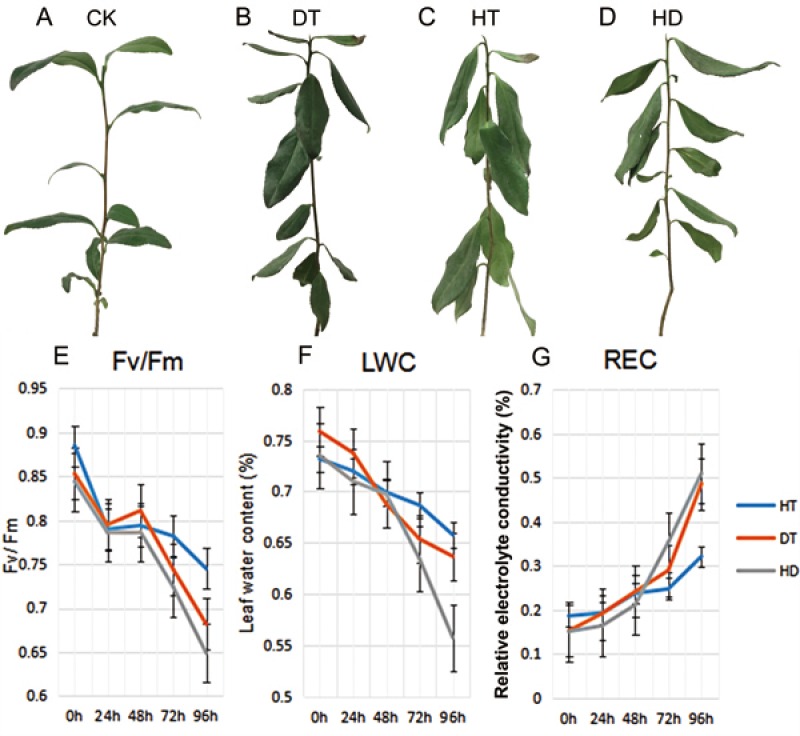
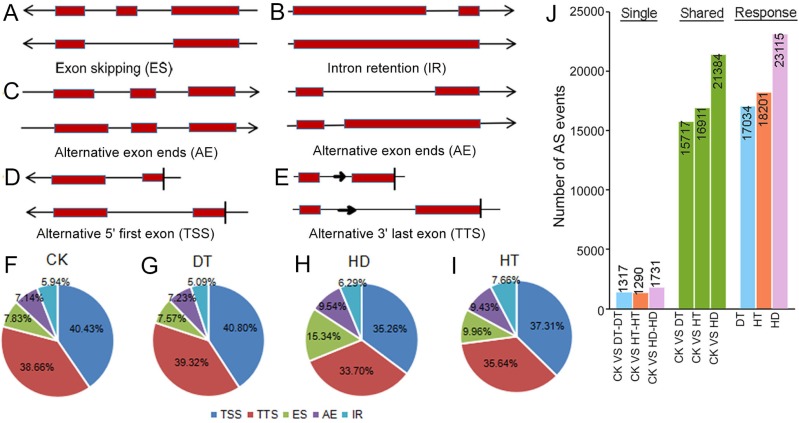
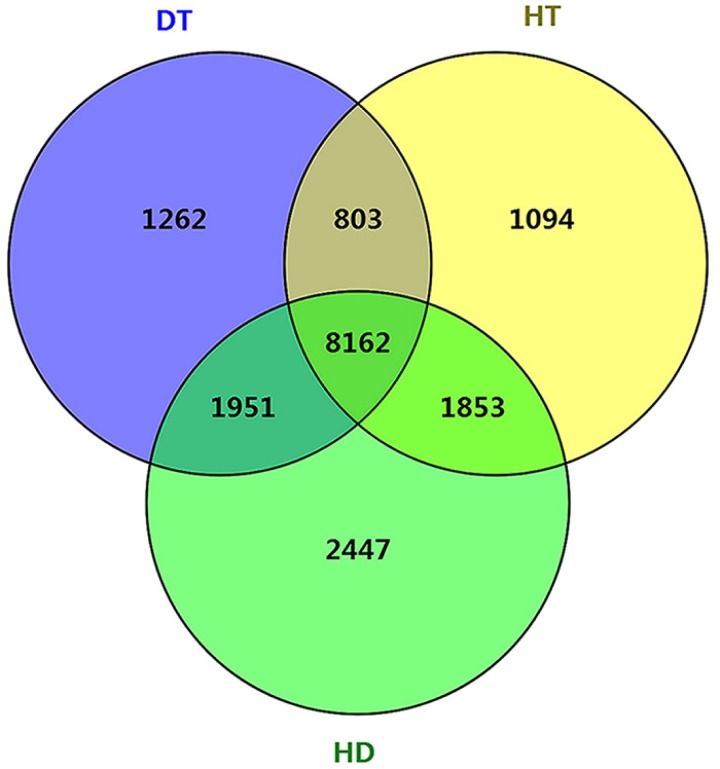
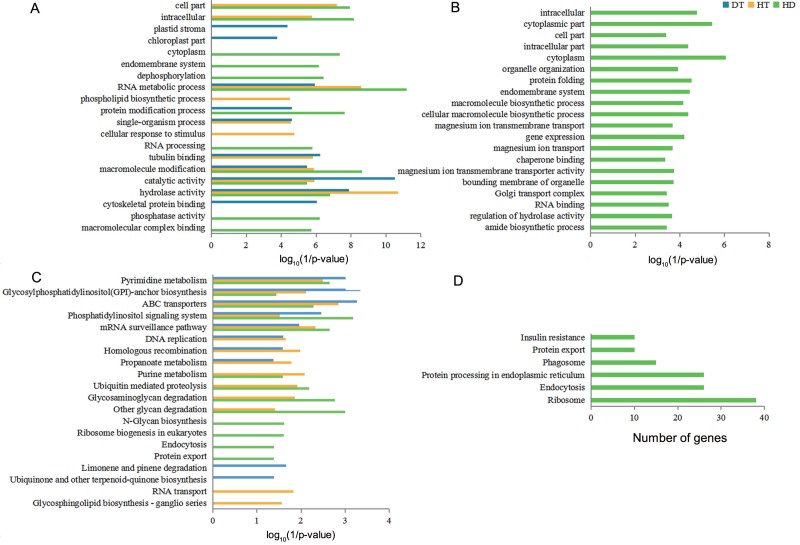
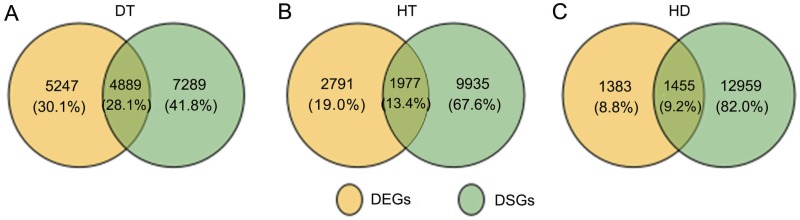
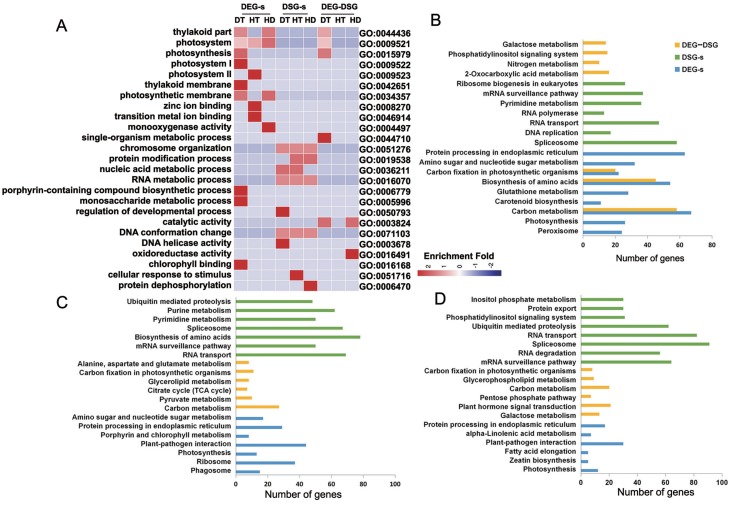
Drought and heat stresses can influence the expressions of genes, and thereby affect the growth and development of plants. Alternative splicing (AS) of genes plays crucial roles through increasing transcriptome diversity in plant stress responses. Tea plants, widely cultivated in the tropics and subtropics, are often simultaneously exposed to drought and heat stresses. In the present study, we performed a global transcriptome of tea leaves treated with drought, heat or their combination. In total, 19,019, 20,025 and 20,253 genes underwent AS in response to drought (DT), heat (HT) and their combined stress (HD), respectively, of which 12,178, 11,912 and 14,413 genes differentially spliced in response to DT, HT and HD, respectively. Also, 2,447 specific differentially spliced genes (DSGs) were found only in response to HD. All DSGs accounted for 48% of the annotated genes in tea tree genome. Comparison of DSGs and differentially expressive genes (DEGs) showed that the proportions of HT and HD-induced DSGs were 13.4% and 9.2%, while the proportion of DT increased to 28.1%. Moreover, the DEG-DSG overlapped genes tended to be enriched in a wide large of pathways in response to DT. The results indicated that the AS of genes in tea leaves was extensively triggered by drought, heat and their combined stresses. In addition, the AS enhanced the transcriptome adaption in response to drought and heat stresses, and the AS also provoked specific molecular functions in response to drought and heat synergy stress. The study might have practical significance for molecular genetic breeding of tea plants with stress resistance.
干旱和热胁迫会影响基因的表达,进而影响植物的生长发育。基因的可变剪接(AS)通过增加植物应激反应中的转录组多样性发挥关键作用。茶树广泛种植于热带和亚热带地区,常同时遭受干旱和热胁迫。在本研究中,我们对经干旱、热或二者组合处理的茶叶进行了全转录组分析。分别有19,019、20,025和20,253个基因在干旱(DT)、热(HT)及其复合胁迫(HD)处理下发生了可变剪接,其中分别有12,178、11,912和14,413个基因在响应DT、HT和HD时发生了差异剪接。此外,仅在HD处理下发现了2,447个特异性差异剪接基因(DSG)。所有DSG占茶树基因组注释基因的48%。DSG与差异表达基因(DEG)的比较表明,HT和HD诱导的DSG比例分别为13.4%和9.2%,而DT诱导的比例增至28.1%。此外,DEG-DSG重叠基因在响应DT时倾向于富集在广泛的多种途径中。结果表明,茶叶中的基因可变剪接受干旱、热及其复合胁迫广泛触发。此外,可变剪接增强了对干旱和热胁迫的转录组适应性,并且可变剪接还引发了对干旱和热协同胁迫的特定分子功能。该研究可能对茶树抗逆分子遗传育种具有实际意义。