Department of Psychology, Northumbria University, Newcastle Upon Tyne, Tyne and Wear, NE1 8SG, UK.
Department of Psychology, College of Arts and Sciences, Lehigh University, Bethlehem, PA, 18015, USA.
Neuropsychologia. 2020 Mar 16;140:107376. doi: 10.1016/j.neuropsychologia.2020.107376. Epub 2020 Feb 4.
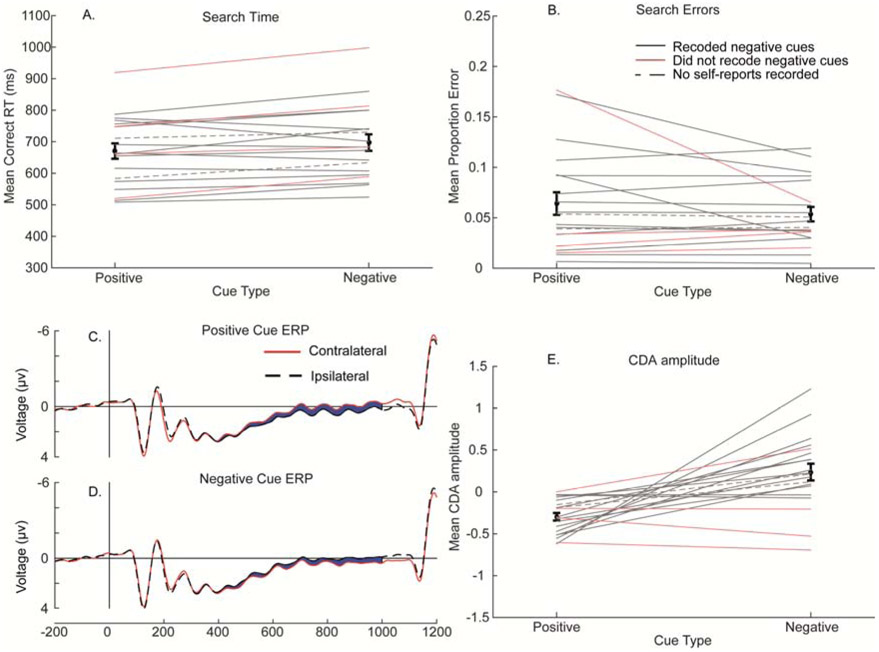
To-be-attended information can be specified either with positive cues (I'll be wearing a blue shirt) or with negative cues (I won't be wearing a red shirt). Numerous experiments have found that positive cues help search more than negative cues. Given that negative cues produce smaller benefits compared to positive cues, it stands to reason that searchers may choose to use positive templates instead of negative templates if given the opportunity. Here, we evaluate this possibility with behavioral measures as well as by directly measuring the formation of positive and negative templates with event-related potentials. Analysis of the contralateral delay activity (CDA) elicited by cues revealed that positive and negative templates relied on working memory to the same extent, even when negative working memory templates could have been circumvented by relying on long-term memories of target colors. Whereas the CDA did not discriminate positive and negative templates, a CNV-like potential did, suggesting cognitive differences between positive and negative templates beyond visual working memory. However, when both positive and negative information were presented in each cue, participants preferred to make use of the positive cues, as indicated by a CDA contralateral to the positive color in negative cue blocks, and a lack of search benefits for positive- and negative-color cues relative to positive-color cues alone. Our results show that searchers elect to selectively encode only positive information into visual working memory when both positive and negative information are available.
待关注的信息可以通过正提示(我将穿一件蓝色的衬衫)或负提示(我不会穿一件红色的衬衫)来指定。许多实验发现,正提示比负提示更有助于搜索。由于负提示产生的收益比正提示小,因此,如果有机会,搜索者可能会选择使用正模板而不是负模板。在这里,我们通过行为测量以及通过直接测量与事件相关的电位来测量正模板和负模板的形成来评估这种可能性。对提示引起的对侧延迟活动(CDA)的分析表明,正模板和负模板在很大程度上依赖于工作记忆,即使负工作记忆模板可以通过依赖目标颜色的长期记忆来避免。虽然 CDA 不能区分正模板和负模板,但 CNV 样电位可以,这表明正模板和负模板之间存在超出视觉工作记忆的认知差异。然而,当每个提示中都同时呈现正提示和负提示时,参与者更喜欢使用正提示,这表现在负提示块中对正颜色的 CDA 对侧,以及相对于仅正颜色提示,正颜色和负颜色提示的搜索收益缺乏。我们的结果表明,当正提示和负提示都可用时,搜索者选择将仅正信息选择性地编码到视觉工作记忆中。