Freedy Keren M, McDonnell Stephen J
Department of Materials Science and Engineering, University of Virginia, Charlottesville, VA 22904, USA.
Materials (Basel). 2020 Feb 4;13(3):693. doi: 10.3390/ma13030693.
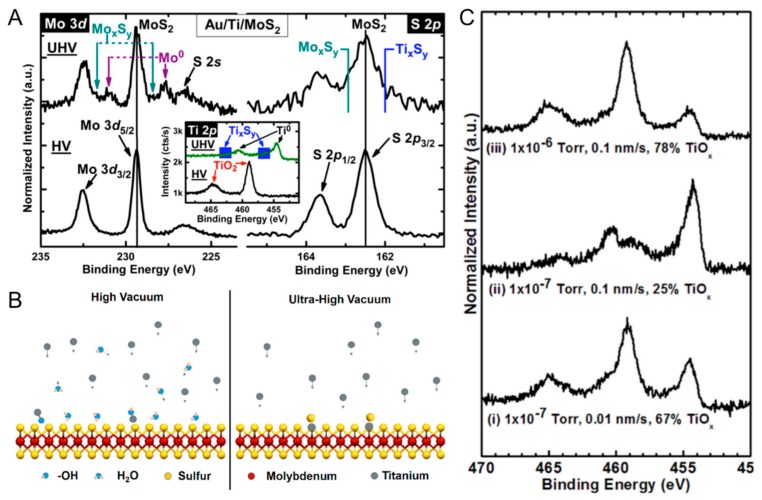
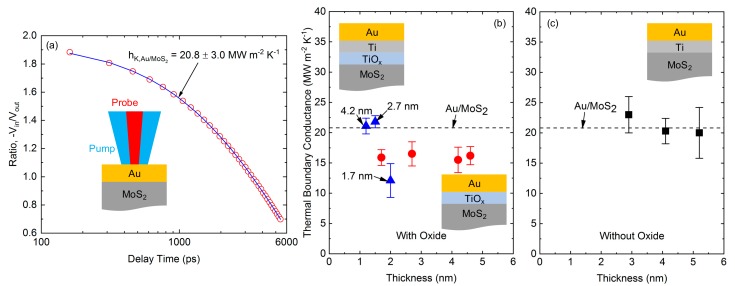
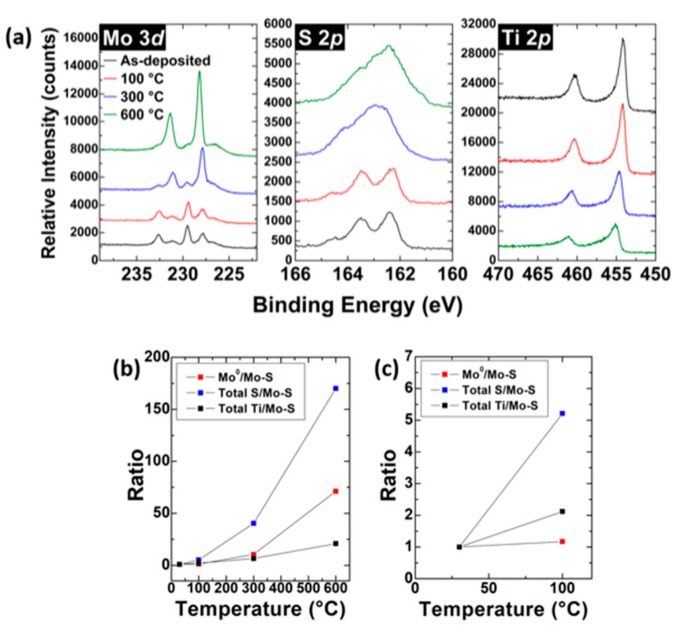
In this review on contacts with MoS, we consider reports on both interface chemistry and device characteristics. We show that there is considerable disagreement between reported properties, at least some of which may be explained by variability in the properties of geological MoS. Furthermore, we highlight that while early experiments using photoemission to study the interface behavior of metal-MoS showed a lack of Fermi-level pinning, device measurements repeatedly confirm that the interface is indeed pinned. Here we suggest that a parallel conduction mechanism enabled by metallic defects in the MoS materials may explain both results. We note that processing conditions during metal depositions on MoS can play a critical role in the interface chemistry, with differences between high vacuum and ultra-high vacuum being particularly important for low work function metals. This can be used to engineer the interfaces by using thin metal-oxide interlayers to protect the MoS from reactions with the metals. We also report on the changes in the interfaces that can occur at high temperature which include enhanced reactions between Ti or Cr and MoS, diffusion of Ag into MoS, and delamination of Fe. What is clear is that there is a dearth of experimental work that investigates both the interface chemistry and device properties in parallel.
在这篇关于与二硫化钼(MoS)接触的综述中,我们考虑了有关界面化学和器件特性的报告。我们表明,所报道的特性之间存在相当大的分歧,其中至少有一些可以通过地质二硫化钼特性的变化来解释。此外,我们强调,虽然早期使用光发射来研究金属 - 二硫化钼界面行为的实验表明缺乏费米能级钉扎,但器件测量反复证实该界面确实被钉扎。在此我们认为,二硫化钼材料中的金属缺陷所促成的平行传导机制可以解释这两种结果。我们注意到,在二硫化钼上沉积金属时的处理条件在界面化学中可能起着关键作用,对于低功函数金属而言,高真空和超高真空之间的差异尤为重要。这可以通过使用薄金属氧化物中间层来保护二硫化钼不与金属发生反应,从而用于设计界面。我们还报告了在高温下可能发生的界面变化,包括钛(Ti)或铬(Cr)与二硫化钼之间增强的反应、银(Ag)扩散到二硫化钼中以及铁(Fe)的分层。很明显,缺乏同时研究界面化学和器件特性的实验工作。