Department of Power Mechanical Engineering, National Tsing Hua University, Hsinchu 30013, Taiwan.
Institute of Biochemistry, Microbiology and Immunology, Chung Shan Medical University, Taichung 40201, Taiwan.
Int J Mol Sci. 2020 Feb 5;21(3):1061. doi: 10.3390/ijms21031061.
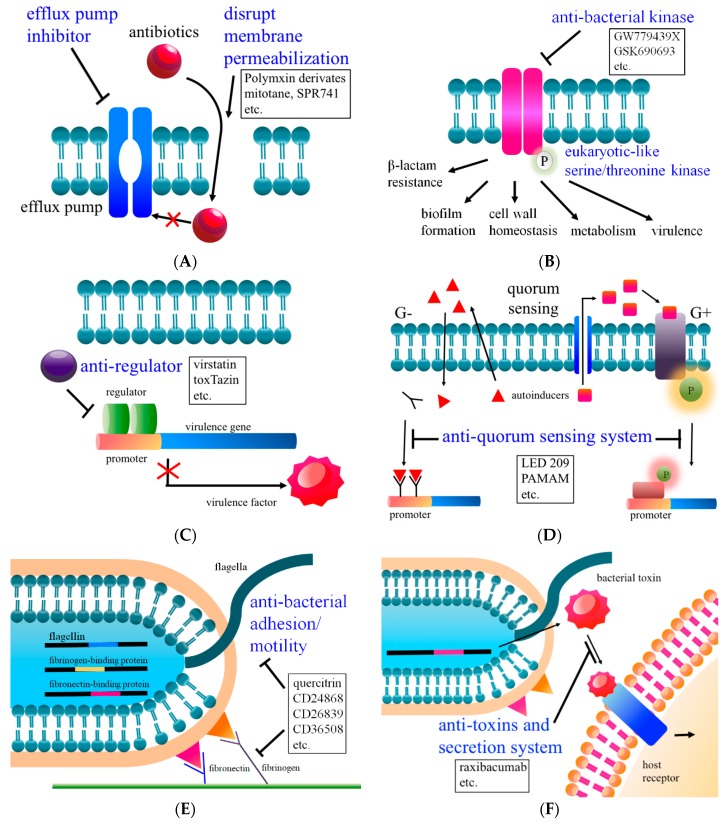
Antibiotics are one of the greatest medical advances of the 20th century, however, they are quickly becoming useless due to antibiotic resistance that has been augmented by poor antibiotic stewardship and a void in novel antibiotic discovery. Few novel classes of antibiotics have been discovered since 1960, and the pipeline of antibiotics under development is limited. We therefore are heading for a post-antibiotic era in which common infections become untreatable and once again deadly. There is thus an emergent need for both novel classes of antibiotics and novel approaches to treatment, including the repurposing of existing drugs or preclinical compounds and expanded implementation of combination therapies. In this review, we highlight to utilize alternative drug targets/therapies such as combinational therapy, anti-regulator, anti-signal transduction, anti-virulence, anti-toxin, engineered bacteriophages, and microbiome, to defeat antibiotic-resistant bacteria.
抗生素是 20 世纪最伟大的医学进步之一,但由于抗生素管理不善和新型抗生素发现的空白,导致抗生素耐药性迅速增加,抗生素正变得越来越无效。自 1960 年以来,几乎没有发现新的抗生素类别,而且正在开发的抗生素管道有限。因此,我们正走向一个后抗生素时代,在这个时代,普通感染变得无法治疗,再次变得致命。因此,我们迫切需要新型抗生素和新的治疗方法,包括重新利用现有药物或临床前化合物以及扩大联合治疗的实施。在这篇综述中,我们强调利用替代药物靶点/疗法,如联合治疗、反调节剂、反信号转导、抗毒力、抗毒素、工程噬菌体和微生物组,来对抗抗药性细菌。