Department of Psychiatry, University of Toronto, Toronto, Ontario, M5T 1R8, Canada.
Institute for Health Policy, Management and Evaluation, University of Toronto, Toronto, Ontario, M5T 3M6, Canada.
BMC Psychiatry. 2020 Feb 7;20(1):54. doi: 10.1186/s12888-020-2478-8.
Decisions about antidepressant use in pregnancy are complex. Little is known about how pregnancy-planning and already pregnant women making these decisions differ.
In 95 Canadian women having difficulty deciding whether to take antidepressants in pregnancy, we compared sociodemographic factors, clinical characteristics, and treatment intent between women planning pregnancy (preconception women) and currently-pregnant women.
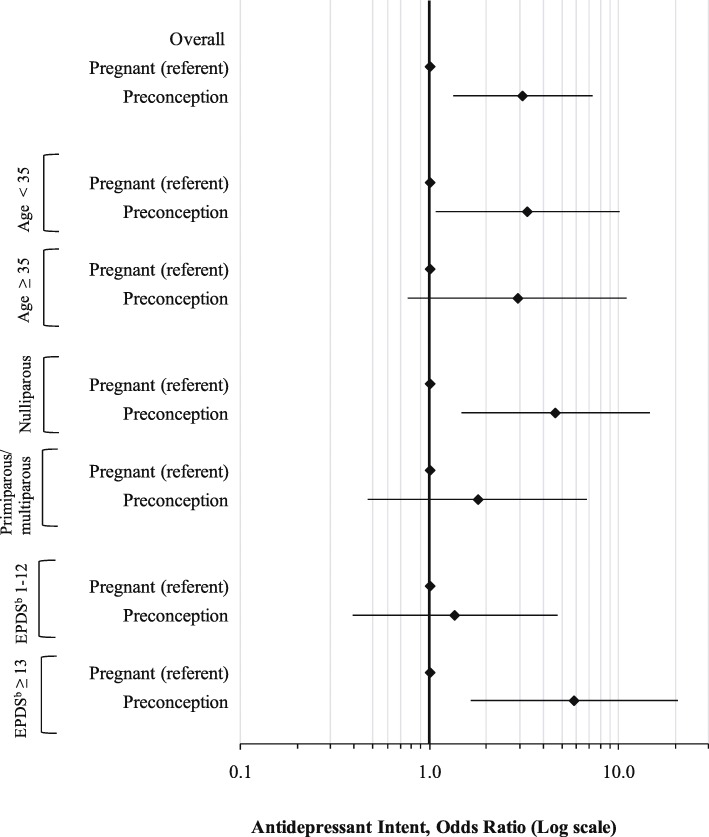
About 90% of preconception women (n = 55) were married or cohabitating and university-educated, and over 60% had an annual income of > 80,000 CAD/year; this was not different from currently-pregnant women (n = 40). Almost all women had previously used antidepressants, but preconception women were more likely to report current use (85.5% vs. 45.0%). They were more likely to have high decisional conflict (83.6% vs. 60.0%) and less likely to be under the care of a psychiatrist (29.1% vs. 52.5%). Preconception women were more likely than pregnant women to report the intent to use antidepressants (60% vs. 32.5%, odds ratio 3.11, 95% confidence interval 1.33-7.32); this was partially explained by between-group differences in current antidepressant use.
Preconception women were more likely than pregnant women to intend to use antidepressants in pregnancy, in part because more of them were already using this treatment. Strategies to enhance support for decision-making about antidepressant medication use in pregnancy may need to be tailored differently for pregnancy-planning and already pregnant women.
在怀孕期间使用抗抑郁药的决策是复杂的。对于计划怀孕和已经怀孕的女性在做出这些决策时的差异,我们知之甚少。
在 95 名加拿大女性中,她们在怀孕期间是否决定服用抗抑郁药存在困难,我们比较了计划怀孕(备孕女性)和当前怀孕女性的社会人口统计学因素、临床特征和治疗意向。
约 90%的备孕女性(n=55)已婚或同居,受过大学教育,超过 60%的人年收入>80000 加元/年;这与当前怀孕的女性(n=40)没有区别。几乎所有的女性之前都使用过抗抑郁药,但备孕女性更有可能报告目前正在使用(85.5% vs. 45.0%)。她们更有可能报告有较高的决策冲突(83.6% vs. 60.0%),较少的人在精神科医生的照顾下(29.1% vs. 52.5%)。备孕女性比孕妇更有可能报告打算在怀孕期间使用抗抑郁药(60% vs. 32.5%,优势比 3.11,95%置信区间 1.33-7.32);这在一定程度上可以解释为两组之间目前抗抑郁药使用的差异。
备孕女性比孕妇更有可能在怀孕期间打算使用抗抑郁药,部分原因是她们中有更多的人已经在使用这种治疗方法。为了增强关于在怀孕期间使用抗抑郁药物的决策支持,可能需要针对计划怀孕和已经怀孕的女性制定不同的策略。