Department of Spine Surgery, Xiangya Hospital, Central South University, 87#Xiangya Road, Changsha, 410008, Hunan, People's Republic of China.
Hunan Engineering Laboratory of Advanced Artificial Osteo-materials, Xiangya Hospital, Central South University, 87#Xiangya Road, Changsha, 410008, Hunan, People's Republic of China.
BMC Musculoskelet Disord. 2020 Feb 7;21(1):86. doi: 10.1186/s12891-020-3115-x.
To compare the clinical and radiological outcomes between posterior mono-segment and short-segment fixation combined with one-stage posterior debridement and bone grafting fusion in treating single-segment lumbar spinal tuberculosis (LSTB).
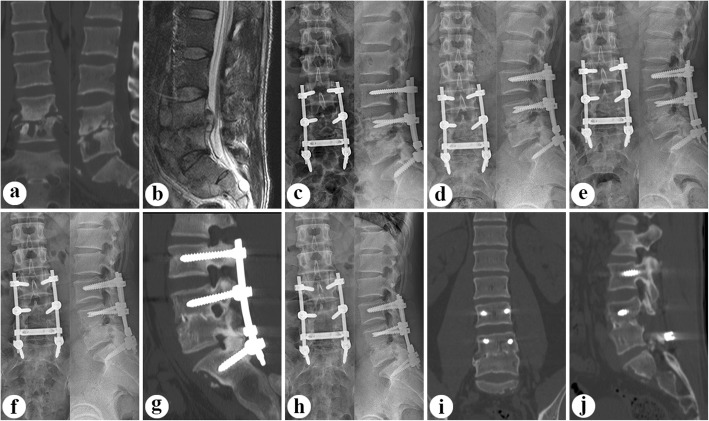
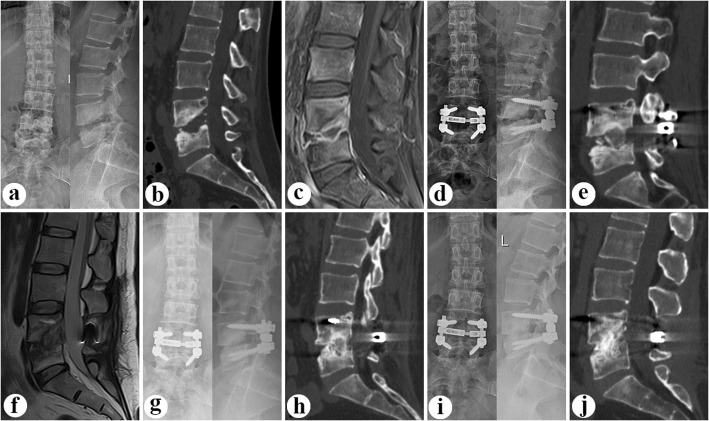
Sixty-two patients with single-segment LSTB treated by a posterior-only approach were divided into two groups: short-segment fixation (Group A, n = 32) and mono-segment fixation (Group B, n = 30). The clinical and radiographic outcomes were analyzed and compared between the two groups.
The intraoperative bleeding volume, operation time, and hospitalization duration were lower in Group B than in Group A. All patients achieved the bony fusion criteria. The visual analog scale score, Japanese Orthopedic Association score, and Oswestry Disability Index were substantially improved 3 months postoperatively and at the last visit in both groups, with no significant difference between the two groups (P > 0.05). Kirkaldy-Willis functional evaluation at the final follow-up demonstrated that all patients in both groups achieved excellent or good results. The difference in the angle correction rate and correction loss between Groups A and B was not significant (P > 0.05).
One-stage posterior debridement, bone grafting fusion, and mono-segment or short-segment fixation can provide satisfactory clinical and radiological outcomes. Mono-segment fixation is more suitable for the treatment of single-segment LSTB because the lumbar segments with normal motion can be preserved with less trauma, a shorter operation time, shorter hospitalization, and lower costs.
比较后路单节段与短节段固定结合一期后路清创植骨融合治疗单节段腰椎脊柱结核(LSTB)的临床和影像学结果。
62 例采用后路单纯手术治疗的单节段 LSTB 患者分为两组:短节段固定组(A 组,n=32)和单节段固定组(B 组,n=30)。分析比较两组患者的临床和影像学结果。
B 组术中出血量、手术时间和住院时间均低于 A 组。所有患者均达到骨性融合标准。两组术后 3 个月及末次随访时视觉模拟评分、日本矫形协会评分和 Oswestry 功能障碍指数均明显改善,两组间无统计学差异(P>0.05)。末次随访时,Kirkaldy-Willis 功能评估显示两组患者均取得了优秀或良好的结果。A、B 两组间角度矫正率和矫正丢失的差异无统计学意义(P>0.05)。
一期后路清创、植骨融合与单节段或短节段固定均可获得满意的临床和影像学结果。单节段固定更适合治疗单节段 LSTB,因为可以保留正常运动的腰椎节段,创伤更小、手术时间更短、住院时间更短、费用更低。