Division of Pulmonary and Critical Care Medicine, Department of Internal Medicine, National Taiwan University Hospital Yunlin Branch, Douliu, Taiwan.
Institute of Occupational Medicine and Industrial Hygiene, National Taiwan University College of Public Health, Taipei, Taiwan.
Respir Res. 2020 Feb 7;21(1):45. doi: 10.1186/s12931-020-1285-6.
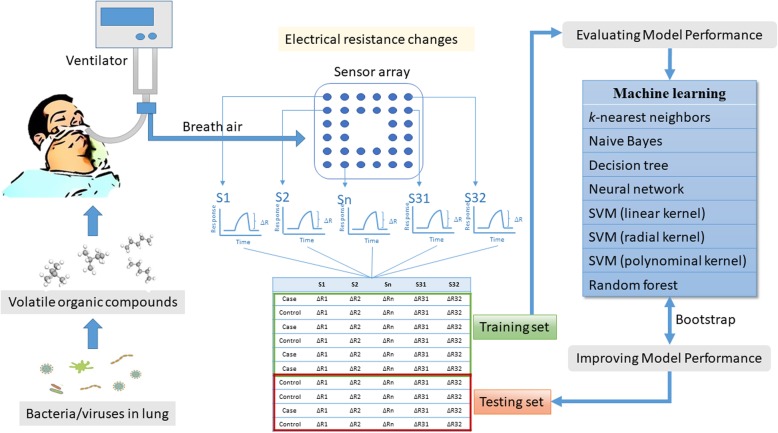
Ventilator-associated pneumonia (VAP) is a significant cause of mortality in the intensive care unit. Early diagnosis of VAP is important to provide appropriate treatment and reduce mortality. Developing a noninvasive and highly accurate diagnostic method is important. The invention of electronic sensors has been applied to analyze the volatile organic compounds in breath to detect VAP using a machine learning technique. However, the process of building an algorithm is usually unclear and prevents physicians from applying the artificial intelligence technique in clinical practice. Clear processes of model building and assessing accuracy are warranted. The objective of this study was to develop a breath test for VAP with a standardized protocol for a machine learning technique.
We conducted a case-control study. This study enrolled subjects in an intensive care unit of a hospital in southern Taiwan from February 2017 to June 2019. We recruited patients with VAP as the case group and ventilated patients without pneumonia as the control group. We collected exhaled breath and analyzed the electric resistance changes of 32 sensor arrays of an electronic nose. We split the data into a set for training algorithms and a set for testing. We applied eight machine learning algorithms to build prediction models, improving model performance and providing an estimated diagnostic accuracy.
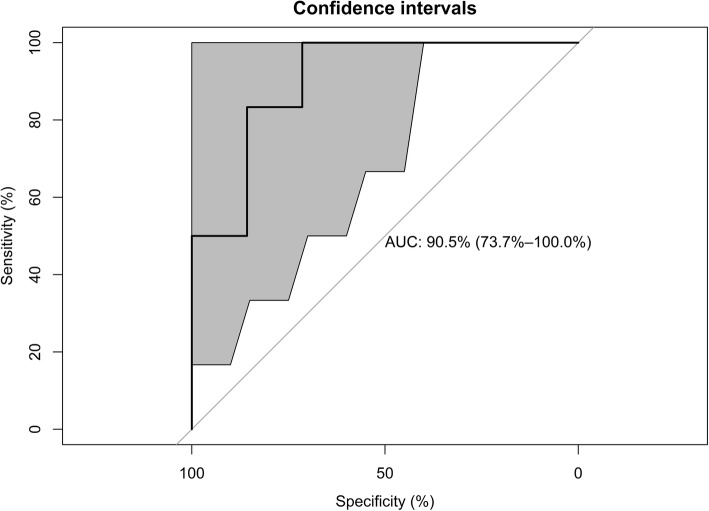
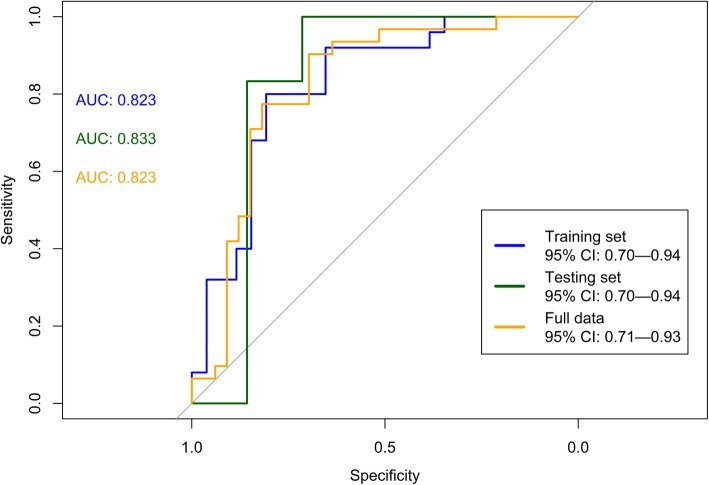
A total of 33 cases and 26 controls were used in the final analysis. Using eight machine learning algorithms, the mean accuracy in the testing set was 0.81 ± 0.04, the sensitivity was 0.79 ± 0.08, the specificity was 0.83 ± 0.00, the positive predictive value was 0.85 ± 0.02, the negative predictive value was 0.77 ± 0.06, and the area under the receiver operator characteristic curves was 0.85 ± 0.04. The mean kappa value in the testing set was 0.62 ± 0.08, which suggested good agreement.
There was good accuracy in detecting VAP by sensor array and machine learning techniques. Artificial intelligence has the potential to assist the physician in making a clinical diagnosis. Clear protocols for data processing and the modeling procedure needed to increase generalizability.
呼吸机相关性肺炎(VAP)是重症监护病房患者死亡的重要原因。早期诊断 VAP 对于提供适当的治疗和降低死亡率非常重要。开发一种非侵入性且高度准确的诊断方法很重要。电子传感器的发明已被应用于分析呼吸中的挥发性有机化合物,以使用机器学习技术检测 VAP。然而,构建算法的过程通常不明确,这使得医生无法将人工智能技术应用于临床实践。需要制定明确的模型构建和评估准确性的流程。本研究的目的是开发一种使用机器学习技术的 VAP 呼吸测试,并制定标准化协议。
我们进行了一项病例对照研究。这项研究纳入了台湾南部一家医院重症监护病房的患者,时间为 2017 年 2 月至 2019 年 6 月。我们招募了患有 VAP 的患者作为病例组,以及没有肺炎的呼吸机通气患者作为对照组。我们收集呼气并分析电子鼻 32 个传感器阵列的电阻变化。我们将数据分为一组用于训练算法,一组用于测试。我们应用了八种机器学习算法来构建预测模型,以提高模型性能并提供估计的诊断准确性。
最终分析共纳入 33 例病例和 26 例对照。使用八种机器学习算法,测试集中的平均准确率为 0.81±0.04,灵敏度为 0.79±0.08,特异性为 0.83±0.00,阳性预测值为 0.85±0.02,阴性预测值为 0.77±0.06,受试者工作特征曲线下面积为 0.85±0.04。测试集中的平均 Kappa 值为 0.62±0.08,表明一致性良好。
通过传感器阵列和机器学习技术检测 VAP 具有较好的准确性。人工智能有可能协助医生进行临床诊断。需要制定明确的数据处理和建模流程协议,以提高通用性。