Department of Biochemistry, Adam Mickiewicz University in Poznan, Uniwersytet Poznanski 6 Street, 61-614, Poznan, Poland.
Laboratory of Genome Biology, Adam Mickiewicz University in Poznan, Uniwersytet Poznanski 6 Street, 61-614, Poznan, Poland.
Environ Sci Pollut Res Int. 2020 Apr;27(12):13809-13825. doi: 10.1007/s11356-020-07885-3. Epub 2020 Feb 8.
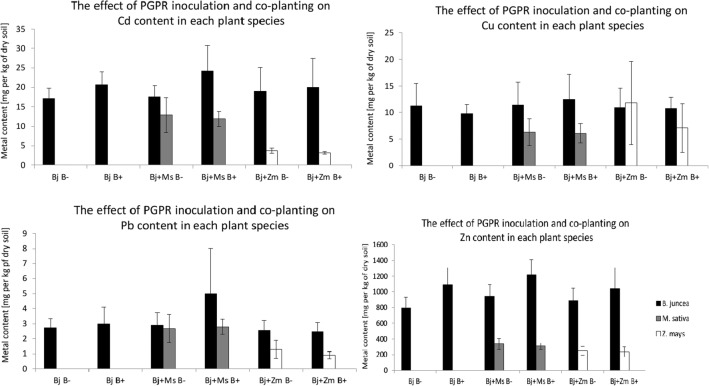
Biomass production and metal accumulation in plant tissue (bioconcentration) are two critical factors limiting the phytoextraction rate. Metal translocation to aboveground organs should be accounted for as the third most important factor, as harvesting of the plant roots is usually economically disadvantageous. These three parameters could be potentially increased with the use of companion planting, a well-known agricultural technique, and inoculation with plant growth-promoting bacteria (PGPB). The aim of the study was to determine whether intercropping and inoculation with endophytic PGPB (Burkholderia phytofirmans PsJN) can increase the efficiency of phytoextraction of Zn, Pb, and Cd. The study was conducted on Brassica juncea (L.) Czern. "Małopolska" grown in a monoculture or co-planted with Zea mays L. "Codimon" and Medicago sativa L. "Sanditi." Results show that companion planting and inoculation with rhizobacteria can increase the efficiency of metal phytoextraction, mainly by increasing the yield of dry biomass and the survival rate of plants grown on contaminated soil. We have shown that the simultaneous planting of B. juncea with M. sativa and inoculation with PGPB were the most efficient variants of assisted phytoextraction reaching a recovery of 95% Zn, 90% Cd, and on average about 160% Pb compared with control B. juncea plants grown in monoculture.
生物量的生产和金属在植物组织中的积累(生物浓缩)是限制植物提取率的两个关键因素。金属向地上器官的转移应被视为第三个最重要的因素,因为收获植物根系在经济上通常是不利的。这三个参数可以通过间作(一种众所周知的农业技术)和接种植物生长促进细菌(PGPB)来潜在增加。本研究的目的是确定间作和接种内生 PGPB(Burkholderia phytofirmans PsJN)是否可以提高 Zn、Pb 和 Cd 的植物提取效率。该研究在 Brassica juncea(L.)Czern. "Małopolska" 单作或与 Zea mays L. "Codimon" 和 Medicago sativa L. "Sanditi" 混作的条件下进行。结果表明,间作和接种根际细菌可以提高金属植物提取的效率,主要是通过增加污染土壤上生长的植物的生物量和存活率来实现。我们已经表明,B. juncea 与 M. sativa 同时种植并接种 PGPB 是辅助植物提取的最有效变体,与单作 B. juncea 植物相比,Zn 的回收率达到 95%,Cd 达到 90%,Pb 的平均回收率约为 160%。