Department of Veterinary Clinical Sciences, Washington State University, Pullman, Washington.
Department of Biomedical and Diagnostic Sciences, University of Tennessee, Knoxville, Tennessee.
J Vet Intern Med. 2020 Mar;34(2):933-940. doi: 10.1111/jvim.15724. Epub 2020 Feb 8.
In humans, gabapentin an analgesic, undergoes non-proportional pharmacokinetics which can alter efficacy. No information exists on the pharmacokinetics of dosages >20 mg/kg, escalating dosages or dose proportionality of gabapentin in horses.
Gabapentin exposure in plasma would not increase proportionally relative to the dose in horses receiving dosages ≥20 mg/kg. To assess the plasma pharmacokinetics of gabapentin after nasogastric administration of gabapentin at dosages of 10 to 160 mg/kg in adult horses.
Nine clinically healthy adult Arabian and Quarter Horses.
In a randomized blinded trial, gabapentin was administered by nasogastric intubation to horses at 10, 20 mg/kg (n = 3) and 60, 80, 120, 160 mg/kg (n = 6). Plasma was collected before and at regular times over 64 hours after administration of gabapentin. Gabapentin was quantified using a validated chromatographic method. Dose proportionality was estimated using a power model. Pharmacokinetic parameters were estimated using compartmental pharmacokinetic analysis.
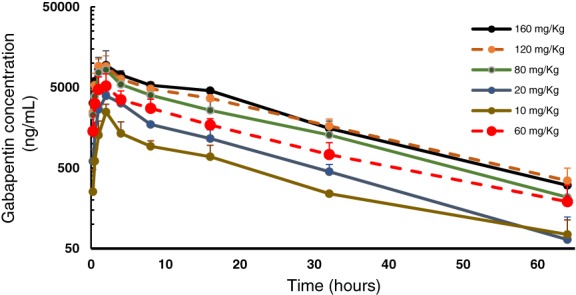
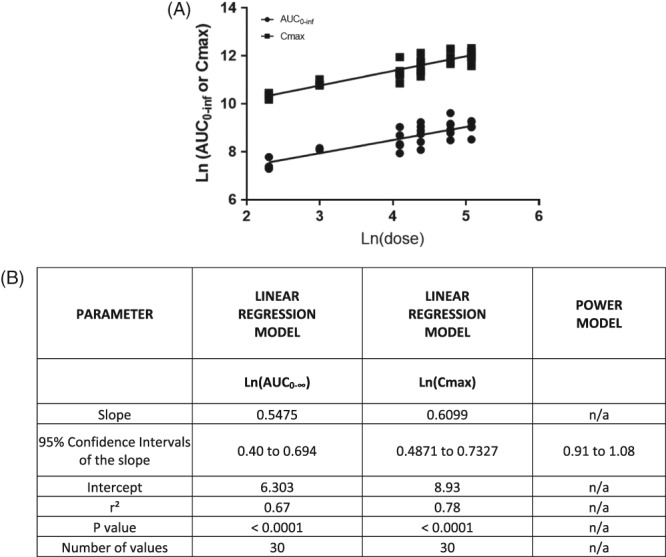
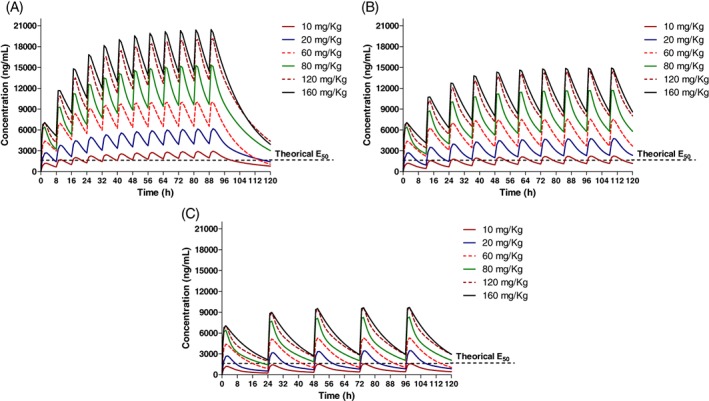
Plasma pharmacokinetics parameters of gabapentin were estimated after nasogastric administration at dosages of 10 to 160 mg/kg. Gabapentin plasma concentration increased with dose increments. However, the area under the concentration curve from zero to infinity and maximal plasma concentration did not increase proportionally relative to the dose in horses.
Gabapentin exposure in plasma is not proportional relative to the dose in horses receiving nasogastric dosages of 10 to 160 mg/kg.
在人类中,作为一种镇痛药的加巴喷丁呈现非比例药代动力学,这可能会改变其疗效。目前尚无关于马给予 20mg/kg 以上剂量、逐步增加剂量或加巴喷丁剂量比例性的药代动力学信息。
给予 20mg/kg 以上剂量的马,其血浆中加巴喷丁的暴露量不会与剂量成比例增加。评估马经鼻胃管给予 10 至 160mg/kg 剂量的加巴喷丁后的血浆药代动力学。
9 匹临床健康的成年阿拉伯马和夸特马。
在一项随机、双盲试验中,通过鼻胃管给予马 10、20mg/kg(n=3)和 60、80、120、160mg/kg(n=6)剂量的加巴喷丁。在给予加巴喷丁前和给药后 64 小时内的定期时间采集血浆。使用经过验证的色谱方法定量加巴喷丁。使用幂模型估计剂量比例性。使用房室药代动力学分析估算药代动力学参数。
在 10 至 160mg/kg 剂量经鼻胃管给予后,估算了加巴喷丁的血浆药代动力学参数。加巴喷丁的血浆浓度随剂量增加而增加。然而,在马中,从零到无穷大的浓度曲线下面积和最大血浆浓度与剂量不成比例增加。
在接受 10 至 160mg/kg 经鼻胃管给予剂量的马中,血浆中加巴喷丁的暴露量与剂量不成比例。