Department of Gastroenterology, Hepatology and Infectious Diseases, University Hospital Magdeburg, Magdeburg, Germany.
Department of Gastroenterology and Internal Medicine, KKH Prignitz, Perleberg, Germany.
J Int Assoc Provid AIDS Care. 2020 Jan-Dec;19:2325958219900713. doi: 10.1177/2325958219900713.
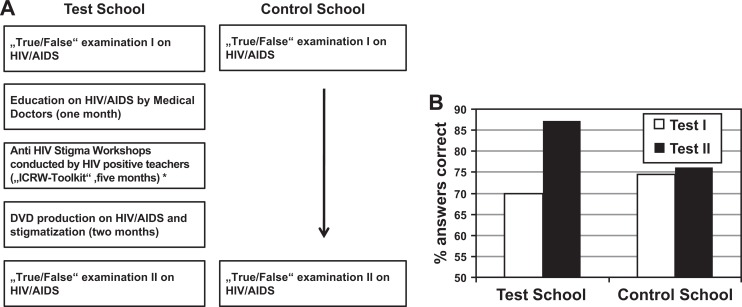
The universal access to treatment and care for people living with HIV (PLWHIV) is still a major problem, especially in sub-Saharan Africa, where 70% of HIV-infected people live. Equally important is the fact that HIV/AIDS-related stigma is recognized to be a major obstacle to successfully control the spread of this disease. We devised a pilot project (titled "My friend with HIV remains a friend") to fight the HIV/AIDS stigmatization through educating secondary school students by openly HIV-positive teachers. In a first step, we have measured the amount and type of stigma felt by the PLWHIV in Buea/Cameroon using the "The people living with HIV Stigma Index" from Joint United Nations Programme on HIV/AIDS. Gossiping and verbal insults were experienced by 90% of the interviewees, while 9% have experienced physical assaults. Using these data and material from the "Toolkit for action" from the "International Centre for the Research on Women," the teachers educated the students on multiple aspects of HIV/AIDS and stigma. The teaching curriculum included role-plays, picture visualizations, drawing, and other forms of interactions like visits to HIV and AIDS treatment units. Before and after this intervention, the students undertook "True/False" examinations on HIV/AIDS and stigma. We compared these results with results from students from another school, who did not participate in this intervention. We were able to show that the students taking part in the intervention improved by almost 20% points in comparison to the other students. Their results did not change.
普遍获得艾滋病毒感染者(PLHIV)的治疗和护理仍然是一个主要问题,特别是在撒哈拉以南非洲,那里有 70%的艾滋病毒感染者生活。同样重要的是,艾滋病毒/艾滋病相关耻辱感被认为是成功控制这种疾病传播的主要障碍。我们设计了一个试点项目(名为“我与 HIV 感染者的朋友仍然是朋友”),通过让公开的 HIV 阳性教师教育中学生来消除对艾滋病毒/艾滋病的污名化。在第一步中,我们使用联合国艾滋病规划署的“艾滋病毒感染者耻辱指数”来衡量喀麦隆布埃亚的 PLHIV 感受到的耻辱程度和类型。90%的受访者经历过八卦和言语侮辱,而 9%的受访者经历过身体攻击。利用这些数据和来自“国际妇女研究中心”的“行动工具包”中的材料,教师们就艾滋病毒/艾滋病和耻辱的多个方面对学生进行了教育。教学课程包括角色扮演、图片可视化、绘画以及其他形式的互动,如参观艾滋病毒和艾滋病治疗单位。在干预之前和之后,学生们对艾滋病毒/艾滋病和耻辱进行了“真假”考试。我们将这些结果与另一所没有参与该干预的学校的学生的结果进行了比较。我们能够表明,参与干预的学生与其他学生相比,提高了近 20 个百分点。他们的结果没有改变。