Shim Su-Hyeon, Lee Sang-Kyu, Lee Dae-Woo, Brilhaus Dominik, Wu Guangxi, Ko Sooyeon, Lee Choon-Hwan, Weber Andreas P M, Jeon Jong-Seong
Graduate School of Biotechnology and Crop Biotech Institute, Kyung Hee University, Yongin, South Korea.
Institute of Plant Biochemistry, Cluster of Excellence on Plant Sciences, Heinrich Heine University, Düsseldorf, Germany.
Front Plant Sci. 2020 Jan 24;10:1726. doi: 10.3389/fpls.2019.01726. eCollection 2019.
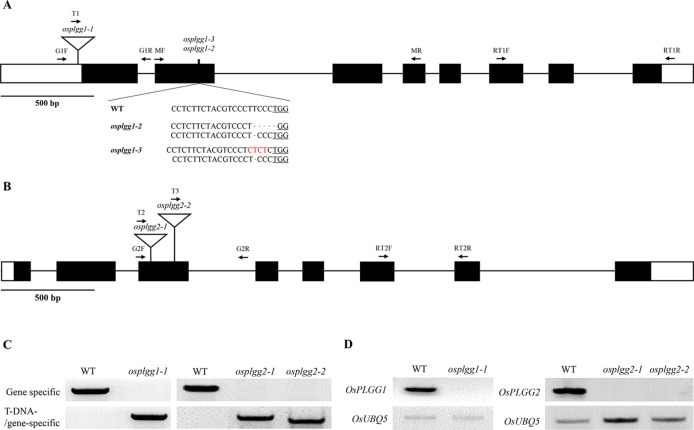
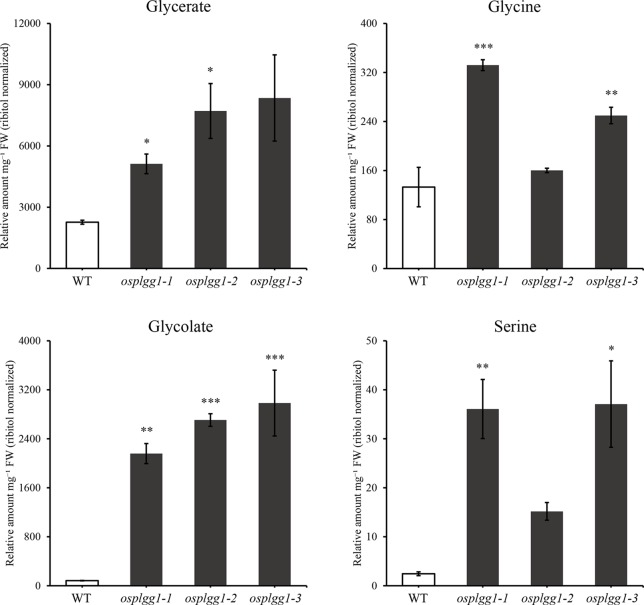
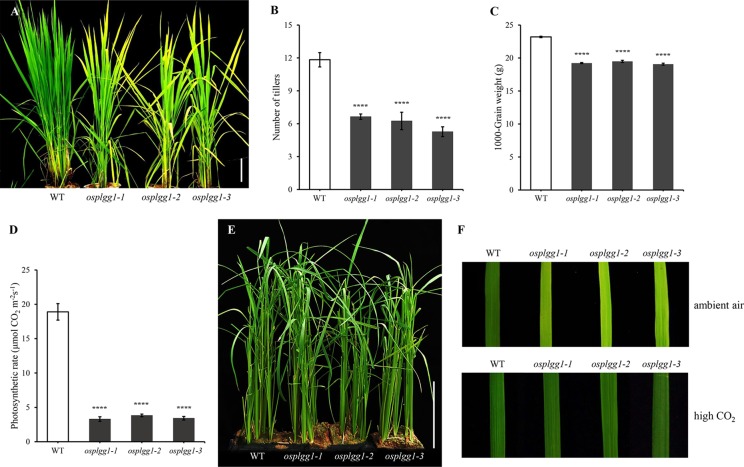
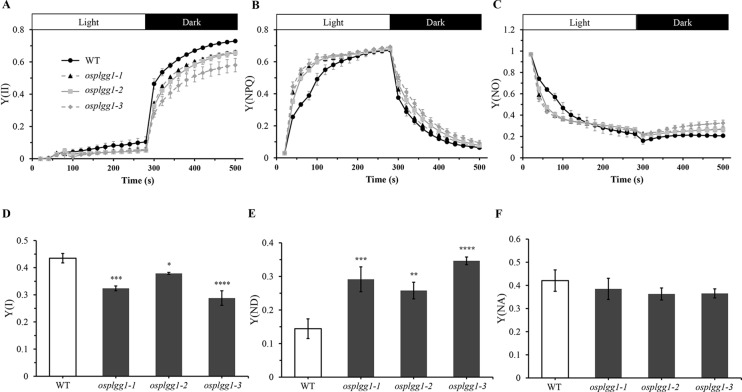
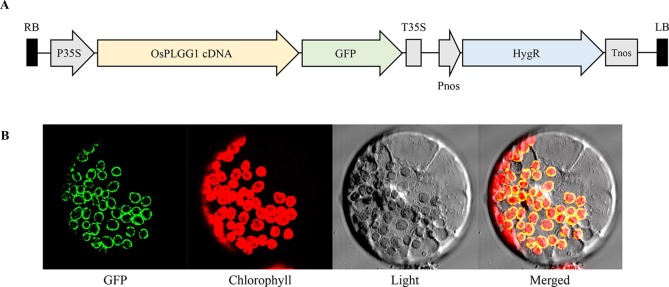
Ribulose-1,5-bisphosphate carboxylase/oxygenase, the key enzyme of photosynthetic carbon fixation, is able to accept both O and CO as substrates. When it fixes O, it produces 2-phosphoglycolate, which is detoxified by photorespiration and recycled to the Calvin-Benson-Bassham cycle. To complete photorespiration, metabolite transport across three organelles, chloroplasts, peroxisomes, and mitochondria, is necessary through transmembrane transporters. In rice () little is known about photorespiratory transmembrane transporters. Here, we identified the rice plastidic glycolate/glycerate translocator 1 (OsPLGG1), a homolog of PLGG1. OsPLGG1 mutant lines, , , and , showed a growth retardation phenotype, such as pale green leaf, reduced tiller number, and reduced seed grain weight as well as reduced photosynthetic carbon reduction rate due to low activities of photosystem I and II. The plant growth retardation in mutants was rescued under high CO condition. Subcellular localization of OsPLGG1-GFP fusion protein, along with its predicted N-terminal transmembrane domain, confirmed that OsPLGG1 is a chloroplast transmembrane protein. Metabolite analysis indicated significant accumulation of photorespiratory metabolites, especially glycolate and glycerate, which have been shown to be transported by the PLGG1, and changes for a number of metabolites which are not intermediates of photorespiration in the mutants. These results suggest that OsPLGG1 is the functional plastidic glycolate/glycerate transporter, which is necessary for photorespiration and growth in rice.
1,5-二磷酸核酮糖羧化酶/加氧酶是光合碳固定的关键酶,它能够同时接受氧气(O₂)和二氧化碳(CO₂)作为底物。当它固定氧气时,会产生2-磷酸乙醇酸,后者通过光呼吸作用被解毒并重新进入卡尔文-本森-巴斯姆循环。为了完成光呼吸作用,代谢物需要通过跨膜转运蛋白在叶绿体、过氧化物酶体和线粒体这三种细胞器之间进行运输。在水稻中,对于光呼吸跨膜转运蛋白的了解还很少。在这里我们鉴定出了水稻质体乙醇酸/甘油酸转运体1(OsPLGG1),它是拟南芥AtPLGG1的同源物。OsPLGG1突变体株系(osplgg1-1、osplgg1-2、osplgg1-3和osplgg1-4)表现出生长迟缓的表型,如叶片淡绿、分蘖数减少、种子粒重降低,以及由于光系统I和II活性较低导致光合碳还原速率降低。在高二氧化碳条件下,osplgg1突变体的植物生长迟缓现象得到了缓解。OsPLGG1-GFP融合蛋白的亚细胞定位以及其预测的N端跨膜结构域证实,OsPLGG1是一种叶绿体跨膜蛋白。代谢物分析表明,光呼吸代谢物显著积累,尤其是乙醇酸和甘油酸,已知它们是由AtPLGG1转运的,并且突变体中许多非光呼吸中间产物的代谢物也发生了变化。这些结果表明,OsPLGG1是功能性的质体乙醇酸/甘油酸转运体,是水稻光呼吸和生长所必需的。