Beese Carsten J, Brynjólfsdóttir Sólveig H, Frankel Lisa B
Biotech Research and Innovation Centre, University of Copenhagen, Copenhagen, Denmark.
Danish Cancer Society Research Center, Copenhagen, Denmark.
Front Cell Dev Biol. 2020 Jan 21;7:373. doi: 10.3389/fcell.2019.00373. eCollection 2019.
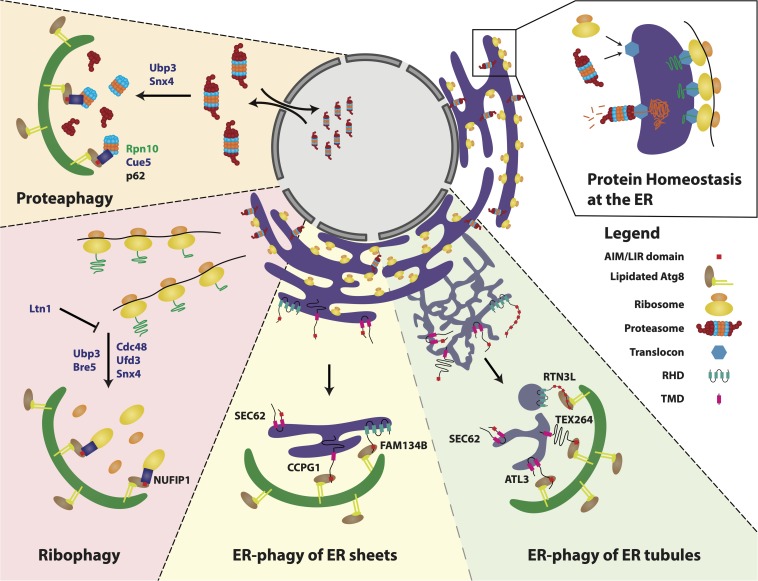
The eukaryotic cell has developed intricate machineries that monitor and maintain proteome homeostasis in order to ensure cellular functionality. This involves the carefully coordinated balance between protein synthesis and degradation pathways, which are dynamically regulated in order to meet the constantly changing demands of the cell. Ribosomes, together with the endoplasmic reticulum (ER), are the key drivers of protein synthesis, folding, maturation and sorting, while the proteasome plays a pivotal role in terminating the existence of thousands of proteins that are misfolded, damaged or otherwise obsolete. The synthesis, structure and function of these dedicated machines has been studied for decades, however, much less is understood about the mechanisms that control and execute their own turnover. Autophagy, an evolutionarily conserved catabolic pathway, mediates degradation of a large variety of cytosolic substrates, ranging from single proteins to entire organelles or multi-subunit macromolecular complexes. In this review, we focus on selective autophagy of three key components of the protein homeostasis machinery: ribosomes, ER and proteasomes, through the selective autophagy pathways of ribophagy, ER-phagy, and proteaphagy. We discuss newly discovered mechanisms for the selective clearance of these substrates, which are often stress-dependent and involve specialized signals for cargo recognition by a growing number of receptors. We further discuss the interplay between these pathways and their biological impact on key aspects of proteome homeostasis and cellular function in health and disease.
真核细胞已经发展出复杂的机制来监测和维持蛋白质组的稳态,以确保细胞的功能。这涉及蛋白质合成和降解途径之间精心协调的平衡,这些途径受到动态调节,以满足细胞不断变化的需求。核糖体与内质网(ER)一起,是蛋白质合成、折叠、成熟和分选的关键驱动因素,而蛋白酶体在终止数千种错误折叠、受损或以其他方式过时的蛋白质的存在方面发挥着关键作用。这些专门机器的合成、结构和功能已经研究了几十年,然而,对于控制和执行它们自身周转的机制却了解得少得多。自噬是一种进化上保守的分解代谢途径,介导多种胞质底物的降解,范围从单个蛋白质到整个细胞器或多亚基大分子复合物。在这篇综述中,我们通过核糖体自噬、内质网自噬和蛋白酶体自噬等选择性自噬途径,聚焦于蛋白质稳态机制的三个关键组成部分:核糖体、内质网和蛋白酶体的选择性自噬。我们讨论了这些底物选择性清除的新发现机制,这些机制通常依赖于应激,并且涉及越来越多的受体用于货物识别的专门信号。我们进一步讨论了这些途径之间的相互作用及其对蛋白质组稳态和健康与疾病中细胞功能关键方面的生物学影响。