Telethon Institute of Genetics and Medicine (TIGEM), Pozzuoli (NA), Italy.
Telethon Institute of Genetics and Medicine (TIGEM), Pozzuoli (NA), Italy.
Exp Cell Res. 2020 Nov 1;396(1):112276. doi: 10.1016/j.yexcr.2020.112276. Epub 2020 Sep 9.
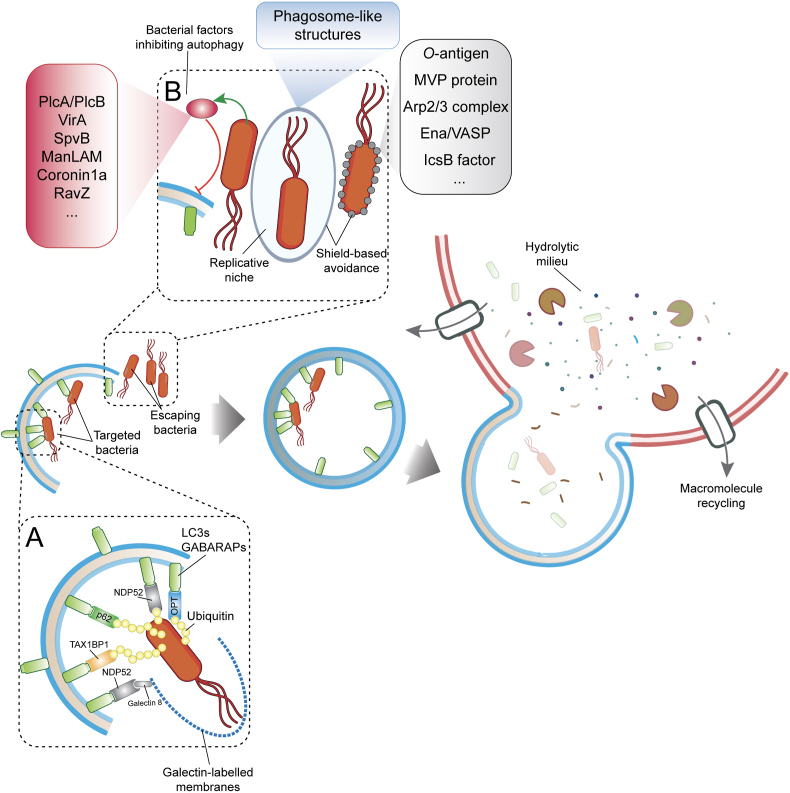
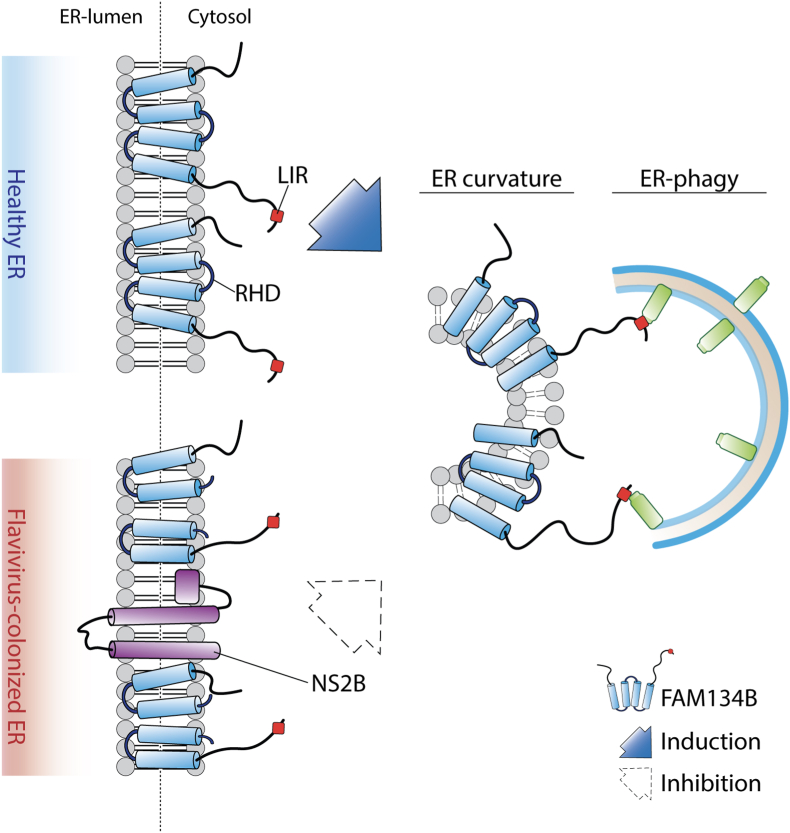
Autophagy is an evolutionary conserved catabolic process devoted to the removal of unnecessary and harmful cellular components. In its general form, autophagy governs cellular lifecycle through the formation of double membrane vesicles, termed autophagosomes, that enwrap and deliver unwanted intracellular components to lysosomes. In addition to this omniscient role, forms of selective autophagy, relying on specialized receptors for cargo recognition, exert fine-tuned control over cellular homeostasis. In this regard, xenophagy plays a pivotal role in restricting the replication of intracellular pathogens, thus acting as an ancient innate defense system against infections. Recently, selective autophagy of the endoplasmic reticulum (ER), more simply ER-phagy, has been uncovered as a critical mechanism governing ER network shape and function. Six ER-resident proteins have been characterized as ER-phagy receptors and their orchestrated function enables ER homeostasis and turnover overtime. Unfortunately, ER is also the preferred site for viral replication and several viruses hijack ER machinery for their needs. Thus, it is not surprising that some ER-phagy receptors can act to counteract viral replication and minimize the spread of infection throughout the organism. On the other hand, evolutionary pressure has armed pathogens with strategies to evade and subvert xenophagy and ER-phagy. Although ER-phagy biology is still in its infancy, the present review aims to summarize recent ER-phagy literature, with a special focus on its role in counteracting viral infections. Moreover, we aim to offer some hints for future targeted approaches to counteract host-pathogen interactions by modulating xenophagy and ER-phagy pathways.
自噬是一种进化上保守的分解代谢过程,专门用于清除不必要和有害的细胞成分。在其一般形式中,自噬通过形成双膜囊泡(称为自噬体)来控制细胞生命周期,自噬体包裹并将不需要的细胞内成分递送至溶酶体。除了这种无所不知的作用外,依赖于货物识别的专用受体的选择性自噬形式,对细胞内稳态进行微调控制。在这方面,异噬在限制细胞内病原体的复制中起着关键作用,因此是一种古老的先天防御系统,可抵抗感染。最近,内质网(ER)的选择性自噬,更简单地称为 ER 自噬,已被发现是一种控制 ER 网络形状和功能的关键机制。已经鉴定了六种内质网驻留蛋白作为 ER 自噬受体,它们的协调功能使 ER 保持平衡并随着时间的推移进行周转。不幸的是,ER 也是病毒复制的首选部位,并且几种病毒劫持 ER 机制来满足其需求。因此,一些 ER 自噬受体可以抵抗病毒复制并最大程度地减少感染在整个生物体中的传播,这并不奇怪。另一方面,进化压力使病原体具备了逃避和颠覆异噬和 ER 自噬的策略。尽管 ER 自噬生物学仍处于起步阶段,但本综述旨在总结最近的 ER 自噬文献,特别关注其在抵抗病毒感染中的作用。此外,我们旨在为通过调节异噬和 ER 自噬途径来对抗宿主-病原体相互作用提供一些未来的靶向方法的提示。