Elshorbagy Mahmoud H, López-Fraguas Eduardo, Chaudhry Fateh A, Sánchez-Pena José Manuel, Vergaz Ricardo, García-Cámara Braulio
GDAF-UC3M, Department Tecnología Electrónica, Universidad Carlos III de Madrid. Avda. Universidad, 30. Leganés, Madrid, Spain.
Physics Department, Faculty of Science, Minia University, 61519, El-Minya, Egypt.
Sci Rep. 2020 Feb 10;10(1):2271. doi: 10.1038/s41598-020-58978-5.
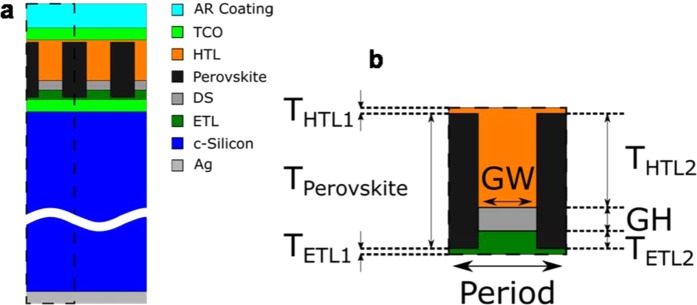
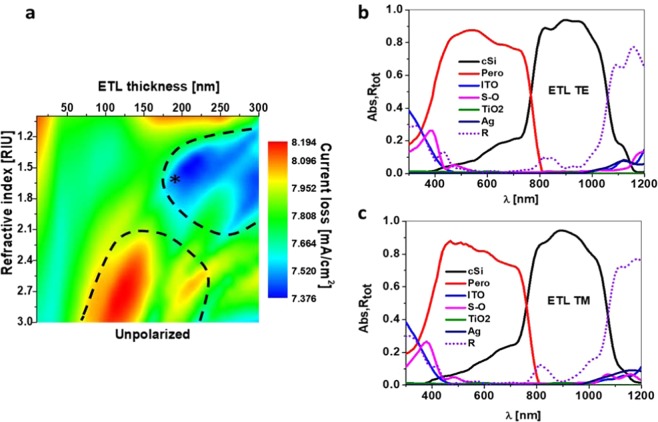
The use of several layers of different materials, taking advantage of their complementary bandgap energies, improves the absorption in multi-junction solar cells. Unfortunately, the inherent efficiency increment of this strategy has a limitation: each interface introduces optical losses. In this paper, we study the effects of materials and geometry in the optical performance of a nanostructured hybrid perovskite - silicon tandem solar cell. Our proposed design increases the performance of both subcells by managing light towards the active layer, as well as by minimizing reflections losses in the interfaces. We sweep both refractive index and thickness of the transport layers and the dielectric spacer composing the metasurface, obtaining a range of these parameters for the proper operation of the device. Using these values, we obtain a reduction in the optical losses, in particular they are more than a 33% lower than those of a planar cell, mainly due to a reduction of the reflectivity in the device. This approach leads to an enhancement in the optical response, widens the possibilities for the manufacturers to use different materials, and allows wide geometrical tolerances.
利用不同材料的互补带隙能量使用多层材料,可提高多结太阳能电池的吸收率。不幸的是,这种策略固有的效率提升存在一个限制:每个界面都会引入光学损耗。在本文中,我们研究了材料和几何结构对纳米结构混合钙钛矿-硅串联太阳能电池光学性能的影响。我们提出的设计通过将光导向有源层以及最小化界面处的反射损耗来提高两个子电池的性能。我们扫描了构成超表面的传输层和介电间隔层的折射率和厚度,获得了一系列用于器件正常运行的这些参数。使用这些值,我们降低了光学损耗,特别是它们比平面电池的光学损耗低33%以上,这主要是由于器件反射率的降低。这种方法导致光学响应增强,拓宽了制造商使用不同材料的可能性,并允许较大的几何公差。