Department of Disease Control, London School of Hygiene and Tropical Medicine, London, United Kingdom.
Clinical Research Department, London School of Hygiene and Tropical Medicine, London, United Kingdom.
Am J Trop Med Hyg. 2020 Apr;102(4):740-743. doi: 10.4269/ajtmh.19-0726.
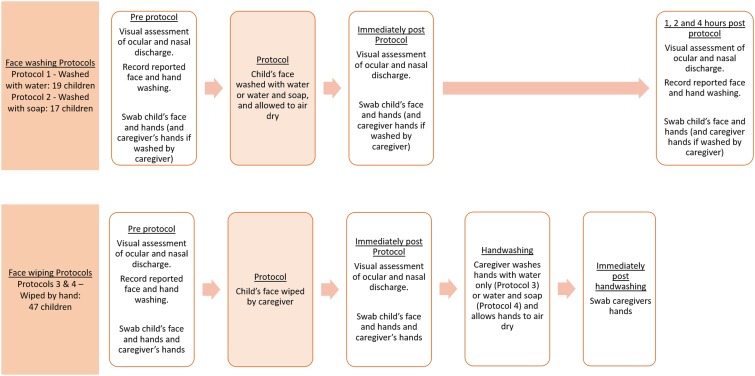
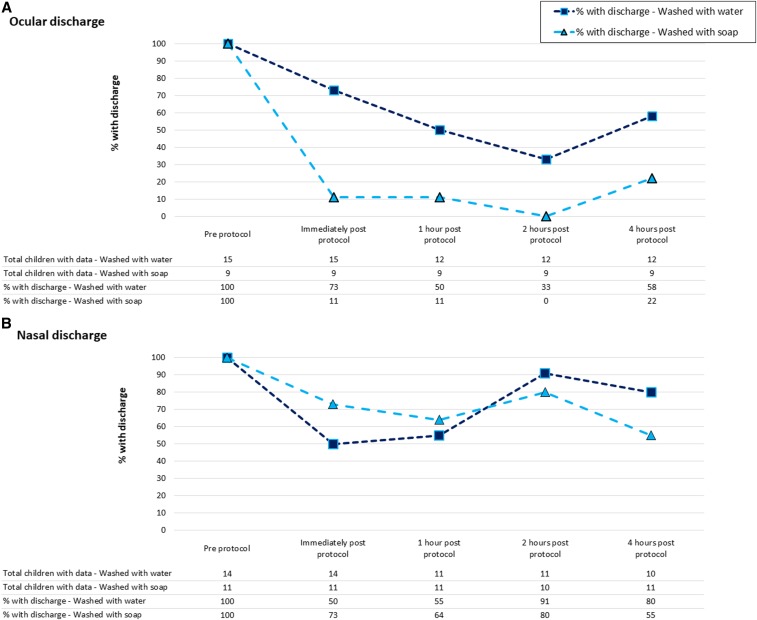
Eye-to-eye transmission of , the causative agent of trachoma, may be plausibly interrupted if faces are kept free of ocular and nasal discharge. Between April and June 2018, 83 children aged 1-9 years with active trachoma were recruited from 62 households and allocated to a face cleaning protocol: face washing with water, face washing with water and soap, or face wiping. Faces were examined for the presence of ocular and nasal discharge, and swabs were taken from faces and hands to test for at baseline, immediately post protocol, and after 1, 2, and 4 hours (washing protocols). Washing with soap was more effective at removing ocular discharge than either washing with water (89% and 27% of discharge removed, respectively, = 0.003) or wiping with a hand (42%, = 0.013). The reduction in prevalence of ocular discharge was sustained for at least four hours. The prevalence of on face swabs was reduced by all washing protocols. The importance of soap should not be overlooked during facial cleanliness promotion.
如果保持面部没有眼部分泌物和鼻分泌物,沙眼病原体可能会通过眼神接触传播,这是合理的。2018 年 4 月至 6 月,从 62 户家庭中招募了 83 名 1-9 岁患有活动性沙眼的儿童,并分配到面部清洁方案:用水洗脸、用水和肥皂洗脸或用手擦拭。检查面部是否有眼部分泌物和鼻分泌物,并在基线、方案后立即以及 1、2 和 4 小时后(洗涤方案)从面部和手部采集拭子以检测 。用肥皂洗涤比用水洗涤(分别去除 89%和 27%的分泌物,= 0.003)或用手擦拭(42%,= 0.013)更有效地去除眼部分泌物。眼部分泌物的患病率至少持续四个小时下降。所有洗涤方案都降低了面部拭子上的 患病率。在促进面部清洁时,不应忽视肥皂的重要性。