Kim Ga-Eon, Kim Nah Ihm, Lee Ji Shin, Park Min Ho, Kang Keunsoo
Departments of Pathology.
Surgery, Chonnam National University Medical School, Gwangju.
Appl Immunohistochem Mol Morphol. 2020 Feb;28(2):111-122. doi: 10.1097/PAI.0000000000000717.
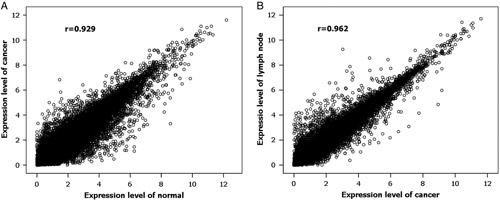
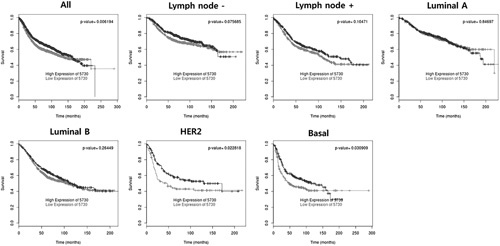
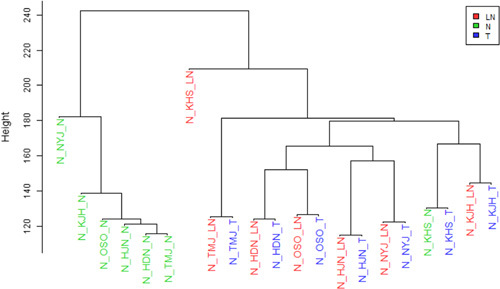
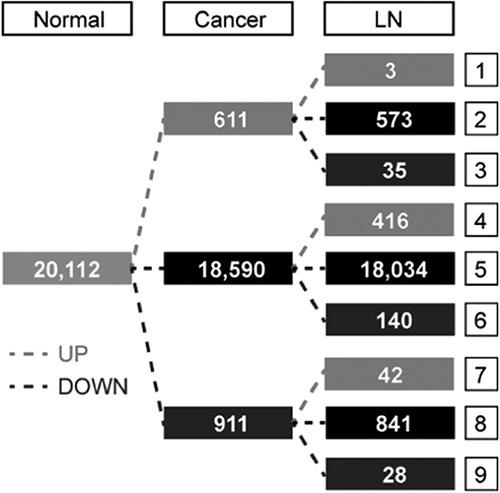
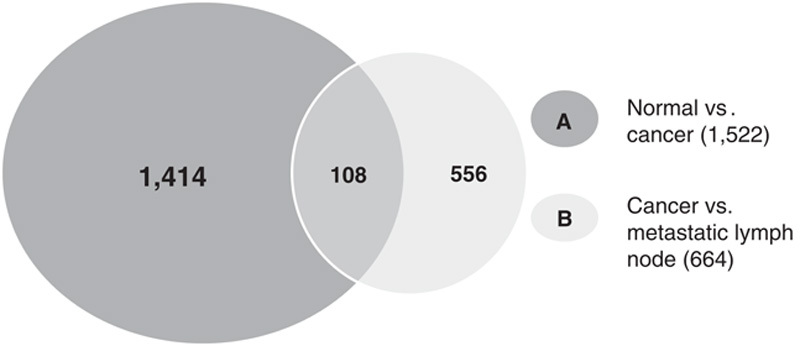
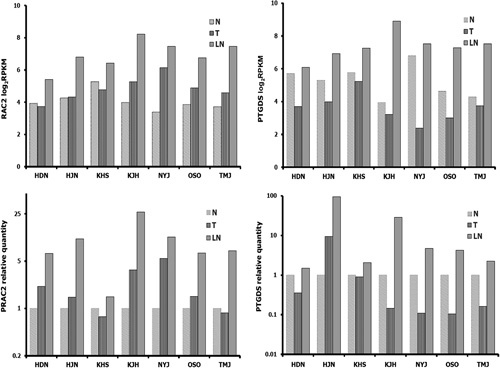
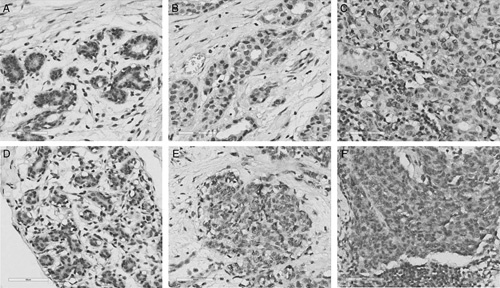
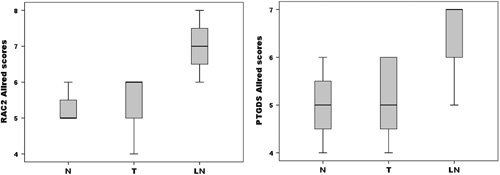
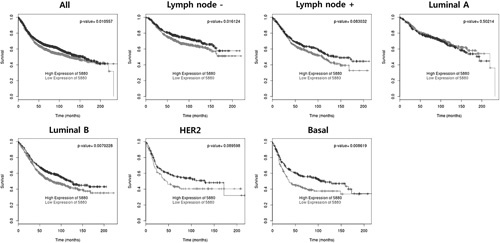
Genome-wide screening of transcriptional changes among normal, cancer, and nodal metastases provides insights into the molecular basis of breast cancer (BC) progression and metastasis. To identify transcriptional changes and differentially expressed genes (DEGs) in the metastatic progression of BC and to determine the prognostic role of these DEGs in clinical outcome, we compared transcriptome profiling in matched normal, cancer, and lymph node metastatic tissues of 7 patients with estrogen receptor-positive, HER2-negative BC by using massive parallel RNA sequencing. The global profiles of gene expression in cancer and nodal metastases were highly correlated (r=0.962, P<0.001). In 6 (85.8%) patients, cancer and corresponding nodal metastases from the same patient clustered together. We identified 1522 and 664 DEGs between normal and cancer and between cancer and nodal metastases, respectively. The DEGs in normal versus cancer and cancer versus nodal metastases were significantly clustered in 1 and 8 Kyoto Encyclopedia of Genes and Genomes (KEGG) pathways, respectively. The chemokine signaling pathway was the most significant pathway in the cancer-to-nodal metastasis transition (false discovery rate=2.15E-13). The expression of 2 dysregulated RAC2 and PTGDS genes was confirmed by quantitative real-time polymerase chain reaction and immunohistochemistry. Interestingly, the lower RAC2 and PTGDS expression were associated with significantly worse disease-free survival in patients with BC. Our results show a high concordance of gene expression in BC and their nodal metastases, and identify DEGs associated with the metastatic progression of BC. The DEGs identified in this study represent novel biomarkers for predicting the prognosis of patients with BC.
对正常组织、癌组织和淋巴结转移灶进行全基因组转录变化筛查,有助于深入了解乳腺癌(BC)进展和转移的分子基础。为了识别BC转移过程中的转录变化和差异表达基因(DEG),并确定这些DEG在临床结局中的预后作用,我们使用大规模平行RNA测序比较了7例雌激素受体阳性、HER2阴性BC患者匹配的正常组织、癌组织和淋巴结转移组织的转录组谱。癌组织和淋巴结转移灶中的基因表达全局谱高度相关(r = 0.962,P < 0.001)。在6例(85.8%)患者中,同一患者的癌组织和相应淋巴结转移灶聚集在一起。我们分别在正常组织与癌组织之间以及癌组织与淋巴结转移灶之间鉴定出1522个和664个DEG。正常组织与癌组织之间以及癌组织与淋巴结转移灶之间的DEG分别显著聚集在1个和8个京都基因与基因组百科全书(KEGG)通路中。趋化因子信号通路是癌组织向淋巴结转移转变中最显著的通路(错误发现率 = 2.15E - 13)。通过定量实时聚合酶链反应和免疫组织化学证实了2个失调的RAC2和PTGDS基因的表达。有趣的是,较低的RAC2和PTGDS表达与BC患者显著较差的无病生存率相关。我们的结果显示BC及其淋巴结转移灶中基因表达高度一致,并鉴定出与BC转移进展相关的DEG。本研究中鉴定出的DEG代表了预测BC患者预后的新型生物标志物。