Nebraska Center for Virology, University of Nebraska-Lincoln, Lincoln, Nebraska, United States of America.
School of Public Health, University of Kinshasa, Kinshasa, Democratic Republic of Congo.
PLoS One. 2020 Feb 11;15(2):e0228670. doi: 10.1371/journal.pone.0228670. eCollection 2020.
Complex mosaic structures of HIV-1 were found in the Democratic Republic of Congo (DRC). Currently, there is limited information on the circulating HIV-1 strains, the distribution of these strains and antiretroviral (ART) resistant viruses in different regions of the country, and the HIV-1 strains harbored by the high-risk groups like female sex workers (FSW) reported to be the source of recombinant and ART resistant viruses.
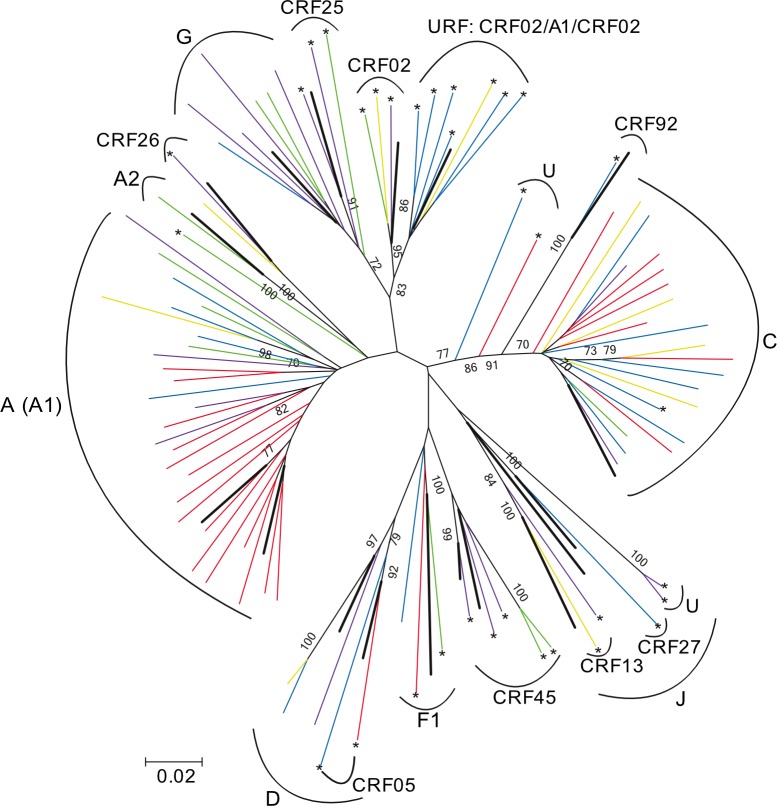
Dried Blood Spots (DBS), collected from 325 infected FSWs in ten cities from 2012 DRC HIV/STI Integrated Biological and Behavioral Surveillance Survey, were tested for HIV-1 genotypes and antiretroviral resistance mutations. Regional segregation of HIV-1 clades was detected using phylogenetics. The significance for differences in HIV-1 subtype and drug resistance mutations were evaluated using Chi-square tests.
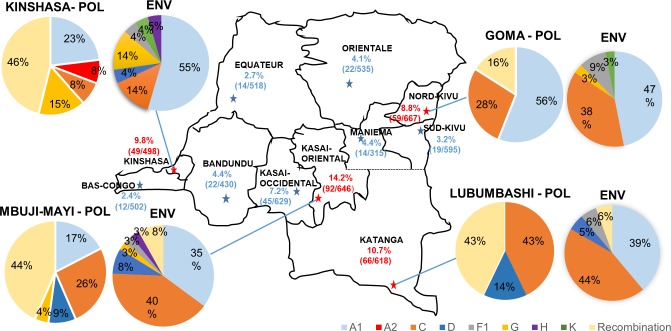
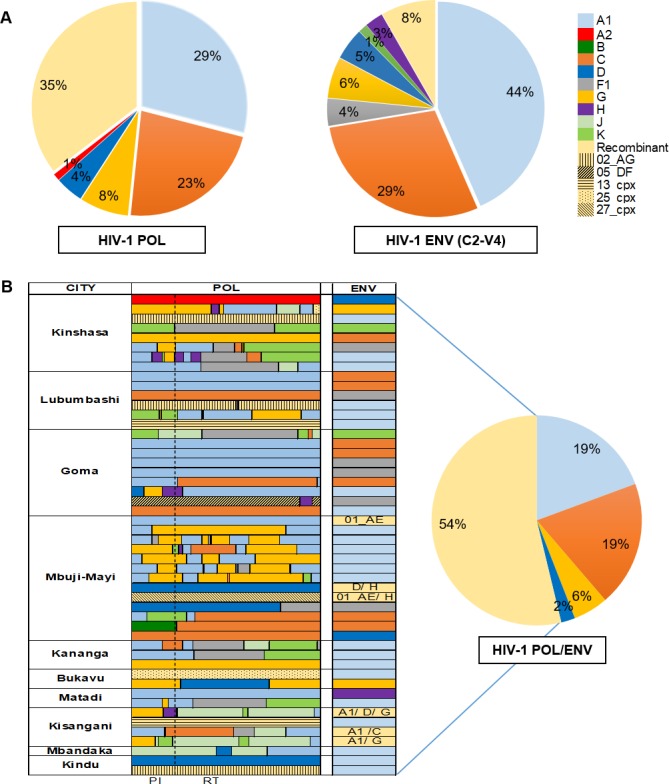
There were 145 (env) and 93 (pol) sequences analyzed. Based on env sequences, the predominant subtype was A1 (44%), and recombinants as defined pol sequences comprised 35% of the total sample. Paired sequences of pol and env from DRC FSW revealed mosaic recombinant in 54% of the sequences. Distinct geographic distributions of different HIV-1 subtypes and recombinants were observed. Subtype A1 was prevalent (40%) in Goma located in the East and significantly higher than in Mbuji-Mayi (p<0.05) in the South-central region, or in Lubumbashi in the South. Antiretroviral resistance was detected in 21.5% of 93 pol sequences analyzed, with the M184I/V and K103N mutations that confer high-level resistance to NRTI and NNRTI, respectively, being the most frequent mutations. However, the K103N mutant viruses were found only in the East.
HIV-1 variants found in DRC FSW reflect those reported to circulate in the general population from the corresponding geographical locations. HIV-1 mosaic genetics were readily detected in FSW. Importantly, ART resistance mutations to NNRTI and NRTI were common in the DRC sex workers.
在刚果民主共和国(DRC)发现了 HIV-1 的复杂镶嵌结构。目前,关于该国不同地区流行的 HIV-1 株、这些株的分布以及抗逆转录病毒(ART)耐药病毒,以及报告为重组和 ART 耐药病毒来源的高危人群(如性工作者)中 HIV-1 株的信息有限。
对 2012 年来自刚果民主共和国 HIV/性传播感染综合生物与行为监测调查中来自十个城市的 325 名受感染性工作者的干燥血斑(DBS)进行了 HIV-1 基因型和抗逆转录病毒耐药突变检测。使用系统发生学检测 HIV-1 群的区域隔离。使用卡方检验评估 HIV-1 亚型和耐药突变差异的显著性。
共分析了 145 个(env)和 93 个(pol)序列。根据 env 序列,主要亚型为 A1(44%),而根据 pol 序列定义的重组体占总样本的 35%。刚果民主共和国性工作者的 pol 和 env 配对序列显示 54%的序列为镶嵌重组。观察到不同 HIV-1 亚型和重组体的明显地理分布。在位于东部的戈马,A1 亚型(40%)最为流行,明显高于位于中南部的姆布吉-马伊(p<0.05)或南部的卢本巴希。分析的 93 个 pol 序列中检测到 21.5%的抗逆转录病毒耐药,其中 M184I/V 和 K103N 突变分别对 NRTI 和 NNRTI 产生高水平耐药,是最常见的突变。然而,K103N 突变病毒仅在东部发现。
在刚果民主共和国性工作者中发现的 HIV-1 变体反映了在相应地理区域内报告的在一般人群中流行的变体。在性工作者中,HIV-1 镶嵌遗传很容易被检测到。重要的是,抗逆转录病毒耐药突变对 NNRTI 和 NRTI 在刚果民主共和国性工作者中很常见。