Department of Statistics and Quantitative Methods (DISMEQ), University of Milano-Bicocca, 20126 Milano, Italy.
Department of Management, Information and Production Engineering (DIGIP), University of Bergamo, 24044 Dalmine, Italy.
Int J Environ Res Public Health. 2020 Feb 8;17(3):1088. doi: 10.3390/ijerph17031088.
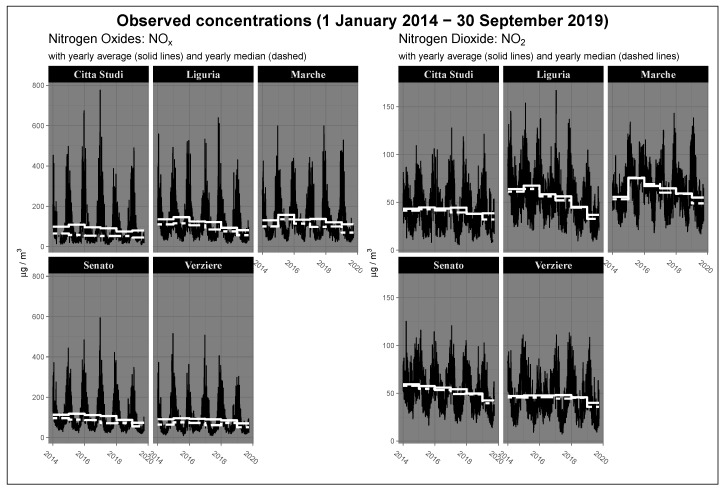
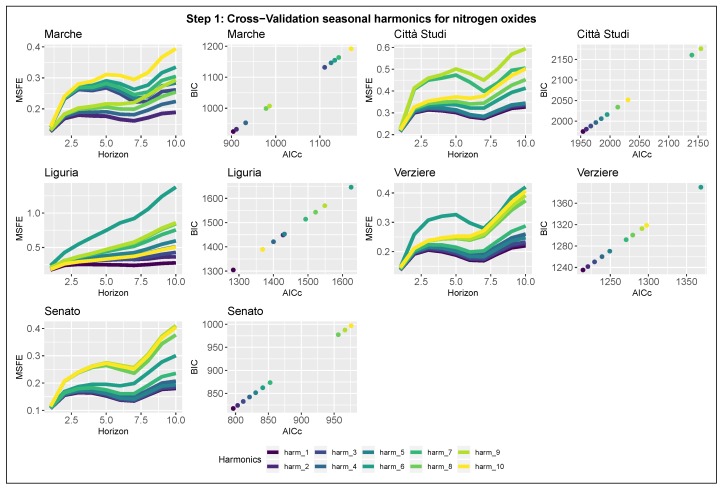
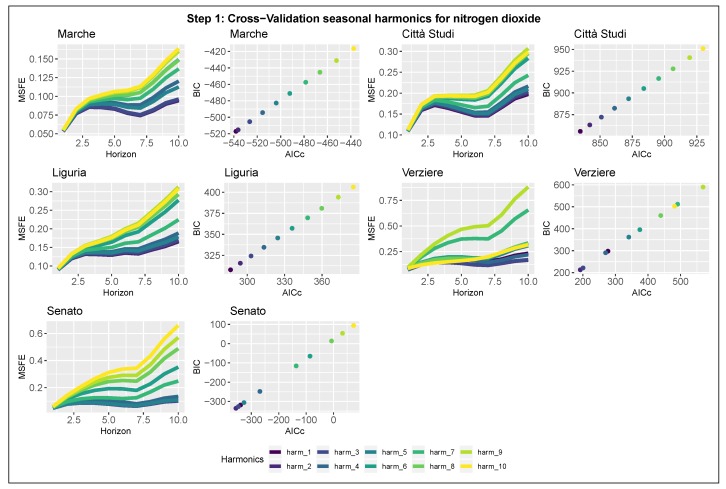
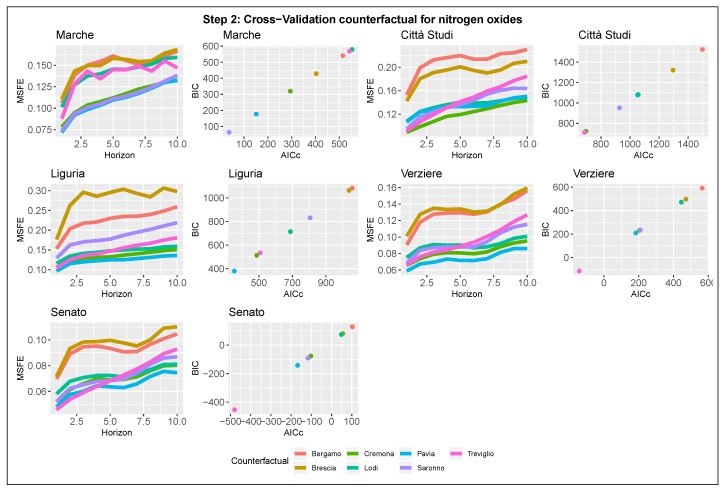
Most urban areas of the Po basin in the North of Italy are persistently affected by poor air quality and difficulty in disposing of airborne pollutants. In this context, the municipality of Milan started a multi-year progressive policy based on an extended limited traffic zone (Area B). Starting on 25 February 2019, the first phase partially restricted the circulation of some classes of highly polluting vehicles on the territory, in particular, Euro 0 petrol vehicles and Euro 0 to 3 diesel vehicles, excluding public transport. This is the early-stage of a long term policy that will restrict access to an increasing number of vehicles. The goal of this paper is to evaluate the early-stage impact of this policy on two specific vehicle-generated pollutants: total nitrogen oxides (NO x ) and nitrogen dioxide (NO 2 ), which are gathered by Lombardy Regional Agency for Environmental Protection (ARPA Lombardia). We use a statistical model for time series intervention analysis based on unobservable components. We use data from 2014 to 2018 for pre-policy model selection and the relatively short period up to September 2019 for early-stage policy assessment. We include weather conditions, socio-economic factors, and a counter-factual, given by the concentration of the same pollutant in other important neighbouring cities. Although the average concentrations reduced after the policy introduction, this paper argues that this could be due to other factors. Considering that the short time window may be not long enough for social adaptation to the new rules, our model does not provide statistical evidence of a positive policy effect for NO x and NO 2 . Instead, in one of the most central monitoring stations, a significant negative impact is found.
意大利北部波河流域的大多数城市地区一直受到空气质量差和难以处理空气污染物的困扰。在这种情况下,米兰市政府启动了一项多年渐进政策,该政策基于一个扩展的有限交通区(B 区)。自 2019 年 2 月 25 日起,第一阶段部分限制了一些高污染车辆在该地区的流通,特别是欧 0 汽油车和欧 0 至 3 柴油车,但公共交通除外。这是一项长期政策的早期阶段,该政策将限制越来越多的车辆进入。本文的目的是评估该政策对两种特定车辆产生的污染物的早期影响:总氮氧化物(NOx)和二氧化氮(NO2),这两种污染物由伦巴第地区环境保护局(ARPA Lombardia)收集。我们使用基于不可观测成分的时间序列干预分析统计模型。我们使用 2014 年至 2018 年的数据进行政策前模型选择,并使用相对较短的时间(截至 2019 年 9 月)进行早期政策评估。我们包括天气条件、社会经济因素和一个反事实因素,即同一污染物在其他重要邻近城市的浓度。尽管政策实施后平均浓度有所降低,但本文认为这可能是由于其他因素造成的。考虑到适应新规则的短时间窗口可能不够长,我们的模型没有为 NOx 和 NO2 提供政策积极影响的统计证据。相反,在一个最中心的监测站发现了显著的负面影响。