Weigard Alexander, Heathcote Andrew, Matzke Dora, Huang-Pollock Cynthia
Department of Psychiatry, Addiction Center, University of Michigan.
School of Medicine, University of Tasmania, Australia.
Clin Psychol Sci. 2019 Jul;7(4):856-872. doi: 10.1177/2167702619838466. Epub 2019 Apr 18.
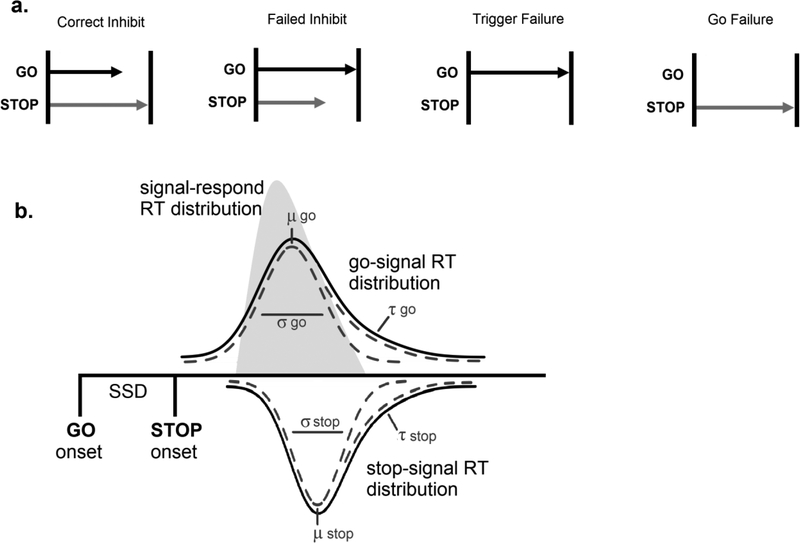
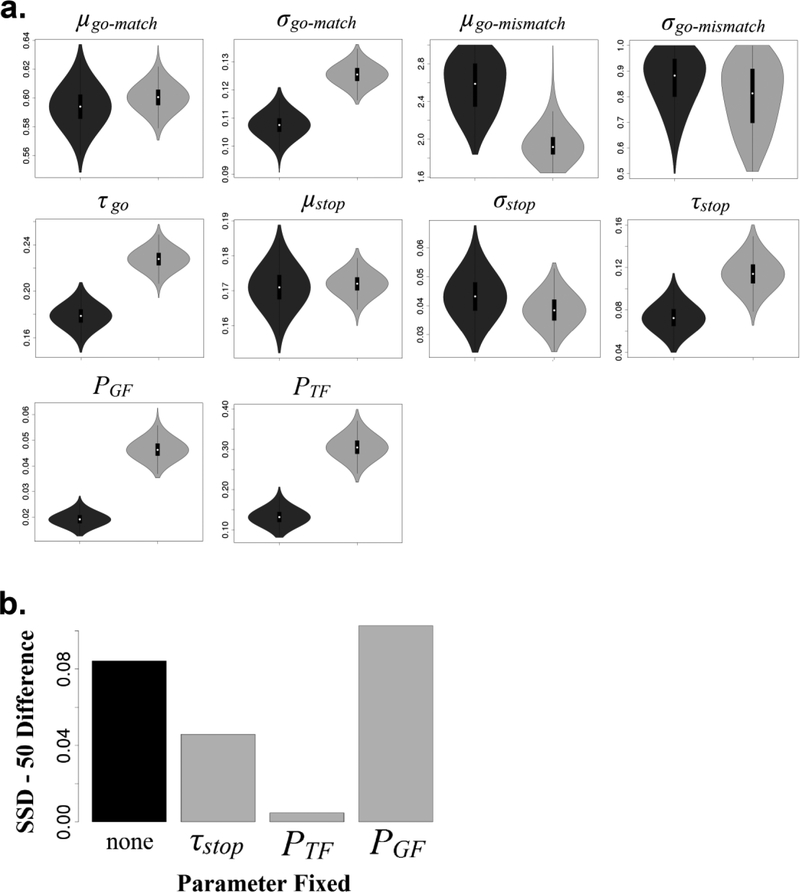
Mean stop-signal reaction time (SSRT) is frequently employed as a measure of response inhibition in cognitive neuroscience research on ADHD. However, this measurement model is limited by two factors which may bias SSRT estimation in this population: 1) excessive skew in "go" RT distributions, and 2) trigger failures, or instances in which individuals fail to trigger an inhibition process in response to the "stop" signal. We use a Bayesian parametric approach, which allows unbiased estimation of the shape of entire SSRT distributions and the probability of trigger failures, to clarify mechanisms of stop-signal task deficits in ADHD. Children with ADHD displayed greater positive skew than their peers in both "go" RT and SSRT distributions. However, they also displayed more frequent trigger failures, which appeared to drive ADHD-related stopping difficulties. Results suggest that stop-signal task performance in ADHD reflects impairments in early attentional processes, rather than inefficiency in the stop process.
平均停止信号反应时间(SSRT)在注意力缺陷多动障碍(ADHD)的认知神经科学研究中经常被用作反应抑制的一种度量。然而,这种测量模型受到两个因素的限制,这两个因素可能会使该人群中SSRT的估计产生偏差:1)“执行”反应时(RT)分布的过度偏态,以及2)触发失败,即个体未能响应“停止”信号触发抑制过程的情况。我们使用贝叶斯参数方法,该方法能够对整个SSRT分布的形状和触发失败的概率进行无偏估计,以阐明ADHD中停止信号任务缺陷的机制。患有ADHD的儿童在“执行”RT和SSRT分布中比同龄人表现出更大的正偏态。然而,他们也表现出更频繁的触发失败,这似乎导致了与ADHD相关的停止困难。结果表明,ADHD中停止信号任务的表现反映了早期注意力过程的损伤,而不是停止过程的低效。