Medical Research Council Laboratory for Molecular Cell Biology, University College London, London, U.K.
Biochem Soc Trans. 2020 Feb 28;48(1):95-101. doi: 10.1042/BST20190328.
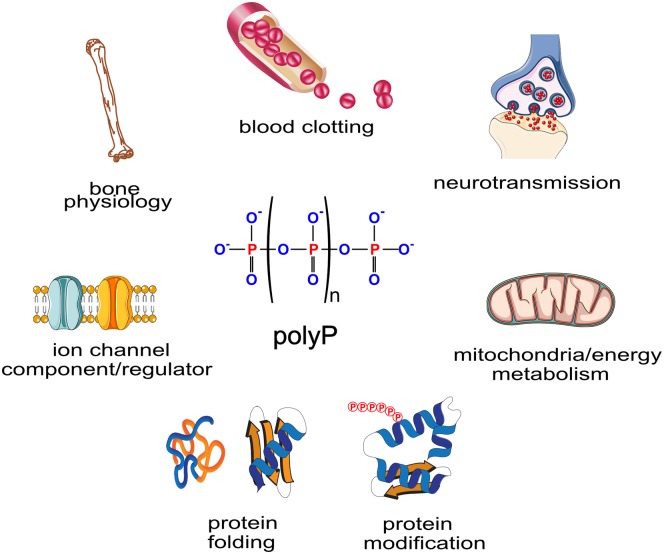
Inorganic polyphosphate (polyP) is a ubiquitous polymer of tens to hundreds of orthophosphate residues linked by high-energy phosphoanhydride bonds. In prokaryotes and lower eukaryotes, both the presence of polyP and of the biosynthetic pathway that leads to its synthesis are well-documented. However, in mammals, polyP is more elusive. Firstly, the mammalian enzyme responsible for the synthesis of this linear biopolymer is unknown. Secondly, the low sensitivity and specificity of available polyP detection methods make it difficult to confidently ascertain polyP presence in mammalian cells, since in higher eukaryotes, polyP exists in lower amounts than in yeast or bacteria. Despite this, polyP has been given a remarkably large number of functions in mammals. In this review, we discuss some of the proposed functions of polyP in mammals, the limitations of the current detection methods and the urgent need to understand how this polymer is synthesized.
无机多聚磷酸盐(polyP)是一种由数十到数百个通过高能磷酸酐键连接的正磷酸盐残基组成的普遍存在的聚合物。在原核生物和低等真核生物中,多聚磷酸盐的存在及其生物合成途径都有很好的记录。然而,在哺乳动物中,多聚磷酸盐则更加难以捉摸。首先,负责合成这种线性生物聚合物的哺乳动物酶是未知的。其次,现有的多聚磷酸盐检测方法的灵敏度和特异性较低,这使得很难确定哺乳动物细胞中多聚磷酸盐的存在,因为在高等真核生物中,多聚磷酸盐的含量低于酵母或细菌。尽管如此,多聚磷酸盐在哺乳动物中被赋予了许多惊人的功能。在这篇综述中,我们讨论了多聚磷酸盐在哺乳动物中的一些已知功能,以及当前检测方法的局限性,以及迫切需要了解这种聚合物是如何合成的。