Bahbishi Nora, Mzain Waad, Badeeb Bayan, Nassar Hani M
Faculty of Dentistry, King Abdulaziz University, P.O. Box 80209, Jeddah 21589, Saudi Arabia.
Department of Restorative Dentistry, Faculty of Dentistry, King Abdulaziz University, P.O. Box 80209, Jeddah 21589, Saudi Arabia.
Materials (Basel). 2020 Feb 9;13(3):787. doi: 10.3390/ma13030787.
To assess the color stability and surface microhardness of Bulk-Fill composite materials available in the Saudi Arabia market.
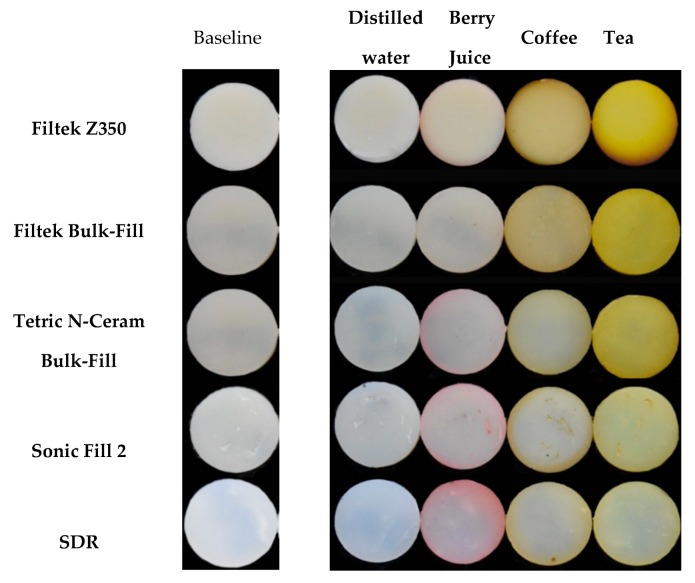
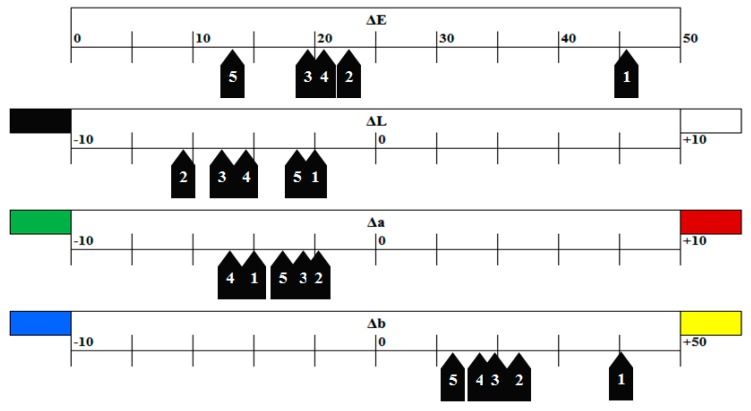
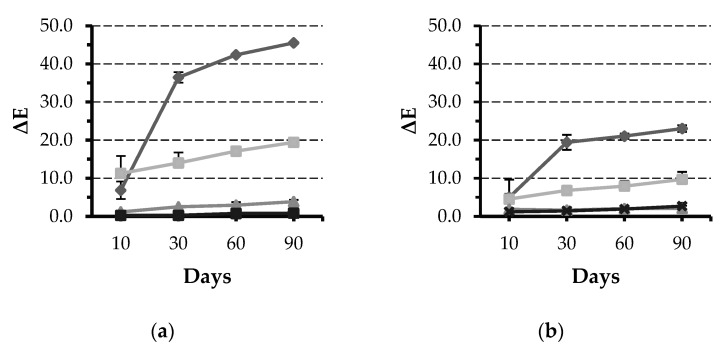
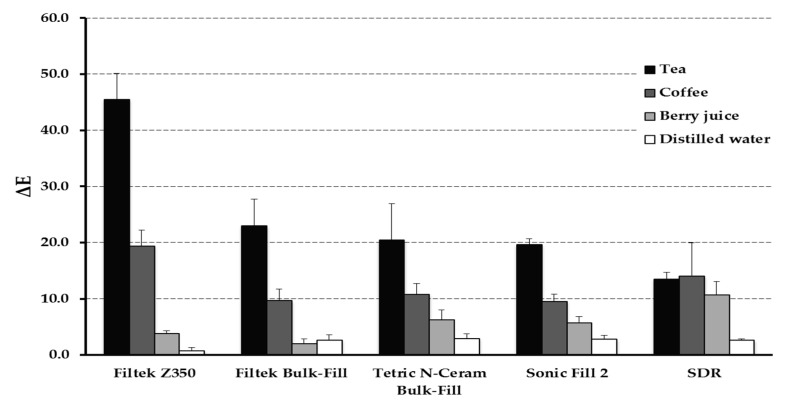
Five composite materials (Filtek Z350, Filtek Bulk-Fill, Tetric N-Ceram Bulk-Fill, Sonic Fill 2, and SDR) were investigated. Samples ( = 20; 10 mm in diameter and 2 mm in thickness) were fabricated using a stainless-steel mold and were immersed in tea, coffee, berry juice, and distilled water (control). Baseline (T) shades of specimens were recorded using a spectrophotometer and after 10 (T), 30 (T), 60 (T), and 90 days (T) of immersion. Measurements were obtained against a black background and CIE Lab* data was used to calculate ΔE for each group. Vickers microhardness values were obtained at T and T. Data was analyzed using mixed model repeated measure ANOVA at 0.05 significance level.
Time, material, and solution effects have statistically significant effect on ΔE. Tea was the most staining solution. Z350 was associated with the highest ΔE values while SDR showed the lowest values. No other materials showed significant difference between each other. Solutions were statistically different from each other. All materials were different from each other regarding microhardness.
Bulk-Fill materials showed more color stability but lower microhardness values compared to universal resin control.
评估沙特阿拉伯市场上的大块充填复合材料的颜色稳定性和表面显微硬度。
研究了五种复合材料(Filtek Z350、Filtek Bulk-Fill、Tetric N-Ceram Bulk-Fill、Sonic Fill 2和SDR)。使用不锈钢模具制作样本(n = 20;直径10毫米,厚度2毫米),并将其浸入茶、咖啡、浆果汁和蒸馏水(对照)中。使用分光光度计记录样本的基线(T0)颜色,并在浸泡10天(T10)、30天(T30)、60天(T60)和90天(T90)后记录。在黑色背景下进行测量,并使用CIE Lab*数据计算每组的ΔE。在T0和T90时获得维氏显微硬度值。使用混合模型重复测量方差分析在0.05显著性水平下分析数据。
时间、材料和溶液对ΔE有统计学显著影响。茶是染色性最强的溶液。Z350的ΔE值最高,而SDR的ΔE值最低。其他材料之间没有显著差异。溶液之间在统计学上存在差异。所有材料在显微硬度方面彼此不同。
与通用树脂对照相比,大块充填材料显示出更高的颜色稳定性,但显微硬度值较低。