Yen Hung-Chi, Kuo Tsung-Rong, Wang Chun-Ta, Lin Jia-De, Chen Chia-Chun, Hsiao Yu-Cheng
Department of Chemistry, National Taiwan Normal University, 88 Ting-Chow Rd., Sec. 4, Taipei 11677, Taiwan.
Graduate Institute of Nanomedicine and Medical Engineering, Taipei Medical University, 250 Wuxing St., Taipei 11031, Taiwan.
Nanomaterials (Basel). 2020 Feb 9;10(2):290. doi: 10.3390/nano10020290.
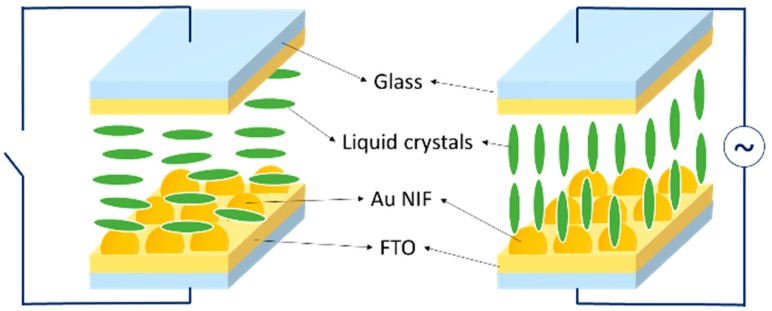
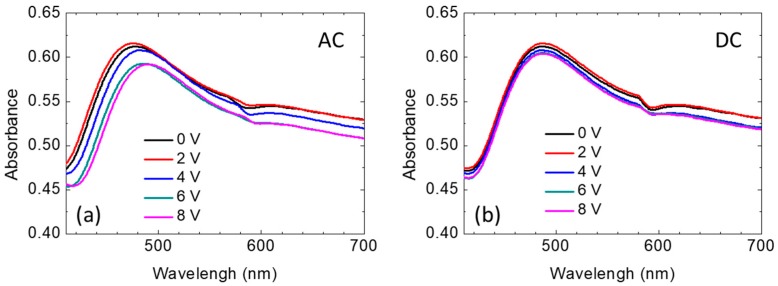
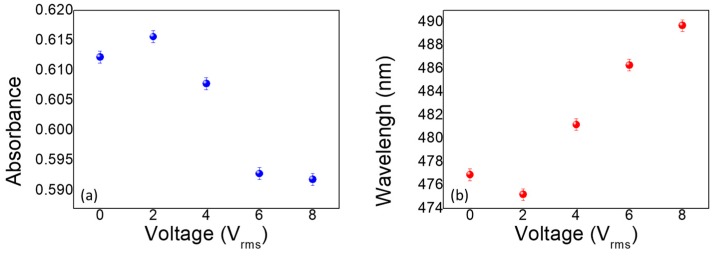
A system comprising a gold nanoisland film (Au NIF) covered with a liquid crystal (LC) material is introduced. By applying a voltage across the LC bulk, we demonstrate that changes in the refractive-index and orientation significantly modified the hybrid plasmonic-photonic resonances of the Au NIF. The hybrid structure enabled active control of the spectrum of the resonance wavelength of the metallic nanoisland by means of an externally applied electric field. Our modeling supports the observed results in LC/Au NIF. In a combination of the nanostructured surface with birefringent LCs, nonpolarized wavelength tunability of ~15 nm and absorbance tunability of ~0.024 were achieved in the visible wavelength, opening the door to optical devices and nanoscale sensors.
介绍了一种由覆盖有液晶(LC)材料的金纳米岛薄膜(Au NIF)组成的系统。通过在液晶主体上施加电压,我们证明了折射率和取向的变化显著改变了Au NIF的混合等离子体 - 光子共振。这种混合结构能够通过外部施加的电场对金属纳米岛共振波长的光谱进行主动控制。我们的建模支持了在LC/Au NIF中观察到的结果。在纳米结构表面与双折射液晶的组合中,在可见波长范围内实现了约15 nm的非偏振波长可调性和约0.024的吸光度可调性,为光学器件和纳米级传感器打开了大门。