Buonerba Carlo, Dolce Pasquale, Iaccarino Simona, Scafuri Luca, Verde Antonio, Costabile Ferdinando, Pagliuca Martina, Morra Rocco, Riccio Vittorio, Ribera Dario, De Placido Pietro, Romeo Valeria, Crocetto Felice, Longo Nicola, Imbimbo Ciro, De Placido Sabino, Di Lorenzo Giuseppe
Regional Reference Center for Rare Tumors, Department of Oncology and Hematology, AOU Federico II of Naples, 80131 Naples, Italy.
National Reference Center for Environmental Health, Zoo-prophylactic Institute of Southern Italy, 80055 Portici, Italy.
Cancers (Basel). 2020 Feb 10;12(2):408. doi: 10.3390/cancers12020408.
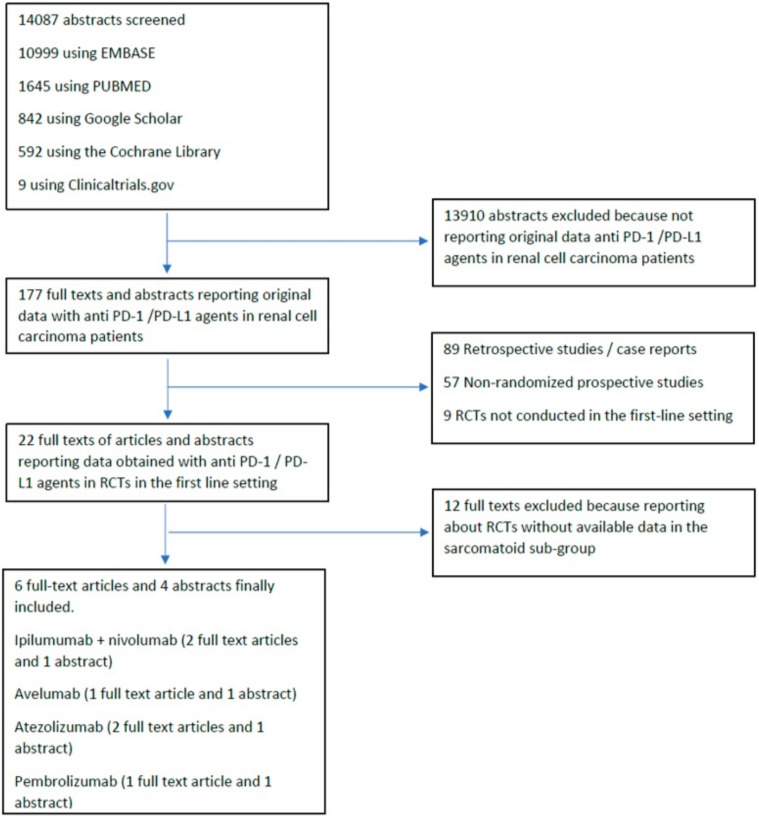
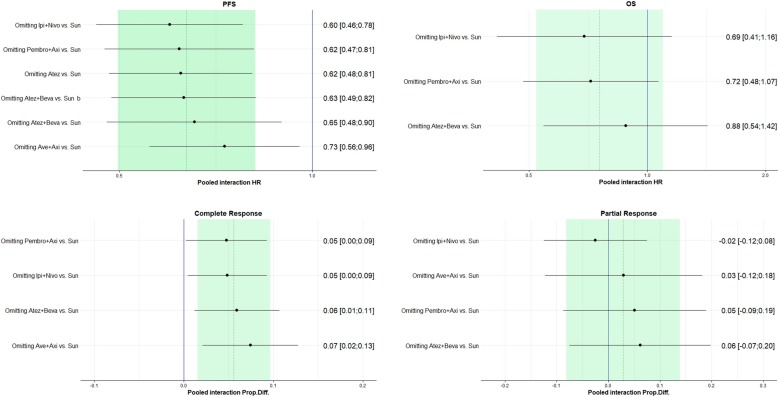
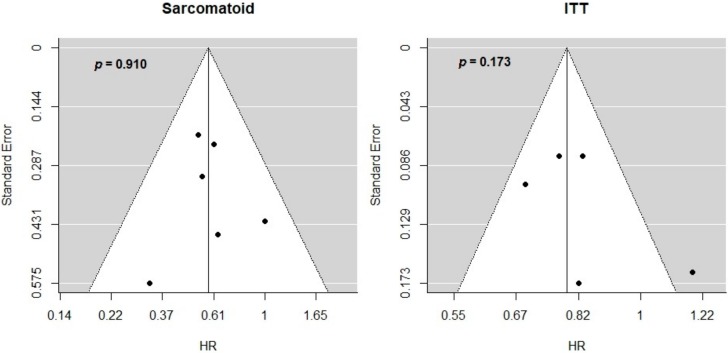
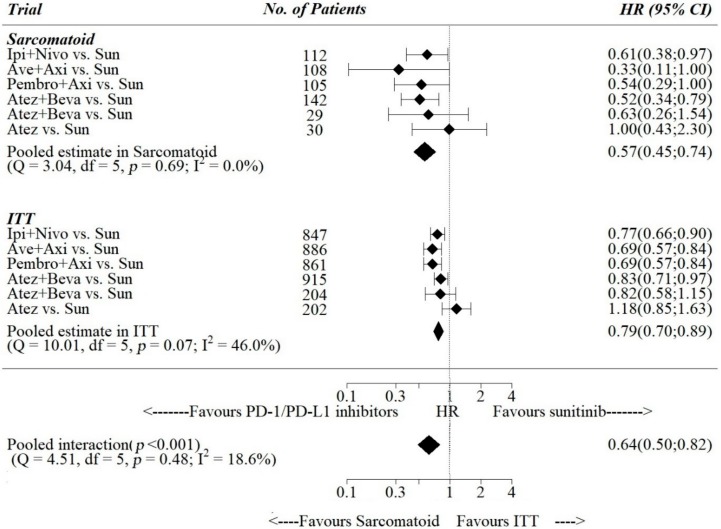
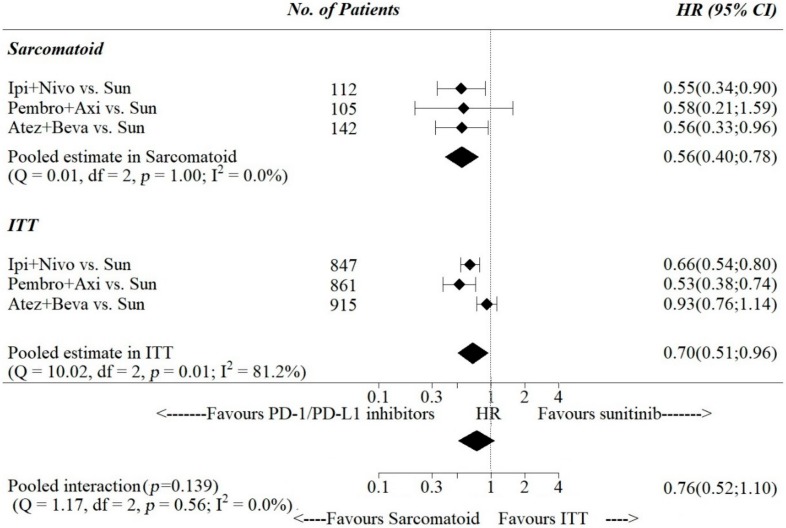
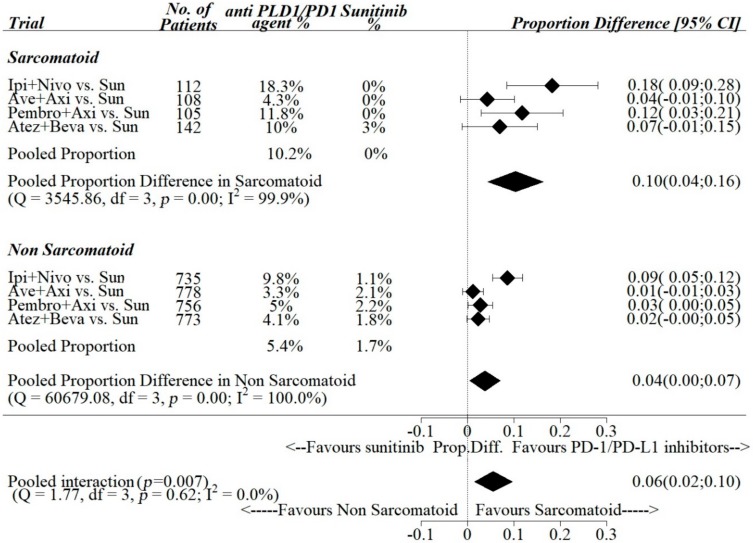
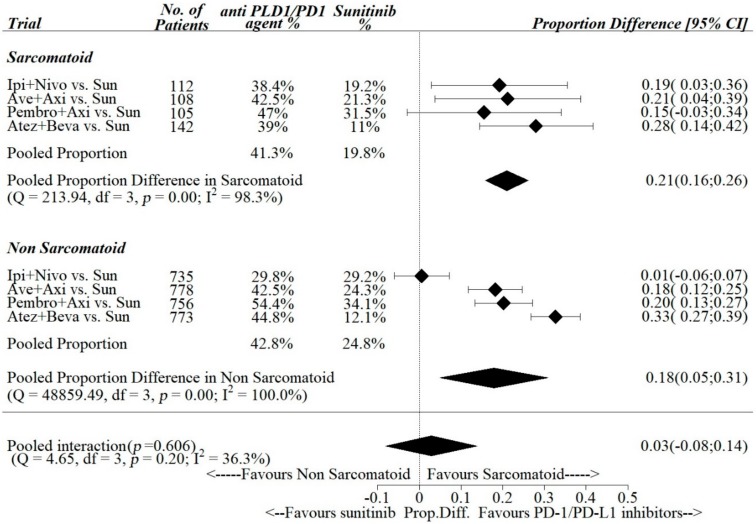
Immunotherapy based on anti PD-1/PD-L1 inhibitors has proven to be more effective than sunitinib in the first-line setting of advanced renal cell carcinoma (RCC). RCC patients with sarcomatoid histology (sRCC) have a poor prognosis and limited therapeutic options. We performed a systematic review and a meta-analysis of randomized-controlled trials (RCTs) of first-line anti PD-1/PDL-1 agents vs. sunitinib, presenting efficacy data in the sub-group of sRCC patients. The systematic research was conducted on Google Scholar, Cochrane Library, PubMed and Embase and updated until 31th January, 2020. Abstracts from ESMO and ASCO (2010-2019) were also reviewed. Full texts and abstracts reporting about RCTs testing first-line anti-PD-1/ PD-L1 agents vs. sunitinib in RCC were included if sRCC sub-group analyses of either PFS (progression-free survival), OS (overall survival) or radiological response rate were available. Pooled data from 3814 RCC patients in the ITT (intention-to-treat) population and from 512 sRCC patients were included in the quantitative synthesis. In the sRCC sub-group vs. the ITT population, pooled estimates of the PFS-HRs were 0.57 (95%: 0.45-0.74) vs. 0.79 (95% CI: 0.70-0.89), respectively, with a statistically meaningful interaction favoring the sRCC sub-group (pooled ratio of the PFS-HRs = 0.64; 95% CI: 0.50-0.82; < 0.001). Pooled estimates of the difference in CR-R (complete response-rate) achieved with anti-PD-1/PDL-1 agents vs. sunitinib were + 0.10 (95% CI: 0.04-0.16) vs. + 0.04 (95% CI: 0.00-0.07) in the sRCC vs. the non-sRCC sub groups, with a statistically meaningful difference of + 0.06 (95% CI: 0.02-0.10; = 0.007) favoring the sRCC sub-group. Sarcomatoid histology may be associated with improved efficacy of anti PD-1/PDL-1 agents vs. sunitinib in terms of PFS and CR-R.
基于抗PD-1/PD-L1抑制剂的免疫疗法在晚期肾细胞癌(RCC)一线治疗中已被证明比舒尼替尼更有效。具有肉瘤样组织学特征(sRCC)的RCC患者预后较差且治疗选择有限。我们对一线抗PD-1/PDL-1药物与舒尼替尼的随机对照试验(RCT)进行了系统评价和荟萃分析,呈现了sRCC患者亚组的疗效数据。系统研究在谷歌学术、考克兰图书馆、PubMed和Embase上进行,并更新至2020年1月31日。还对ESMO和ASCO(2010 - 2019年)的摘要进行了审查。如果有PFS(无进展生存期)、OS(总生存期)或放射学缓解率的sRCC亚组分析,纳入报告RCC中一线抗PD-1/PD-L1药物与舒尼替尼对比试验的全文和摘要。ITT(意向性治疗)人群中3814例RCC患者以及512例sRCC患者的汇总数据纳入定量合成。在sRCC亚组与ITT人群中,PFS-HR的汇总估计值分别为0.57(95%:0.45 - 0.74)和0.79(95%CI:0.70 - 0.89),存在有利于sRCC亚组的具有统计学意义的交互作用(PFS-HR的汇总比值 = 0.64;95%CI:0.50 - 0.82;<0.001)。在sRCC与非sRCC亚组中,抗PD-1/PDL-1药物与舒尼替尼相比达到的CR-R(完全缓解率)差异的汇总估计值分别为+0.10(95%CI:0.04 - 0.16)和+0.04(95%CI:0.00 - 0.07),有利于sRCC亚组的具有统计学意义的差异为+0.06(95%CI:0.