Department of Obstetrics and Gynecology, The Second Affiliated Hospital of University of South China, Hengyang, China.
Clinical Research Institute, The First Affiliated Hospital of University of South China, Hengyang, China.
BMC Cancer. 2020 Feb 12;20(1):116. doi: 10.1186/s12885-020-6609-x.
Epithelial ovarian cancer (EOC) is the leading cause of gynecological cancer-associated deaths and a majority of its histological type is manifested as serous ovarian cancer (SOC). In this study, we investigated whether the timing of onset of chemotherapy-induced neutropenia (CIN) is related to chemotherapeutic response and disease outcome of SOC.
One hundred sixty-nine primary SOC patients receiving six doses of carboplatin plus paclitaxel adjuvant chemotherapy following cytoreductive surgery were retrospectively included in this research. CIN was grouped as early onset and late onset neutropenia depending on the timing of development. Development of CIN prior to or with administration of 3rd cycle of chemotherapy was listed as early onset neutropenia, while those CIN due to later stage chemotherapy were grouped into non-early type. The relevance of time of CIN onset with the clinical characteristics, chemotherapeutic response, progression free survival (PFS) and overall survival (OS) were determined and analyzed by using Kaplan-Meier curves, Logistic regression method, Cox proportional hazards models, and Chi-square tests.
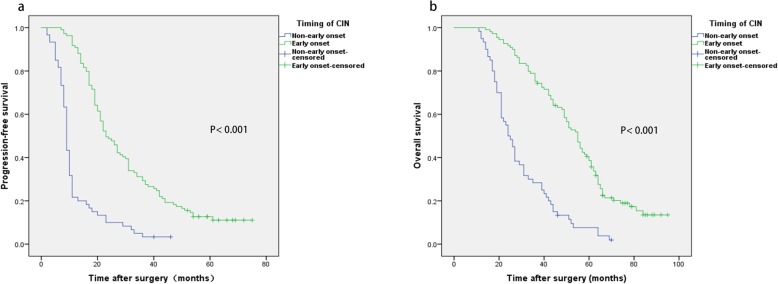
The age distribution of the patients was between 27 to 77 years. Fifty years was the median. No statistical significances of difference in age, FIGO stage, histological grade, tumor residual and lymph node invasion, as well as CA125 level in each CIN group were found (all P>0.05). The patients from non-early onset group showed higher chemoresistance rates (78.33%) compared to those from early onset group (9.17%). Additionally, patients in early onset group showed improved median PFS (23 vs. 9 months; P<0.001) and median OS (55 vs.24 months; P<0.001).
Early onset neutropenia may be potentially used as a potential indicator for chemosensitivity and favorable prognosis of SOC in patients who underwent six cycles of carboplatin plus paclitaxel adjuvant chemotherapy following primary cytoreductive surgery.
上皮性卵巢癌(EOC)是妇科癌症相关死亡的主要原因,其大多数组织学类型表现为浆液性卵巢癌(SOC)。在本研究中,我们研究了化疗诱导的中性粒细胞减少症(CIN)的发病时间是否与 SOC 的化疗反应和疾病结局有关。
本研究回顾性纳入了 169 例接受细胞减灭术后接受六周期卡铂加紫杉醇辅助化疗的原发性 SOC 患者。根据 CIN 的发展情况,将 CIN 分为早发性和迟发性中性粒细胞减少症。在化疗第 3 周期前或同时发生的 CIN 被列为早发性中性粒细胞减少症,而因较晚化疗引起的 CIN 则归入非早发型。采用 Kaplan-Meier 曲线、Logistic 回归方法、Cox 比例风险模型和卡方检验确定和分析 CIN 发病时间与临床特征、化疗反应、无进展生存期(PFS)和总生存期(OS)的相关性。
患者年龄分布在 27 至 77 岁之间,中位数为 50 岁。在每个 CIN 组中,年龄、FIGO 分期、组织学分级、肿瘤残留和淋巴结侵犯以及 CA125 水平均无统计学差异(均 P>0.05)。非早发型组患者的化疗耐药率(78.33%)明显高于早发型组(9.17%)。此外,早发型组患者的中位 PFS(23 与 9 个月;P<0.001)和中位 OS(55 与 24 个月;P<0.001)均得到改善。
对于接受原发细胞减灭术后接受六周期卡铂加紫杉醇辅助化疗的患者,早发性中性粒细胞减少症可能可作为预测 SOC 化疗敏感性和预后的潜在指标。