Ganjian Niloofar, Riviere-Cinnamond Ana
Milken Institute School of Public Health The George Washington University Washington, D.C United States of America Milken Institute School of Public Health, The George Washington University, Washington, D.C., United States of America.
Pan American Health Organization Pan American Health Organization Washington, D.C United States of America Pan American Health Organization, Washington, D.C., United States of America.
Rev Panam Salud Publica. 2020 Feb 11;44:e14. doi: 10.26633/RPSP.2020.14. eCollection 2020.
To assess the distribution of Mayaro virus (MAYV) in Latin America and the Caribbean and evaluate existing country-level MAYV surveillance mechanisms.
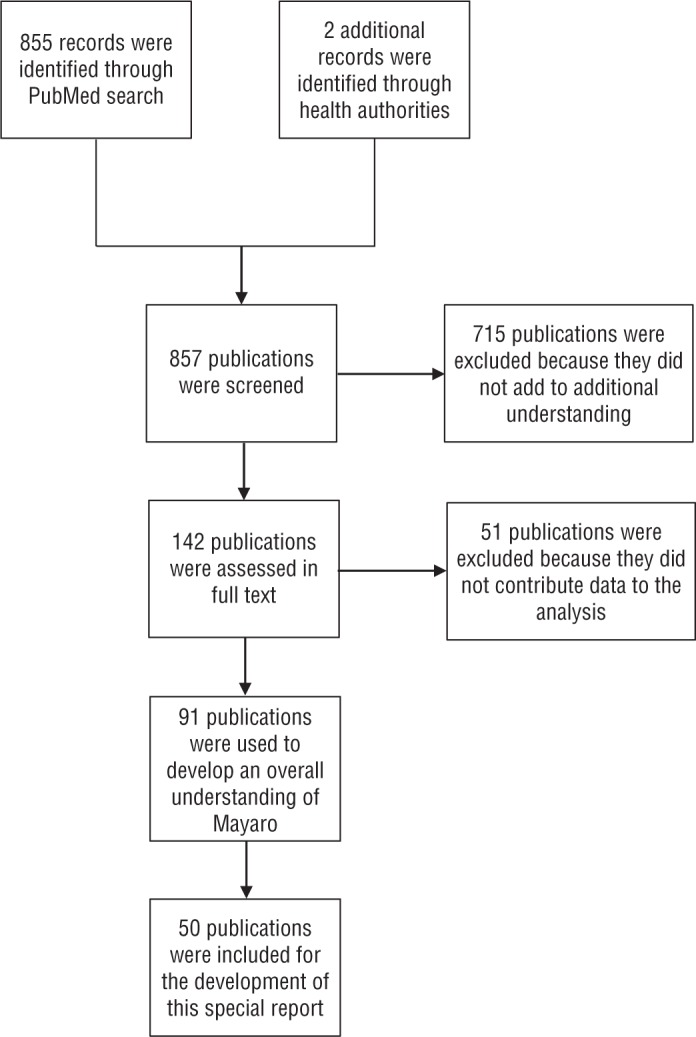
Research was conducted from May 2018 through May 2019 to collect data from academic literature on Mayaro fever in Latin America and the Caribbean. PubMed, ClinicalKey, Scopus, Nature, SciELO, LILACS, and Google Scholar were searched for peer-reviewed journal articles, and data from health authorities, including the Pan American Health Organization (PAHO) and ministries of health, was also sought. MAYV-related publications published from 1954 through 2019 were screened. Publications that added to the overall understanding of MAYV, including its geographical and epidemiological distribution, were included in this report.
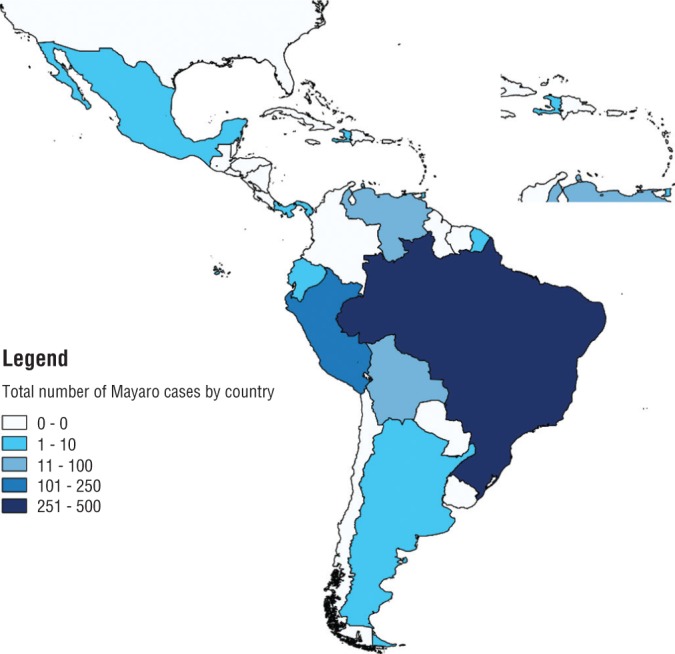
A total of 901 MAYV cases have been reported in humans in countries in Latin America and the Caribbean. Since its discovery in 1954 in Trinidad and Tobago, MAYV has been isolated from individuals living in Argentina, Bolivia, Brazil, Ecuador, French Guiana, Haiti, Mexico, Panama, Peru, and Venezuela. Of those 901 cases, 42 of them were reported exclusively by health authorities. In contrast, 843 confirmed and presumptive autochthonous cases and an additional 16 imported cases were identified in academic literature. No country-level surveillance mechanisms for MAYV were recorded in academic literature or by health authorities.
This report demonstrates that MAYV surveillance efforts are limited in comparison to the virus's presence in Latin America and the Caribbean, highlighting the importance of enhancing arboviral surveillance systems in the affected countries.
评估马亚罗病毒(MAYV)在拉丁美洲和加勒比地区的分布情况,并评估各国现有的MAYV监测机制。
于2018年5月至2019年5月开展研究,从有关拉丁美洲和加勒比地区马亚罗热的学术文献中收集数据。检索了PubMed、ClinicalKey、Scopus、Nature、SciELO、LILACS和谷歌学术等数据库,以查找经同行评审的期刊文章,同时还收集了包括泛美卫生组织(PAHO)和各国卫生部在内的卫生当局的数据。筛选了1954年至2019年发表的与MAYV相关的出版物。本报告纳入了有助于全面了解MAYV的出版物,包括其地理和流行病学分布情况。
拉丁美洲和加勒比地区各国共报告了901例人类感染MAYV的病例。自1954年在特立尼达和多巴哥发现MAYV以来,已从生活在阿根廷、玻利维亚、巴西、厄瓜多尔、法属圭亚那、海地、墨西哥、巴拿马、秘鲁和委内瑞拉的个体中分离出该病毒。在这901例病例中,有42例是由卫生当局单独报告的。相比之下,学术文献中确定了843例确诊和推定的本地病例以及另外16例输入病例。学术文献或卫生当局均未记录到各国的MAYV监测机制。
本报告表明,与MAYV在拉丁美洲和加勒比地区的存在情况相比,对其的监测工作有限,突出了加强受影响国家虫媒病毒监测系统的重要性。