Department of Microbiology, Faculty of Medicine, School of Health Sciences, University of Ioannina, 45110 Ioannina, Greece.
Department of Physiology, Anatomy and Microbiology, La Trobe University, Bundoora, VIC 3086, Australia.
Viruses. 2018 Apr 4;10(4):175. doi: 10.3390/v10040175.
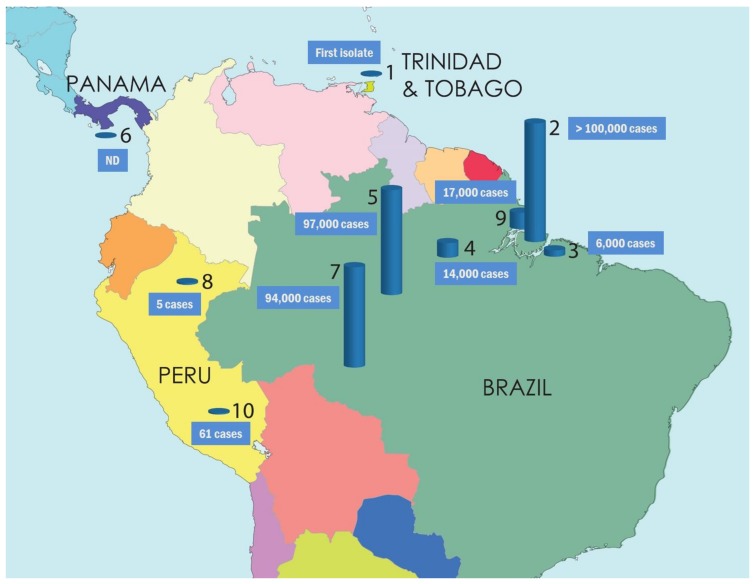
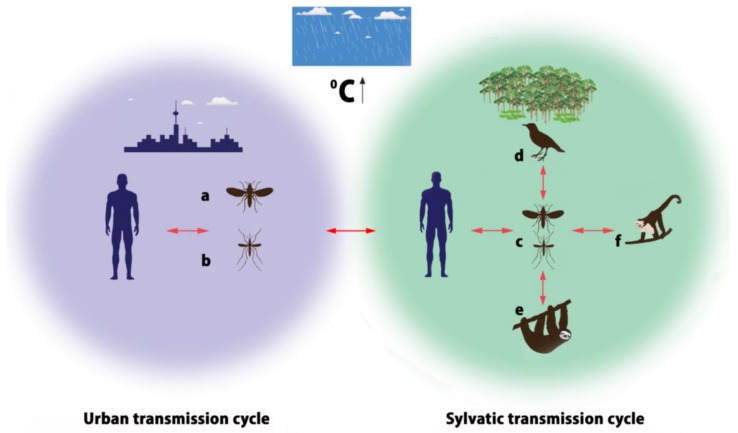
Oropouche fever is an emerging zoonotic disease caused by Oropouche virus (OROV), an arthropod transmitted Orthobunyavirus circulating in South and Central America. During the last 60 years, more than 30 epidemics and over half a million clinical cases attributed to OROV infection have been reported in Brazil, Peru, Panama, Trinidad and Tobago. OROV fever is considered the second most frequent arboviral febrile disease in Brazil after dengue fever. OROV is transmitted through both urban and sylvatic transmission cycles, with the primary vector in the urban cycle being the anthropophilic biting midge . Currently, there is no evidence of direct human-to-human OROV transmission. OROV fever is usually either undiagnosed due to its mild, self-limited manifestations or misdiagnosed because its clinical characteristics are similar to dengue, chikungunya, Zika and yellow fever, including malaria as well. At present, there is no specific antiviral treatment, and in the absence of a vaccine for effective prophylaxis of human populations in endemic areas, the disease prevention relies solely on vector control strategies and personal protection measures. OROV fever is considered to have the potential to spread across the American continent and under favorable climatic conditions may expand its geographic distribution to other continents. In view of OROV's emergence, increased interest for formerly neglected tropical diseases and within the One Health concept, the existing knowledge and gaps of knowledge on OROV fever are reviewed.
奥罗普切热是一种由奥罗普切病毒(OROV)引起的新发人畜共患病,该病毒是一种节肢动物传播的正粘病毒,在南美洲和中美洲流行。在过去的 60 年中,巴西、秘鲁、巴拿马、特立尼达和多巴哥报告了 30 多次流行和超过 50 万例归因于 OROV 感染的临床病例。奥罗普切热被认为是继登革热之后巴西第二常见的虫媒病毒性发热疾病。OROV 通过城市和森林传播周期传播,城市传播周期的主要媒介是嗜人吸血蠓。目前,没有证据表明存在 OROV 的直接人际传播。由于其轻度、自限性表现,奥罗普切热通常未被诊断,或者由于其临床特征与登革热、基孔肯雅热、寨卡热和黄热病相似,包括疟疾,因此被误诊。目前,尚无针对该病毒的特效治疗方法,而且在没有针对流行地区人群的有效预防疫苗的情况下,疾病预防只能依靠控制病媒和采取个人防护措施。奥罗普切热有可能在美洲大陆传播,如果气候条件有利,其地理分布范围可能会扩大到其他大陆。鉴于 OROV 的出现,人们对以前被忽视的热带病和“同一健康”概念的兴趣增加,因此对奥罗普切热的现有知识和知识差距进行了回顾。