Bernal-Valle Sofía, Monteiro de Mello Mares-Guia María Angélica, Vieira Santos de Abreu Filipe, Souza Campos Fabrício, de Oliveira Cirilo Henrique, Veloso Ramos Antônio Victor, Pereira Lordelo Reizane, De Vleeschouwer Kristel, de Carvalho Oliveira Leonardo, Ferraz Fehlberg Hllytchaikra, Bispo Filippis Ana Maria, Morais Ribeiro Bergmann, Roehe Paulo Michel, da Paixão Sevá Anaiá, Simonini-Teixeira Danilo, Rego Albuquerque George
Department of Agricultural and Environmental Sciences, Universidade Estadual de Santa Cruz, Ilhéus, Bahia, Brazil.
Núcleo de Atendimento e Pesquisa de Animais Silvestres (NAPAS), Universidade Estadual de Santa Cruz, Ilhéus, Bahia, Brazil.
PLoS Negl Trop Dis. 2025 Jan 24;19(1):e0012695. doi: 10.1371/journal.pntd.0012695. eCollection 2025 Jan.
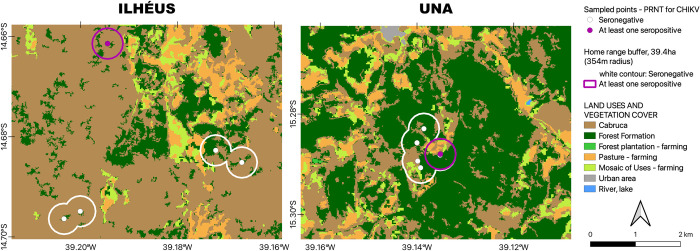
Chikungunya virus (CHIKV) is primarily associated with non-human-primates (NHPs) in Africa, which also infect humans. Since its introduction to Brazil in 2014, CHIKV has predominantly thrived in urban cycles, involving Aedes aegypti mosquitoes. Limited knowledge exists regarding CHIKV occurrence and implications in rural and sylvatic cycles where neotropical NHPs are potential hosts, from which we highlight Leontopithecus chrysomelas (Kuhl, 1820), the golden-headed lion tamarin (GHLT), an endangered species endemic to the Atlantic Forest (AF) in Southern Bahia State, Brazil. The present study investigated wild GHLT groups across two municipalities, Ilhéus and Una, Bahia. Surveys were conducted in three groups within cocoa agroforests (cabrucas) in Ilhéus, and four groups in anthropized forest and agroforestry fragments in Una, between 2021 and 2022. Thirty-two GHLT specimens were captured and chemically immobilized, examined and submitted to blood sample collection; nine specimens were later recaptured in 2022, totaling 41 samples. CHIKV viremia was not detected in any specimens (as assayed by RT-qPCR). Plaque reduction neutralization test (PRNT90) detected CHIKV antibodies in two (6.3%) GHLTs, with 10-20 antibody titers. Seroprevalence in 2021 was 5.6% and in 2022 was 8.7% with an incidence of 4.5%, whereas, a male adult tested seropositive in both years, suggesting either natural re-exposure and antibody maintenance over time. All samples tested seronegative for Mayaro Virus. Eight mosquito species from the Culicidae family were collected, identified and assayed for CHIKV genomes, showing negative results. This study provides the first evidence of natural CHIKV exposure among free-living GHLTs in Brazil, emphasizing their susceptibility and potential role as reservoirs. These findings underscore the possible consequences of anthropic disturbances in the Brazilian AF, without a seroprevalence difference between non-protected forest formations, agroforest fragments and various mosaic farming landscapes in South Bahia, and highlight the importance of conservation efforts for this endemic and endangered primate species.
基孔肯雅病毒(CHIKV)主要与非洲的非人灵长类动物(NHPs)有关,这些动物也会感染人类。自2014年传入巴西以来,CHIKV主要在城市传播周期中肆虐,涉及埃及伊蚊。关于CHIKV在农村和丛林传播周期中的发生情况及影响,我们所知有限,在这些传播周期中,新热带地区的非人灵长类动物是潜在宿主,我们特别提到了金头狮面狨(Leontopithecus chrysomelas,库尔,1820年),它是一种濒危物种,原产于巴西巴伊亚州南部的大西洋森林(AF)。本研究调查了巴伊亚州伊列乌斯和乌纳两个市的野生金头狮面狨群体。2021年至2022年期间,在伊列乌斯的可可农林复合系统(卡布鲁卡)中的三个群体以及乌纳的人工林和农林复合林片段中的四个群体进行了调查。捕获了32只金头狮面狨标本并进行化学固定,检查后采集血样;2022年后来又重新捕获了9只标本,共获得41份样本。在任何标本中均未检测到CHIKV病毒血症(通过RT-qPCR检测)。空斑减少中和试验(PRNT90)在两只(6.3%)金头狮面狨中检测到CHIKV抗体,抗体滴度为10 - 20。2021年的血清阳性率为5.6%,2022年为8.7%,发病率为4.5%,而有一只成年雄性在两年中检测均为血清阳性,这表明可能是自然再次接触并随时间维持了抗体水平。所有样本对马亚罗病毒检测均为血清阴性。收集、鉴定并检测了来自蚊科的八种蚊子的CHIKV基因组,结果均为阴性。本研究提供了巴西自由生活的金头狮面狨自然接触CHIKV的首个证据,强调了它们的易感性以及作为宿主的潜在作用。这些发现强调了巴西大西洋森林中人为干扰可能带来的后果,巴伊亚州南部未受保护的森林群落、农林复合林片段和各种镶嵌式农业景观之间的血清阳性率没有差异,并突出了对这种本土濒危灵长类物种进行保护的重要性。