Centre for Experimental Medicine & Rheumatology, William Harvey Research Institute, Barts and The London School of Medicine and Dentistry, Queen Mary University of London, London, UK.
Department of Translational Medicine, Università del Piemonte Orientale (UPO), Novara, Italy.
Dis Markers. 2020 Jan 19;2020:1614627. doi: 10.1155/2020/1614627. eCollection 2020.
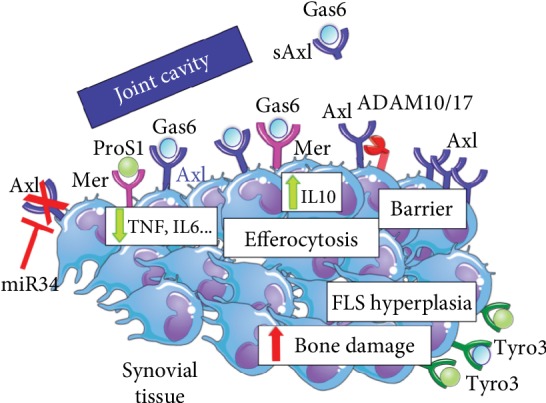
Rheumatoid Arthritis (RA) is the most common chronic inflammatory autoimmune disease involving joints. Among several pathogenic mechanisms, the impairment of homeostatic regulators of inflammation seems to be critically important to sustain persistent infiltration and activation of immune and stromal cells within the diseased synovium. Tyrosine kinase receptors Tyro3, Axl, and Mer are members of the TAM family. Upon binding their ligands Growth Arrest-Specific gene 6 (Gas6) and Protein S (ProS1), TAM receptors (TAMs) exert numerous and diverse biologic functions. Activated Axl and Mer, for instance, can negatively regulate the inflammatory cascade and mediate phagocytosis of apoptotic cells, contributing to prevent the development of autoimmunity. Thus, a role for TAMs has been hypothesized in RA. In this review, we will summarise unmet clinical needs in RA, depict the biology of TAMs and TAM ligands, focussing on their ability to regulate the immune system and inflammation cascade, and finally offer an overview of the state-of-the-art literature about the putative role of TAM axis in RA.
类风湿关节炎(RA)是最常见的慢性炎症性自身免疫性疾病,涉及关节。在几种发病机制中,炎症内稳态调节剂的损伤似乎对维持病变滑膜内免疫细胞和基质细胞的持续浸润和激活至关重要。酪氨酸激酶受体 Tyro3、Axl 和 Mer 是 TAM 家族的成员。TAM 受体(TAMs)在与其配体生长停滞特异性基因 6(Gas6)和蛋白 S(ProS1)结合后,发挥多种不同的生物学功能。例如,激活的 Axl 和 Mer 可以负调节炎症级联反应并介导凋亡细胞的吞噬作用,有助于防止自身免疫的发展。因此,TAMs 在 RA 中的作用已被假设。在这篇综述中,我们将总结 RA 中的未满足的临床需求,描述 TAMs 和 TAM 配体的生物学特性,重点关注它们调节免疫系统和炎症级联反应的能力,最后概述 TAM 轴在 RA 中潜在作用的最新文献。