Sport Research Center, Faculty of Physical Education and Sport, Charles University, 162 52 Prague, Czech Republic.
Department of Health and Human Performance, Texas State University, San Marcos, TX 78666, USA.
Int J Environ Res Public Health. 2020 Feb 11;17(4):1140. doi: 10.3390/ijerph17041140.
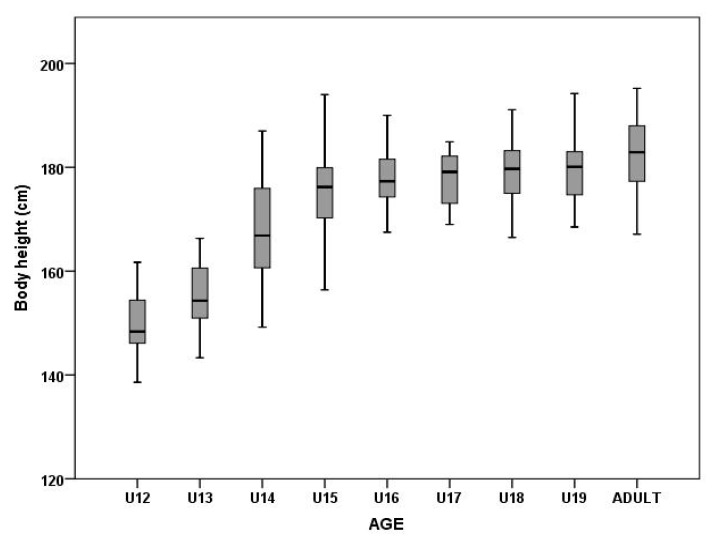
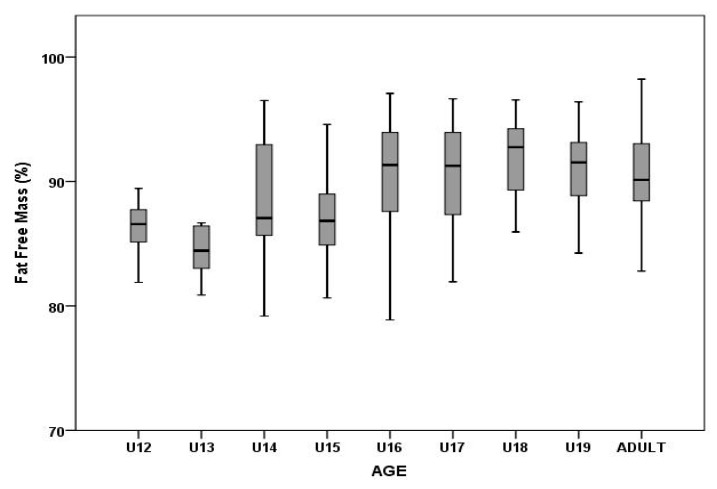
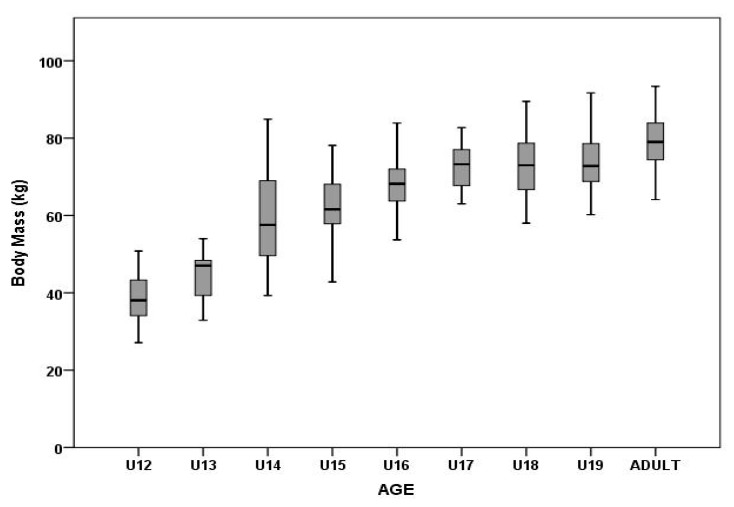
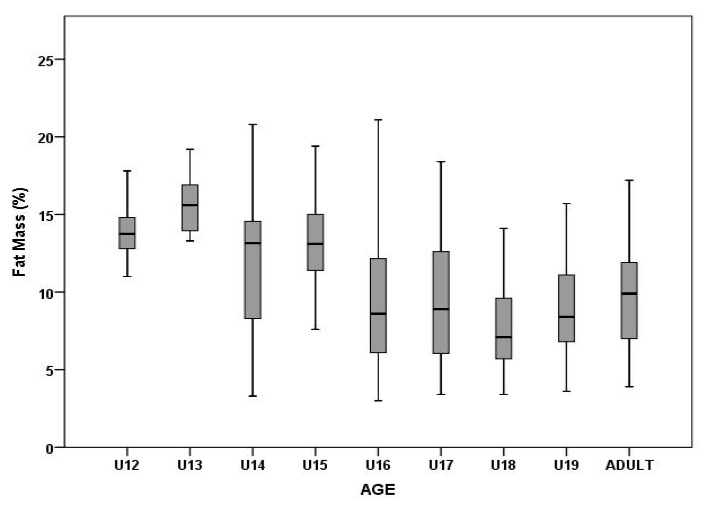
The aim of this study was to identify and compare parameters related to anthropometry, body composition (BC), and morphological asymmetry in elite soccer players in nine age categories at the same soccer club ( = 355). We used a bio-impedance analyzer to measure the following indicators of BC: body height (BH); body mass (BM); relative fat-free mass (FFMr); percentage of fat mass (FM); and bilateral muscle mass differences in the lower extremities (BLD∆). Age showed a significant influence on all parameters observed (F = 9.99, = 0.00, λ = 14.75, η = 0.25). Adolescent players (from U16 through adults) had lower FM values (<10%) compared to players in the U12-U15 categories (>10%). The highest FFMr was observed in the U18 category. Players in the U12 and U13 categories showed more homogenous values compared to older players. With increasing age, significantly higher FFMr was observed in the lower extremities. An inter-limb comparison of the lower extremities showed significant differences in the U17 category (t = 2.77, p = 0.01) and in adult players (t = 5.02, = 0.00). Our results suggest that the end of height growth occurs around the age of 16 years, while weight continues to increase until 20 years. This increase is not linked to decreasing FM, nor to the FFMr, which remains stable. We found morphological asymmetries between limbs in players of the U17 category and in adult players.
本研究旨在识别和比较同一足球俱乐部的 9 个年龄组中(n = 355)精英足球运动员的人体测量学、身体成分(BC)和形态不对称相关参数。我们使用生物阻抗分析仪测量 BC 的以下指标:身高(BH);体重(BM);相对去脂体重(FFMr);体脂肪百分比(FM);和下肢双侧肌肉质量差异(BLD∆)。年龄对所有观察到的参数均有显著影响(F = 9.99,p = 0.00,λ = 14.75,η = 0.25)。青少年球员(U16 至成年组)的 FM 值较低(<10%),而 U12-U15 年龄段的球员则较高(>10%)。U18 年龄段的 FFMr 最高。与年龄较大的球员相比,U12 和 U13 年龄段的球员具有更均匀的数值。随着年龄的增长,下肢的 FFMr 显著增加。下肢的肢体间比较显示,U17 年龄段(t = 2.77,p = 0.01)和成年球员(t = 5.02,p = 0.00)存在显著差异。我们的结果表明,身高生长结束的年龄约为 16 岁,而体重则持续增加到 20 岁。这种增加与 FM 或 FFMr 的减少无关,后者保持稳定。我们发现 U17 年龄段和成年球员的肢体间存在形态不对称。