Universidad Isabel I. Faculty of Health Sciences, Burgos, Spain.
Universidad Europea de Madrid, Faculty of Sports Sciences, Madrid, Spain.
PLoS One. 2019 Jul 24;14(7):e0219945. doi: 10.1371/journal.pone.0219945. eCollection 2019.
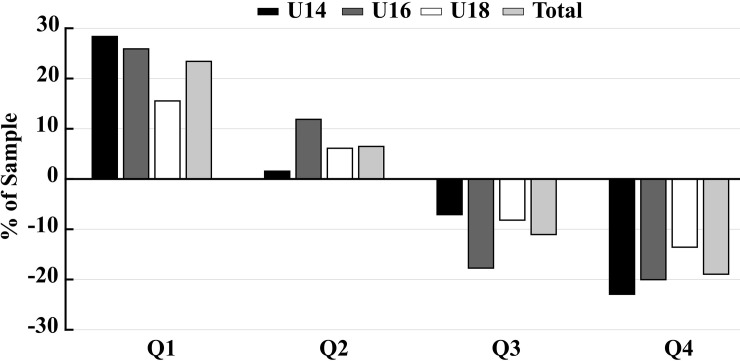
The aim of this study was to analyze the influence of the relative age effect (RAE) on the selection and promotion processes in an elite soccer academy. One hundred and eleven elite youth players who belonged to an elite soccer club from the Spanish "La Liga" participated in this study. Players were classified into three age-categories: under 14 years (U14), under 16 years (U16) and under 18 years (U18); and they were also classified in quartiles based on their date of birth (i.e., January-March, Q1; April-June, Q2; July-September, Q3; October-December, Q4). In addition, two further classification criteria were established based on the selection (i.e., selected and non-selected players) and promotion (i.e., promoted and non-promoted players) processes. The main results showed that in U14 and U16 age-categories, players born early in the year were over-represented compared to players born late in the year, although birth-distribution was not associated with the likelihood of a player to be selected or promoted. In addition, less fat in sum skinfolds, less percentage of fat, higher percentage of muscle and lower endomorphy and mesomorphy components were showed in U14 selected players, in comparison with non-selected players. Likewise, better sprint performance was found in U16 selected players versus non-selected ones. However, no significant differences on anthropometry, body composition, somatotype and physical performance were found between promoted and non-promoted players. Therefore, our results suggest there is need for coaches to reorient their talent identification programs in order to make sure that players selected to continue playing in the club have the potential to promote to the excellence in soccer.
本研究旨在分析相对年龄效应(RAE)对精英足球学院选拔和晋升过程的影响。111 名来自西班牙“西甲”的精英青年球员参加了这项研究。球员们被分为三个年龄组:14 岁以下(U14)、16 岁以下(U16)和 18 岁以下(U18);他们还根据出生日期分为四个四分位数(即 1 月至 3 月,Q1;4 月至 6 月,Q2;7 月至 9 月,Q3;10 月至 12 月,Q4)。此外,还根据选拔(即选拔球员和非选拔球员)和晋升(即晋升球员和非晋升球员)过程建立了另外两个分类标准。主要结果表明,在 U14 和 U16 年龄组中,与晚出生的球员相比,年初出生的球员比例过高,尽管出生分布与球员被选拔或晋升的可能性无关。此外,与非选拔球员相比,U14 选拔球员的全身皮脂厚度总和、体脂百分比较低,肌肉百分比较高,内胚层和中胚层成分较低。同样,U16 选拔球员的冲刺表现优于非选拔球员。然而,在体型、身体成分、体型和身体素质方面,晋升球员和非晋升球员之间没有显著差异。因此,我们的研究结果表明,教练需要重新调整他们的人才识别计划,以确保被选中继续在俱乐部踢球的球员有潜力晋升为足球精英。