Jat H S, Datta Ashim, Choudhary M, Yadav A K, Choudhary V, Sharma P C, Gathala M K, Jat M L, McDonald A
ICAR-Central Soil Salinity Research Institute (ICACSSRI), Karnal, Haryana, India.
International Maize and Wheat Improvement Centre (CIMMYT), NASC Complex, Pusa, New Delhi, India.
Soil Tillage Res. 2019 Jul;190:128-138. doi: 10.1016/j.still.2019.03.005.
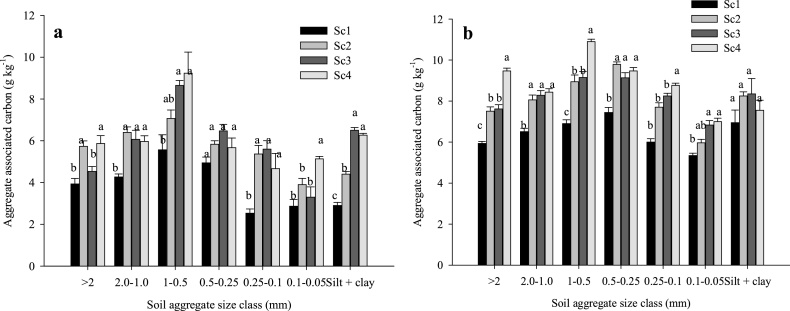
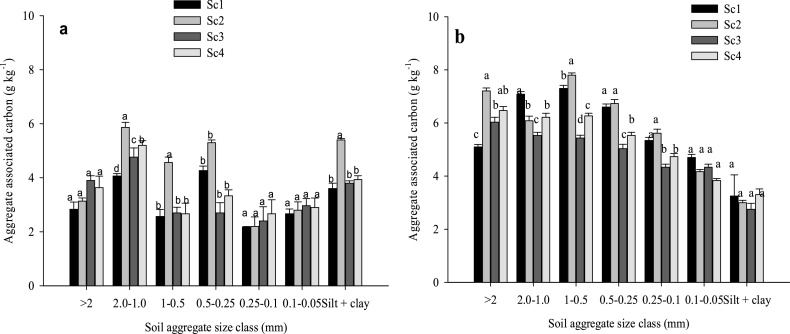
Intensive tillage based management practices are threatening soil quality and systems sustainability in the rice-wheat belt of Northwest India. Furthermore, it is accentuated with puddling of soil, which disrupts soil aggregates. Conservation agriculture (CA) practices involving zero tillage, crop residue management and suitable crop rotation can serve as better alternative to conventional agriculture for maintaining soil quality. Soil organic carbon is an important determinant of soil quality, playing critical role in food production, mitigation and adaptation to climate change as well as performs many ecosystem functions. To understand the turnover of soil carbon in different forms (Total organic carbon-TOC; aggregate associated carbon-AAC; particulate organic carbon- POC), soil aggregation and crop productivity with different management practices, one conventional agriculture based scenario and three CA based crop management scenarios namely conventional rice-wheat system (Sc1), partial CA based rice-wheat-mungbean system (Sc2), full CA-based rice-wheat-mungbean system (Sc3) and maize-wheat-mungbean system (Sc4) were evaluated. TOC was increased by 71%, 68% and 25% after 4 years of the experiment and 75%, 80% and 38% after 6 years of the experiment in Sc4, Sc3 and Sc2, respectively, over Sc1 at 0-15 cm soil depth. After 4 years of the experiment, 38.5% and 5.0% and after 6 years 50.8% and 24.4% improvement in total water stable aggregates at 0-15 and 15-30 cm soil depth, respectively was observed in CA-based scenarios over Sc1. Higher aggregate indices were associated with Sc3 at 0-15 cm soil depth than others. Among the size classes of aggregates, highest aggregate associated C (8.94 g kg) was retained in the 1-0.5 mm size class under CA-based scenarios. After 6 years, higher POC was associated with Sc4 (116%). CA-based rice/maize system (Sc3 and Sc4) showed higher productivity than Sc1. Therefore, CA could be a potential management practice in rice-wheat cropping system of Northwest India to improve the soil carbon pools through maintaining soil aggregation and productivity.
印度西北部稻麦产区基于强化耕作的管理措施正威胁着土壤质量和系统可持续性。此外,土壤淹水加剧了这种情况,它破坏了土壤团聚体。涉及免耕、作物残茬管理和适宜作物轮作的保护性农业(CA)措施,可作为维持土壤质量的更好选择,替代传统农业。土壤有机碳是土壤质量的重要决定因素,在粮食生产、缓解和适应气候变化以及发挥许多生态系统功能方面发挥着关键作用。为了解不同形态(总有机碳-TOC;团聚体相关碳-AAC;颗粒有机碳-POC)的土壤碳周转、不同管理措施下的土壤团聚和作物生产力,评估了一种基于传统农业的情景以及三种基于CA的作物管理情景,即传统稻麦系统(Sc1)、部分基于CA的稻麦-绿豆系统(Sc2)、完全基于CA的稻麦-绿豆系统(Sc3)和玉米-小麦-绿豆系统(Sc4)。在0-15厘米土壤深度处,试验4年后,Sc4、Sc3和Sc2中的TOC分别比Sc1增加了71%、68%和25%,试验6年后分别增加了75%、80%和38%。试验4年后,基于CA的情景在0-15厘米和15-30厘米土壤深度处的总水稳性团聚体分别比Sc1提高了38.5%和5.0%,试验6年后分别提高了50.8%和24.4%。在0-15厘米土壤深度处,Sc3的团聚体指数高于其他情景。在团聚体粒径类别中,基于CA的情景下,1-0.5毫米粒径类别中保留的团聚体相关碳最高(8.94克/千克)。6年后,Sc4的颗粒有机碳含量更高(116%)。基于CA的水稻/玉米系统(Sc3和Sc4)的生产力高于Sc1。因此,CA可能是印度西北部稻麦种植系统中一种潜在的管理措施,通过维持土壤团聚和生产力来改善土壤碳库。