Department of Gerontology Health and Welfare, Pai Chai University, Seo-gu, Daejeon 35345, Korea.
Policy Research Institute, Sanogaucharan, Kathmandu 44600, Nepal.
Nutrients. 2020 Feb 12;12(2):459. doi: 10.3390/nu12020459.
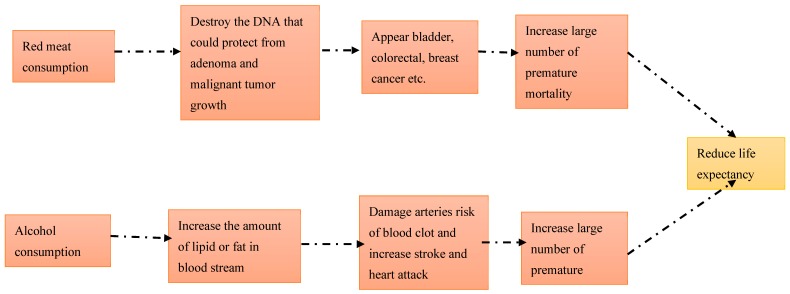
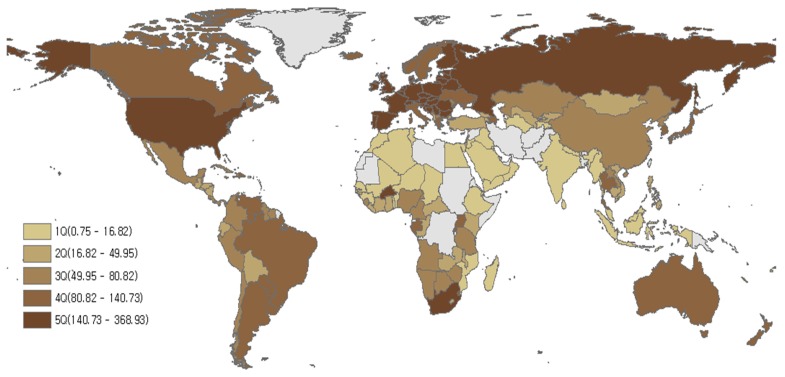
High consumption of red meat, which is carcinogenic to humans, and misuse or abuse of alcohol drinking increase premature death and shortened life expectancy. The aim of this study was to examine the association of alcohol and red meat consumption with life expectancy (LE) by analyzing data from 164 countries using an ecological approach.
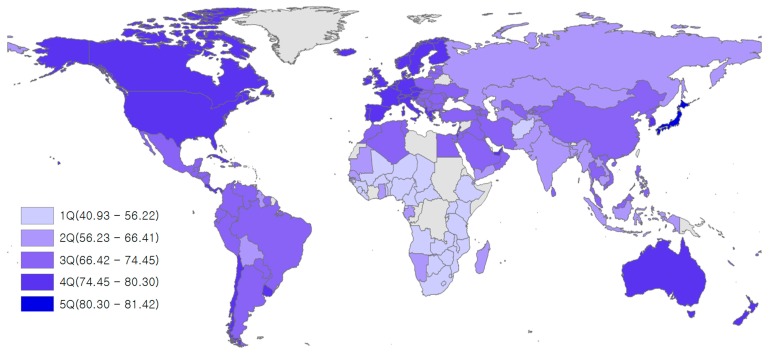
This was a longitudinal ecological study using data from the United Nation's (UN) Food and Agriculture Organization (FAO) for 164 countries over the period 1992-2013. In regression analysis, the relationship of alcohol and red meat consumption with LE was estimated using a pooled ordinary least squares regression model. Alcohol and red meat consumption were measured every 5 years.
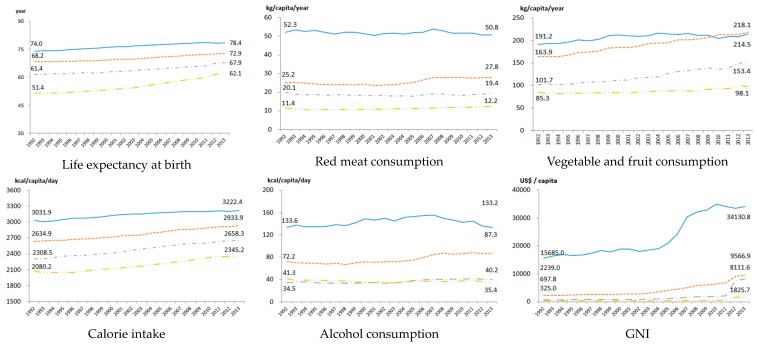
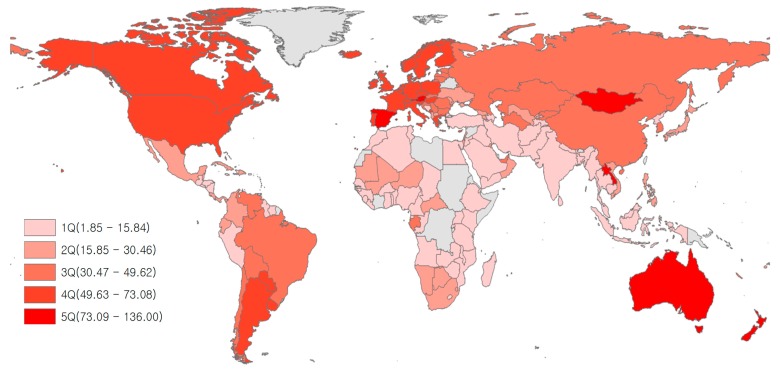
The consumption of alcohol and red meat in high-income countries (HIC) was about 4 times (36.8-143.0 kcal/capita/day) and 5 times (11.2-51.9 kcal/capita/day) higher than that in low-income countries (LIC). Red meat and alcohol consumption had a negative estimated effect on LE in HIC (b = -1.616 = <0.001 and b = -0.615, = 0.003). Alcohol consumption was negatively associated with LE for all income groups, while positive relationships were found for all estimates associated with gross national income (GNI).
Red meat and alcohol consumption appeared to have a negative impact on LE in high-income countries (HIC) and upper-middle-income countries (UMIC), although it had no significant association with LE in low-income countries (LIC) or lower-middle-income countries (LMIC). This study suggests reviewing the policies on the gradual reduction of alcohol abuse and the high consumption of red meat, particularly HIC and UMIC.
大量食用致癌的红肉以及滥用或过度饮酒会导致早逝和预期寿命缩短。本研究旨在通过采用生态方法分析联合国粮食及农业组织(FAO)1992 年至 2013 年期间来自 164 个国家的数据,来研究酒精和红肉摄入量与预期寿命(LE)的关系。
这是一项使用 164 个国家在 1992-2013 年期间的数据进行的纵向生态研究。在回归分析中,使用 pooled 普通最小二乘回归模型来估计酒精和红肉摄入量与 LE 的关系。酒精和红肉的摄入量每 5 年测量一次。
高收入国家(HIC)的酒精和红肉消费量分别约为低收入国家(LIC)的 4 倍(36.8-143.0 千卡/人/天)和 5 倍(11.2-51.9 千卡/人/天)。红肉和酒精摄入量对 HIC 的 LE 有负向估计影响(b=-1.616,<0.001 和 b=-0.615,=0.003)。酒精摄入量与所有收入群体的 LE 呈负相关,而与国民总收入(GNI)的所有估计值呈正相关。
红肉和酒精的摄入似乎对高收入国家(HIC)和上中等收入国家(UMIC)的 LE 有负面影响,尽管在低收入国家(LIC)或下中等收入国家(LMIC)中与 LE 没有显著关联。本研究建议审查有关逐步减少酒精滥用和减少红肉高消费的政策,特别是在 HIC 和 UMIC 中。